Showing posts with label Phoenix. Show all posts

Friday, 7 August 2009

A common enemy

David Hughes, The Daily Telegraph's chief leader writer, is waxing outraged about Quentin Davies, complaining that he is blaming defence procurement delays and cost overruns on a government of which he was actually a member.

Thus, in what Hughes calls "a shameless piece of sophistry", he has Davies identifying "the real problem" in as the last Conservative Government which had made such a mess "that we are still living with the consequences."

Hughes really cannot get to grips with this as, in order to dismiss Davies's point, he splutters: "The last Tory government shuffled off into the wilderness more than 12 years ago. That's the equivalent of the Second World War, twice over. And it's still to blame?"

People like Hughes or, of course, far too grand to read blogs – other than their own - but he would have benefited greatly from reading one of our pieces written on 20 July 2006 where we noted that a then-emerging defence "funding gap" raised ...

... important questions about the very nature of our democracy, arising from the lengthening period between ordering military hardware and taking delivery. We are getting to the situation where typical procurement cycles are longer than the length of several parliaments, so that one government can make huge spending commitments which may have to be met by a completely different government.
That effectively the point to which Davies was alluding and, while he placed it in a party political context, it is a good one. Any number of projects with which the Labour administration have had to deal with (and fund) were originated during the tenure of the last Conservative government. These include the Eurofighter, the Merlin helicopter, the Type 45 project, the Nimrod MR4, the medium armoured vehicle project(s) and even the A-400M, to say nothing of the failure of the UAV project, with the purchase of the Phoenix.

Cited in particular by Davies was the Chinook debacle, about which Hughes is so dismissive, yet this was indeed a Tory failure. Strangely, while we have discussed this in previous posts, we have never set down an analysis of what precisely went wrong, but it is only from this knowledge that one can see the full extent of the Tory culpability.

Revisiting the issue therefore, we can recall that the problems go right back to July 1995. Then, the MoD, under Michael Portillo, decided that eight of 14 Chinook HC Mk2 helicopters on order from Boeing should be delivered to an enhanced (HC Mk3) standard, to meet the emerging requirement for a dedicated Special Forces support helicopter.

The point at this stage was that, instead of the standard troop-carrying version, the MoD could have bought the special Chinook MH-47Es, which had been designed specifically by the US for special forces operations. But these were considered too expensive so, as a cost-cutting measure, Portillo agreed that eight airframes should be converted – to a lower standard, incidentally, which would not match the MH-47E and would not even meet known special forces requirements.

Therefore, right from the very start, the project was dictated by cost-cutting, with a "bastardised hybrid solution" devised to give the new helicopters a basic capability at minimum extra cost.

Thus, while the new aircraft were to have improved range and navigation capability, and be fitted with night vision sensors and a new weather radar, the MoD decided to shoehorn new, state-of-the-art digital systems into the existing, old-technology analogue cockpit.

With a projected cost of £259 million for the eight aircraft, the "In-Service Date" (defined as delivery of the first six aircraft) was set for November 1998, with the contract for the avionics upgrade agreed in early 1997, one of the last acts of the dying Major government. In the hot seat then as procurement minister was James Arbuthnot, now chairman of the defence committee.

Unfortunately, only when the conversion work was actually in progress was it discovered that the displays for the weather radar and other systems would not fit inside the existing cockpit, requiring extensive re-working.

This, then was the situation that the Labour administration inherited in May 1997, with the new defence secretary, then George Robertson, having no option but to agree a redefined In-Service Date for a programme which was now slipping badly. Thus, in March 1998, only eight months before the helicopters were due in service, a new ISD was set for January 2002.

Seven of the eight aircraft were actually delivered between July 2001 and May 2002, but then the real problems began to emerge. The aircraft had to be certified for safety before they could be used on operations and it had been assumed that since the systems and displays in the HC Mk 3 cockpit were based upon those fitted to the Royal Netherlands Air Force's advanced CH-47D Chinooks, there could be a "read-across" on the basis of similarity with the Dutch avionics.

Therein lay the real disaster. So many changes had been made that the new hybrid digital/analogue cockpit was now unique. This meant that the software used to make it function had to be fully tested, as of new, in order to the prevailing defence safety standards.

And no one had thought to specify in the contract (agreed in 1997 by the Tories) that software documentation and code for avionics systems should be analysed in accordance with UK defence standards in order to demonstrate software integrity. As a result it was not possible to demonstrate that the helicopter's flight instruments meet the required United Kingdom Defence standards.

Much is then made of the fact that, initially, the manufacturers, Boeing, were reluctant to allow access to the source codes that would allow the systems to be analysed, but they did eventually relent. But that could not resolve the problem.

The process of proving that the software met UK standards was itself time-consuming and extremely expensive. Moreover, because the legacy software in the hybrid cockpit was not amenable to the techniques required to confirm the robustness of new software design there was no guarantee of a successful outcome.

Consequently, the Chinook HC Mk3 was restricted to day/night flying above 500 feet, clear of cloud, and in circumstances that ensured that the pilot could fly the aircraft solely using external reference points and without relying on the flight displays. These restrictions meant that the helicopters could not be used except for the most limited flight trials.

This left the Labour government with an extremely difficult situation, the only option then to do exactly what is now being done - to strip out the new work and restore the helicopters to their original condition, at a cost originally estimated at about £127 million, over and above the £259 million originally estimated.

With that, the helicopters could have entered service in mid-2007 - nine years later than the original In-Service Date, and five years after the revised date. But even then, with dithering in the ranks of the MoD while all possible alternatives were explored – including scrapping the aircraft and using them for spares - it was not until last year that Des Browne bit the bullet and ordered them to be refitted.

Technically, therefore, the bulk of the blame for the problem – and certainly the extra costs – lies with Tory ministers. In fact, though, no lay minister could possibly be expected to second-guess a highly technical contract, and spot the missing details. They were – as are their successors – totally reliant on their expert technical advisors.

However, had not the Tories decided to cut costs and taken the safer route of buying off-the shelf, none of this would have happened. To that extent, political blame does rest with Tory ministers. But as to the technical decisions made subsequently, these are not party political issues. The system failed, as it has done before and since, and will continue to fail until it is reformed.

To that extent, Labour and Conservatives have a problem in common – the MoD. It is, in effect, the common enemy, something that David Hughes, if he had any sense, would recognise.

COMMENT THREAD

Thursday, 28 May 2009

A failure of supervision

As the publication of the book draws near - now scheduled for next Thursday, the same day as the euro-elections - we are beginning the largely thankless task of getting media attention for the launch. To that effect, the first of many press releases have hit the street, couched in terms that may interest the media.

Our first is entitled "Failure of supervision by MPs 'caused deaths of soldiers'". It makes the case - which we have so often made before - that Parliament, and especially the Defence Committee, owes a special duty of care to members of the Armed Forces, to which effect we rightly (in our view) hold MPs responsible for some of our soldiers' deaths - where they could have intervened to save them.

Such a charge is the mirror-image of the "expenses" scandal, where the argument is that, while MPs have been enriching themselves at the taxpayers' expense, soldiers have been dying becuase they have not done their jobs properly. It is difficult sometimes to make a link between the comfortable, well-appointed committee rooms in Westminister and the arid deserts of Helmand, but link there is. This is what we are telling the media:

Failures by a powerful MPs' watchdog committee killed at least five soldiers with many more being badly injured, claims Richard North, author of a hard hitting book on the Iraq war entitled Ministry of Defeat.

The five soldiers included Sergeant Lee "Jonno" Johnson who was killed in December 2007 when his vehicle was hit by a mine, and Major Alexis Roberts of the Royal Gurkha Rifles, who had mentored Prince William during his time training at Sandhurst military academy.

They and the others were killed in a dangerously vulnerable "protected patrol vehicle" called the Pinzgauer Vector which should never have been ordered, says North. Yet in 2006 the vehicle order was "welcomed" by MPs in the Defence Committee, chaired by James Arbuthnot, who has since been criticised for claiming expenses for "swimming pool maintenance".(1)

Although MPs were been diligent in claiming their tax-free expenses, when it came to watching over the safety of troops in Iraq and Afghanistan, they did not pick up fatal flaws in the machines, which offered no protection to mines and roadside bombs, claims North.

The Ministry of Defence first ordered Vectors on June 2006 at a cost of cost £437,000 each, to replace the the Snatch Land Rovers* costing £60,000, in which 37 soldiers have been killed. But so poor was their design that it was incapable of protecting drivers and passengers from more than hand grenades, yet they were being earmarked for Afghanistan where 7.5 kg anti-tank mines were common.(2)

Even when David Gould, deputy chief executive of the Defence Procurement Agency, sitting alongside the then defence secretary Des Browne, warned the committee on 11 July 2006 that they would "actually provide not a great deal more in terms of protection than Snatch", MPs failed to respond.

The choice of the vehicle was not examined again until December last year, but committee chairman James Arbuthnot – himself a former defence minister – only asked a question about its ability to operate on rough terrain. He did not query the deaths and injuries.

Only in April of this year did Arbuthnot finally question defence secretary John Hutton about the safety of the machine, when he was told that the Vector had been the "least successful" of the armoured vehicles purchased by the MoD and that "Mistakes were probably made". On 1 May, three years after the vehicles had been ordered, the MoD officially announced that they were to be withdrawn because they were "too vulnerable" to roadside bombs. Military vehicles often have a service life of 20-30 years.

Bizarrely, the Vectors are being replaced by "uparmoured" Snatch Land Rovers, the very vehicles they were intended to replace. The MoD has spent nearly £50 million on purchasing Vectors so far, and has been forced to spend another £5 million on upgrading the Land Rovers to take their place.

Says Dr North, had the MoD deliberately sought out a design to maximise deaths and injuries, the Army, in selecting the Vector, could not have made a better choice. If Mr Arbuthnot perhaps had been more concerned about soldiers' lives than his swimming pool maintenance, five soldiers might now be alive and many more would not have been injured. He says the design defects were obvious before the vehicles were even bought.(3)

Other MPs warned about the dangers – including the retiring MP Ann Winterton in April 2007, before the vehicles had been deployed, in a debate attended by Mr Arbuthnot and other defence committee members – but the warnings were ignored. (4)

Conservative leader David Cameron has called for reforms to the select committee system, including banning former ministers from being chairmen.

ends

Notes for editors.

1. Defence Committee Report on Defence Procurement 2006, 28 November 2006.

2. The manufacturer's specification cites protection from "two NATO L2A2 hand grenades detonating simultaneously only 150mm below the floor pan" – 350g of high explosive. This vehicle was to be deployed into one of the heaviest mined countries in the world, up against Russian anti-tank mines housing 7.5 Kg of high explosive.

3. The Vector has a "cab forward" layout, with the driver and the front seat passenger sat over the wheel arches. If a mine detonated under a wheel, either the driver or the passenger would be directly in the so-called "cone of destruction", exposed to the full force of the blast. The Snatch has an "engine forward" layout and there is some distance between the front wheels and the occupants of the cab, allowing, as some have, soldiers to escape the full force of a mine and survive.

4. During his tenure as defence procurement minister, James Arbuthnot was responsible for giving the go-ahead to the Phoenix UAV (Unmanned Aerial Vehicle) for the Army. With an original planned in-service date of 1989 and despite having even then failed to perform, production was approved in the summer of 1996.

Unable to cope with the heat of Iraqi summers, it was withdrawn from operation service in May 2006, leaving the Army without a vital capability. Phoenix was formally retired in March 2008 - at an overall cost of £345 million - after less than seven years of operational service. Mr Arbuthnot was also the minister who ordered the ill-fated HC2 Chinook helicopters at an original cost of £259 million and have since cost £422 million for eight aircraft which have yet to fly.

Other projects for which Mr Arbuthnot was responsible - in whole of part - were the Nimrod MR4 project, the Future Large Aircraft (Airbus A400M) which has now been seriously delayed, and he masterminded the privatisation of Armed Forces married quarters.
Perhaps it is unfair to single out one man - but there again, if this is not done, where does the buck actually stop?

COMMENT THREAD

Saturday, 16 May 2009

The fearless Dunn rides again

It used to be said that Sun journalists were the most skilled in what used to be called "Fleet Street". Their skill was in writing one hundred words of accessible prose what took broadsheet writers several thousand to do, while getting accurately to the heart of the story. Then the paper employed Tom Newton Dunn as defence "editor".

He, like many of the hacks today, writes up a story puffing the latest pronouncements of General Sir Richard Dannatt, missing the point completely, and thus reinforcing the paper's unenviable "comic strip" reputation, as it reduces defence matters to the status of a soap opera.

Thus does the fearless Dunn parade his superficiality under the heading: "Army chief: Spend more on Our Boys", telling us that the "outspoken" Army head last night accused the MoD of squandering precious billions on outdated equipment."

This was Dannatt preaching to a sycophantic audience at Chatham House, finally catching up with a reality largely of his own making, arguing that "Britain was still gearing up for a Cold War-style conflict against other powerful nations". But, he said, troops were far more likely over the next 30 years to find themselves fighting terror groups like al-Qaeda.

In the deathless prose of the fearless Dunn, this is translated as "Sir Richard" – there's grovelling for you – warning that "Our Boys in Afghanistan would suffer — or even fail — unless more cash was channelled towards their urgent needs."

The perspicacious Dunn then wisely informs is that this "landmark speech" was last night interpreted as a thinly-veiled attack on PM Gordon Brown's decision this week to buy 40 new Typhoon fighter jets at £60 million each. "And the hugely-popular general's comments will provoke more in-fighting between the RAF and Royal Navy over Britain's dwindling military budget."

What of course we do not get from Dunn – and, to be fair, from any other hack either – is that when it comes to "squandering precious billions", Dannatt has been right there in the thick of it, presiding over the waste of hundreds of millions on dangerously inadequate vehicles, not least the Vector, the Tellar and, to come, the Husky.

This is the man who also blocked the Army from obtaining cheap but entirely adequate helicopters for Iraq and Afghanistan in order to safeguard one of his fantasy projects, the Future Lynx, a helicopter that will cost 2-3 times a more than a suitable equivalent. It will not be available until 2014 – and not in service until 2016.

This is also the man who delayed the response to the catastrophic failure of the Phoenix UAV, leaving the Army devoid of a vital surveillance capability, preferring to wait for the advanced "Watchkeeper" project instead of insisting on buying perfectly capable UAVs off-the-shelf when they were most needed.

Most of all though, this is the man who in mid-2007, when US defence secretary Robert Gates was declaring the MRAP programme as his "highest priority" was declaring that £16 billion FRES programme was his "highest equipment priority". By July 2007, Dannatt was insisting that FRES should acquire a completely unrealistic in-service date of 2012 which, he said, was "non-negotiable", thus blocking the wholesale provision of more suitable, mine protected equipment.

Yet this was also the man who, having decided on one specific armoured vehicle to fulfil his dream, presided over an active conspiracy to block the provision of an equivalent vehicle, available off-the-shelf, the only one which could have met his 2012 deadline and which, within his own terms, could have given the Army the capability which he claimed was so desperately needed.

Now, having been largely responsible for the impoverishment of the Army, Dannatt has the nerve to insist that: "Much of our planned investment in defence is of questionable relevance to the challenges we face now and in the future. The balance of our investments remain heavily skewed towards industrial warfare. Many of these look simply irrelevant."

He also says, with not even a blush, "We must not take the commitment of today's Tommies for granted. We have an obligation to understand their needs and provide them with tools and training, not squander scarce resources," then concluding that, "We are in an era of persistent conflict. Iraq and Afghanistan are not aberrations, they are signposts to the future."

As to the latter assertions, Dannatt is, of course, playing catch-up – these very points were articulated by Robert Gates over a year ago. More specifically, Dannatt is bending to the wind, having spent most of his three-year tenure as Chief of the General Staff preaching the doctrine of the "balanced force", the very antithesis of what he is now embracing.

Nevertheless, such nuances, are beyond the likes of Dunn, Not having reported the Gates speech - The Sun doesn't do US defence politics - not having the first idea what FRES is, and certainly never having reported it intelligently, and having evaded any scrutiny of Dannatt's dire tenure over the equipment programme, Dunn is content to indulge in gushing hero-worship of a man who has perhaps done more damage to the Army than Mike "macho" Jackson.

Unfortunately, Dunn is not entirely alone in allowing Dannatt a free hand, with Thomas Harding The Daily Telegraph also offering an uncritical account of Dannatt's attempt to join the real world.

But here, in a much more measured account, Harding does allow something that Dunn, champion of "Our Boys" could never permit. He writes that Dannatt admits that Britain's performance in Iraq had led to its military reputation and credibility being "called into question" by America." Thus we also hear, via Harding, Dannatt telling us that, "Taking steps to restore this credibility will be pivotal – and Afghanistan provides an opportunity – key to doing so will be an honest self-appraisal of our performance in Iraq."

This is the man who, in December 2008, dismissed criticisms of the operation, telling us that "We have been quite clear about what we had to do and we have done it and we are going to leave in the early part of next year because the job is done". Now, at last, we are hearing a call from that same Dannatt, this time for "an honest self-appraisal of our performance in Iraq" – exactly the call made in my book Ministry of Defeat. Where we lead, Dannatt follows.

Whether the Army can rise to that challenge, or is even capable of carrying it out - with the accent on "honest" - remains to be seen. But that the outgoing CGS should at last ask for it is a step forward. One wonders though, whether his performance will be included in such an appraisal. If it is, though, you can be sure that the fearless Dunn will not report it.

COMMENT THREAD

Wednesday, 6 May 2009

Different realities - 2

If the reality of Michael M Phillips – for a short period at least – was Jalrez Valley in western Afghanistan, defence correspondent Michael Evans has been living a different reality with "our boys" in Helmand.

Published in The Times on 5 May, Evans gives as a quirky insight into one of the incidents briefly mentioned in the USAF "airpower summary" for 30 May.

The bare bones of that incident, as reported by the USAF, were that "a coalition aircraft" strafed an enemy improvised explosive device team. The aircraft engaged after detecting anti-Afghan personnel setting up a "daisy-chained," multiple-explosive IED. The aircraft used guns rather than a precision bomb to prevent damage to the roadway.

Behind that lies a fascinating story, headed in the newspaper as "Wandering Afghan goatherd holds up lethal attack on Taleban roadside bombers". The location is Garmsir and the narrative begins with four Taleban insurgents appearing at one end of a bridge on what is called by British troops "Route Cowboys". They begin to dig a hole for an IED (Evans calls it a "roadside bomb").

This is a scene that must have been repeated thousands of times, in Iraq and in Afghanistan. Far too many times, the outcome has been fatal for British or other coalition troops. But not this time.

Flying above them at a height of 9,000ft, we are told, is a Hermes 450 UAV, relaying pictures of the scene to British controllers. They call in air support, which materialises in the form of two Belgian F-16s. Evans calls them "Belgian Air Force" aircraft, unconscious perhaps that the BAF was disbanded in 2002, to be replaced by the "Air Component" of an unified armed force. It is a small detail, but a telling one.

The F-16s prepare to attack but they are warned off as a young Afghan goatherd with a few goats around him is seen walking towards the bridge. By the time the goatherd has cleared the scene, one of the Taleban fighters, apparently the leader, has left on a motorcycle while another has began to walk backwards holding a wire and disappeared from view.

Then, and only then, the F-16s are cleared to attack. Rather than dropping a 500lb bomb that would have damaged the bridge, one strafes the area with, Evans says, a "30mm cannon", killing the two bomb emplacers. Our reporter is thinking, presumably, of an A-10 which is thus equipped and the figure he offers does not immediately register. But the F-16 is equipped with a 20mm M61 cannon. Another small detail wrong from the man who "was there".

Anyhow, the remaining insurgent mounts a motorbike and leaves, but the UAV follows him south, observing him as he enters a compound to change clothes and drives off to a rendezvous spot known to be a Taleban command centre. "He was allowed to escape," Evans tells us, without further explanation. Not for long, we suspect.

In this piece from Evans, there is a distinct difference in style, compared with the offering from Michael M Phillips. Both have a narrative of the events they observe but Phillips also works in an element of analysis and something of a "strategic overview". This is entirely lacking from Evans – as it is so often from British media pieces. His is a straight "Boys Own" narrative with nothing of any depth which might trouble the reader.

What Evans does do, however, is demonstrate – perhaps unwittingly – the vital and devastatingly successful role of the UAV in counterinsurgency warfare and, in particular, its "battle-winning capabilities" in the fight against the IED.

Therein lies a further story, one which Evans does not tell – the fact that, had British forces been equipped with the Hermes 450 in Iraq, and in particular in al Amarah, history could have been different. Instead, as we recounted at length in an earlier post, the Army there was equipped with the useless Phoenix, thus requiring patrols to be mounted in Snatch Land Rovers, with the tragic results which we have also recorded.

Even then, the availability of the Hermes 450 was a close-run thing. The original plan was for the Phoenix to be replaced by the more sophisticated Watchkeeper system (a heavily modified Hermes), as part of the FRES capability. Although this was not due to be introduced, and then incrementally, until 2010, the Army initially resisted the idea of acquiring the more basic version off-the-shelf, for fear that it would prejudice the Watchkeeper programme.

It was not, therefore, until May 2007 that the issue was forced, and an Urgent Operational Requirement was issued for the Hermes, too late to affect the outcome in Iraq but in time, as Evans now attests, to do good service in Afghanistan.

Even then, when we could use as many of these machine as could be supplied, even last year, the defence committee was retailing the view of industry that the provision of UAVs for "current operations" could undermine future industrial capacity.

Fortunately, as the political emphasis has shifted from "future capacity" to support of current operations, the Hermes has been bought but, had it been left to the Army and the defence industry caucus, the situation described by Evans might have had a less happy outcome for British troops.

To give him his due, Evans's narrative did not stop with this one episode. He goes on to describe a foot patrol, where more traditional methods of IED detection and disposal are witnessed, but with the Hermes in the air providing persistent overwatch.

A bomb is found using methods which our forefathers would have recognised, illustrating that the battle is now being fought with a meld of the old and the new, the answer – such as there is one - being a combination of tactics and techniques, with no "magic wand" that will deal with all eventualities.

Partly – but only partly – illustrating that point, Evans offers a separate analytical piece, telling us that "Helmand's improvised explosive devices exact a terrible toll".

In this, he actually tells us nothing we did not already know, but he also underlines the utility of "protected vehicles", recalling an earlier incident he had reported. This was where a Mastiff had successfully withstood a "donkey bomb" - two buckets hanging on either side of a tethered donkey filled with an estimated 20 Kg of explosives and set off as the vehicle was passing. No one was seriously hurt.

One additional detail is interesting. To help in the hunt for IEDs, we are told that "every aircraft with photographic capabilities roams the skies to look for Taleban fighters digging up the ground. Even the US Air Force B1B bomber has been used because of its advanced cameras."

Despite all this, the IED is still regularly claiming victims. Elsewhere, however, we learn that the successful countermeasures, and especially the use of better armoured vehicles, is – as we would expect – provoking a Taleban response.

The conventional wisdom is that the insurgents would simply build bigger bombs, but in fact the Mastiff has proved so resistant to attack that, even despite six stacked mines being used, no soldier has yet been killed in one.

What seems to be happening is that Taleban bombers have shifted to attacks on Afghan soldiers and police, who do not have the MRAPs or other countermeasures. Thus, with about as many Afghan personnel as there are coalition troops, the Afghans are taking higher casualties because they are more vulnerable.

In Iraq, the US found it necessary to equip the Iraqi Army with its own fleet of MRAPs, and with IED investigation equipment, and it looks as if a similar programme will have to be mounted in Afghanistan. But, for the moment, at least some progress has been made.

More and better technology is still needed. Some is on its way but there are still gaps and glaring deficiencies in an Army which should have been better prepared but which has been behind the curve throughout the campaign.

COMMENT THREAD

Sunday, 8 March 2009

The watchdog that doesn't bark

Governments make mistakes. For a whole variety of reasons they mess up. That is the very nature of things and it is why over time there has developed a system of checks and balances, all aimed at making the government accountable. The system is also devised so as to detect mistakes early, remedy them where possible and, crucially, prevent repetitions.

It was with that in mind that we wrote this piece which also referred to this piece, pointing out the vital role of parliamentary select committees, in making the system work.

I would not be the first to observe that the committees do not function very well, but have indeed noted how one committee in which we take a special interest – the Defence Committee - functions very poorly. Therefore, I thought it would be useful to write a series of case studies on the Defence Committee. The idea is to pick a series of equipment projects that went wrong so to see what the committee did about them, and whether its activities could have been better handled – with some observations then on what could be done to improve the performance.

After this first one, which is below, I will post the case studies separately, and then write a consolidating post drawing out observations and conclusions, bringing them all together – with input from the forum where relevant – in order to frame recommendations. If this works as an exercise, I will then revamp it as a paper, possibly for publication.

For the first case study, I have chosen the Phoenix unmanned aerial vehicle project, which I first looked at in September 2006 in the context of the Nimrod crash in Afghanistan.

The flight of the Phoenix

Last year, on the tenth anniversary of its entry into service, the Phoenix unmanned aerial vehicle (UAV) was formally taken out of service.

In fact, though, it had last flown operationally in May 2006, giving less than seven years of operational service for the cost of £345 million since its inception.

From the start, the Phoenix programme was a disaster. The requirement emerged in the early 1980s as a battlefield UAV to support the British Army, originally designed for artillery spotting. As so often with these projects, though, there was "mission creep" and the final specification emerged to encompass a fully-fledged surveillance aircraft, something for which the original design had never been intended.

Nevertheless, the GEC/Marconi (later to become /BAE Systems) design was selected by the MoD in February 1985 with a planned in-service date of 1989. Although the first example flew in 1986, a the Defence Select committee in 1990 heard from the MoD that difficulties had been experienced with the datalink, which could lead to loss of contact with the air vehicle. The system had become known as the "Bugger Off - because often it did not come back once it had been launched.

There were also computer problems with the ground station and recovery problems. The aircraft was parachute-recovered, upside-down, with the landing impact to be taken by a shock-absorbing plastic hump. Frangible elements of the fuselage were supposed to breaking off to absorb the impact. Unfortunately, other non-frangible elements of the air vehicle were also sustaining considerable damage.

This left the British Army during the first Gulf War having to rely on ageing Canadair CL-89 surveillance UAVs, in service since 1972, which had to be recovered and film processed before targeting data were available. Artillery batteries more frequently were forced to use targeting data provided by US Marine UAV, the RQ-2 Pioneer (pictured left), an aircraft derived from an Israeli design and brought into service by the US in 1986.

The problems with the Phoenix had not by any means been fully resolved by 1994, by which time other concerns had emerged. Crucially, the machine had been originally intended for use in Central Europe and could not cope with hot-and-high conditions, such as in the Gulf. With the added payload the original machine had never been intended to carry, it needed a more powerful engine. In the financial climate of the time, however, that option was abandoned.

By early 1995, Flight International was reporting that the Army was considering cancellation. Six years behind schedule, it had already cost the MoD £227 million - double the original estimate when the deal had been signed.

In March, with the in-service date having already been extended to October 1995, the MoD was admitting that, if it opted to continue with the project, a further two-year minimum delay would be incurred, seeing it enter service by the end of 1997 - eight years late. Cancellation was being "very seriously considered". Not least, the method of recovery continued to cause unacceptable levels of damage.

With so much invested, however, the company was given another chance. In April, the then procurement minister, Roger Freeman, announced that the manufacturer would be allowed to complete an "additional programme of work" to resolve the remaining technical difficulties, lasting about a year, at the contractor's expense. Later that month, MPs were told that potential alternative systems were being considered, in case the Phoenix did not come up to standard. Significantly, highly successful Israeli machines were being examined.

In August 1995, James Arbuthnot was appointed as defence procurement minister. It would now fall to him to make the crucial decision as to whether the programme would continue or whether an alternative would be purchased. Any decision would be highly contentious and cancellation would be highly embarrassing for the government. Already it had been forced to abandon the ill-fated Nimrod airborne early warning aircraft, produced by the same GEC/Marconi/BAE Systems combine, with the airframes having been scrapped in 1991 at a loss of over £1 billion.

Mr Arbuthnot was asked briefly about Phoenix in the October but with the review underway, he batted down the question. With a year's grace bought by the "additional programme of work", it was not then until the anniversary of the announcement on 25 April 1996 that Mr Arbuthnot was called to give an account. By then, the US had been successfully operating its Israeli-designed machines for ten years. However, the announcement about the future of the project was not ready. Mr Arbuthot hoped to be able to make one "before the summer recess".

It was down to Flight International, therefore, to come up with any information on what was going on. From this it was learned that GEC was to resolve the landing problems by equipping the UAV with an air bag, similar to those used in motor cars, to absorb impact of landing. This was precisely the option used on the 25-year-old Canadair UAV which the Phoenix was to replace. There was also talk of fitting a more powerful engine, but nothing was to come of that.

Nothing was to come of Mr Arbuthot's announcement before the summer either. In fact, there is no record of him ever having made one to Parliament, a strategem which would have neatly avoided any questions in the House. Instead, the news of his decision was conveyed by an MoD press release in October, which broke the news: It declared: "We now have confidence in the cost-effectiveness, tactical performance and reliability of the system to meet the army's requirements".

This came to light in Parliament only because it was mentioned in a debate by an opposition spokesman, Dr John Reid. Phoenix was to become operational in 1998, nine years after originally planned, with 198 eventually delivered. Complaining of the delay, Reid declared:

We do not blame the Government for every delay. However, any objective observer who examined the pattern of consistent delays would conclude that it was the only area where the Government appeared to have a strategy. I am reminded that Napoleon once instructed Bourrienne not to open his letters for three weeks and, after that time, expressed satisfaction that most of the correspondence had resolved itself. I have a feeling that the Secretary of State is adopting a Napoleonic strategy to defence procurement: if we delay indefinitely, the need will go away. But it will not.
On 1 May 1997, Tony Blair's New Labour had won the general election and Mr Arbuthot lost his ministerial job. But his legacy, of which Phoenix was part, was to live on. Within months of the Phoenix becoming operational, it was deployed in the Balkans, coinciding with the day that Yugoslavian/ Serbian forces began their withdrawal from Kosovo on 9 June 1999. Eighteen months after it had been accepted into service, 16 machines had been lost or destroyed in the course of 200 sorties, including 13 during operations. Ten were lost or destroyed in Kosova and three more during further operations the following year.

Mr Bruce George, chairman of the Defence Committee in 2000 was less than complimentary about the system. "That is a pretty deadly weapon," he said, "because they do tend to drop out of the sky causing damage to anyone standing underneath. Was that a secret weapon? It was probably quite an accurate weapon." That brought from Vice Admiral Sir Ian Garnett, then Chief of Joint Operations, that, "Of course we would like to have better unmanned aerial vehicles to give us intelligence and perhaps we might have that capability in the future."

The capability provided by the Phoenix, however, was fully recognised by the Defence Committee it remarking in January 2001 that, "The momentum behind developing the capability of Phoenix to provide targeting data to strike aircraft must be maintained."

If that momentum was maintained, it did not extend to the Phoenix programme. The system was deployed during the invasion of Iraq in 2003, with 89 machines being sent. Between March and 3 April, some 23 machines were lost with 13 damaged but repairable. The equipment was openly described as a "dismal failure". Despite that, the Defence Committee, reporting on the war in March 2004 was uncritical. "We are pleased," it said, "to hear that, despite its chequered past, Phoenix made a valuable contribution to the operation."

Nevertheless, so obviously inadequate was the machine that the MoD, under new management since Arbuthnot's time, had already determined on a replacement. Rejecting the proven but very much larger US Predator model, it had an Israeli-built machine in mind, the very option that Arbuthnot and his predecessor had been asked about in 1995 and 1996, and which he had rejected. This was to be the Watchkeeper programme, a licensed-built version of the Elbit Hermes 450, with a projected in-service date of 2006.

One MP on this committee, however, expressed concern that the programme could not be "more aggressively accelerated". This was Gerald Howarth, on 21 May 2003, questioning Sir Peter Spencer KCB, then Chief of Defence Procurement. Sir Peter's answer was very revealing. The development could not be speeded up, "because we are buying a system of which the UAV is a component," he said.

This referred back to the "Strategic Defence Review – New Chapter" published in July 2002 in which the Government had committed to a major reorganisation of defence forces, in particular the Army. It was to introduce a new concept called the Future Rapid Effect System (FRES), linked into a vast computer and communications network, introducing what was known as a "network-centric capability".

Thus, at the time Sir Peter was being questioned, attention was focused on a high-tech "future war" while, at the very same time British troops were engaged in a vicious counter-insurgency campaign in Iraq, equipped with the Phoenix which, as was well known, could not operate in hot conditions – when indeed it operated at all.

This notwithstanding, in November 2003, Defence Minister Adam Ingram assured the House that the Watchkeeper programme was "on track to deliver a tactical UAV capability from 2006."

That, however, was not to be. In July 2004 the "preferred bidder" for Watchkeeper wasannounced, for a contract that was expected to cost £800 million. And not until the following July did then defence secretary John Reid announce the order. But the in-service date was no longer 2006. The capability would be delivered "incrementally" from 2010. This was from the same Dr Reid who in 1996 had complained about the delays in introducing the Phoenix.

Arguably, it was at this point that the Defence Committee might have intervened. As of July 2005, two crucial issues were evident. Firstly, that the Phoenix system was seriously substandard and also inoperable in Iraq during the summer months. Secondly, there was now no prospect of an early replacement. It might have even gone back earlier to 2003, when questions could rightly have been asked. But two years later, there can have been little argument that the Army urgently needed an effective UAV.


That intervention would have been valid and effective is unarguable. In May 2007, reported a month later the MoD, recognising for itself the critical shortage of UAVs, issued an Urgent Operational Requirement (UOR) for a $110 million deal to buy Elbit Hermes 450 UAVs direct from Israel (pictured above), to fill the capability gap – a year after the Phoenix had been withdrawn from Iraq. The first machines were delivered to Iraq and operational by September 2007, a mere four months later. By then it was too late to affect the outcome.

More than a year earlier, however, in mid-2006, another opportunity had arisen for Defence Committee to intervene. It was then gathering evidence on operations in Iraq. That year, and since the general election in June 2005, the Rt Hon James Arbuthnot had taken over as committee chairman – the very man who as procurement minister in 1996, ten years earlier, had given the go-ahead for the production of the Phoenix.

Under his chairmanship in June 2006, the committee took evidence from the then Defence Secretary Des Browne on a range of problems, including the deficiencies of the Snatch Land Rover. But neither then, nor in the report, published on 10 August 2006 were UAVs mentioned.

In fact, it took until May 2008 before Mr Arbuthnot's committee focused on the subject of UAVs, in an investigation devoted to that subject. In its report, published in July 2008, Mr Arbuthnot's committee noted that the acquisition of UAVs, which by then had included the successor to the Predator, known as the Reaper, and Hermes 450 were providing our Armed Forces with "battle winning capabilities", and were "proving effective in the counter-insurgency style of operations which they face in Iraq and Afghanistan."

However, evidence was submitted by the MoD in a written memorandum to the committee, which noted:

Limited range full motion video surveillance is provided by the Phoenix tactical Unmanned Air Vehicle (UAV) system. Originally designed for operations in central Europe, it has not proved suitable for supporting ongoing operations in the more demanding climatic and geographical conditions in Iraq and Afghanistan.
A memorandum from the Royal Aeronautical Society also noted that the "UK experience with UAV technology has not been entirely happy, pace the Phoenix programme".

However, there was no reference to the Phoenix in the conclusions and recommendations section. As to the purchase of the Hermes 450s, the committee had asked why the requirement for the UAVs acquired as UORs had not been identified earlier. It had been told that "in many cases they were identified earlier". The Hermes 450 UAV had been acquired as a "stop-gap" filler because the Phoenix UAV system could not be operated effectively in a hot and high climate. To that, the committee responded:

The MoD has acquired UAV systems for current operations as Urgent Operational Requirements (UORs). In its response to our Report, we expect the MoD to set out its future plans for the UAV systems acquired as UORs and where the future costs fall within the defence budget. We also expect the MoD to set out its longer term strategy for acquiring UAVs systems, given the concern expressed by industry that keeping the UAV systems acquired as UORs in service for a long time could undermine the UK’s national capability in this area.
Thus did the committee convey the concern of the trade body representing the defence contractors, the SBAC. It wanted: "the balance being maintained between developing national capability and supporting UOR capability for urgent operational requirements." Roughly translated, that meant that the defence industry did not want too many off-the-shelf purchases in case it reduced the sales of custom-built machines. And that was the extent of the committee's concerns on UORs.

COMMENT THREAD

Saturday, 21 February 2009

Lost before it started – Part 7

In this final part, where we have explored the reasons for the British failure in Iraq, we turn the tables and speculate on whether they, despite the handicaps, could have succeeded. Reviewing what actually did happen after the British had retreated to their final base at Basra airport, we believe they could.

That is the ultimate tragedy. Instead of attracting the contempt of the Iraqis and the disdain of the Americans – who will never really trust us again – we could truly have walked out of Iraq with our heads held high, without having to pretend we had achieved success. It was that close – and that far.


Could it have been different?

At the start of the occupation in May 2003, the decision to cut back troops levels to 11,000 was disastrous, but not fatal. However, with that, Blair's decision to throw his lot in with the Europeans - compensating, many believe, for his failure to deliver the UK into the embrace of the single currency - seriously hampered the ability of the Army to deal with the insurgency.

And, having pledged the nation's armed forces to the Europeans and Iraq, he offered troops to reinforce the campaign in Afghanistan. That made a tight situation worse.

Even then, defeat was not inevitable. Looking at the campaign in the round, the single most egregious failure was the decision to abandon al Amarah, walking out on a half-trained and poorly equipped 10th Division. That was a major strategic error. Yet that decision itself was not initiated by the politicians but by the military.

Strangely, at the time, there had been very little discussion or debate. Equally, there was virtually no evaluation of the strategic consequences. Then, the "retreat" was an administrative decision. The "road map" had already been revealed by Gen Houghton in March, over three months earlier.

But "repositioning" in order to concentrate on Basra was wrong. Al Amarah was the Mahdi Army's major armoury and it would have made more strategic sense to have cut off the supply of arms at source before dealing with the problem of Basra. It was a "downstream" solution, akin to mopping up a floor after the bath had flooded, without first turning off the taps.

Dealing with the indirect fire

Of course, to have maintained forces at Abu Naji would have required dealing with the indirect fire – one of the main reasons why the base was vacated. Here, the main problems were the lack of suitable equipment, in particular UAVs, helicopters and MRAPs, plus C-RAM for base defence. All three could have been provided. Most were eventually provided, but too late. This was not a problem of money. It was about timing – and commitment.

Even in 2006, at a very late hour, had Gen Dannatt been able to break free of the Army’s obsession with FRES, he could have negotiated a major MRAP package. In exchange for scrapping FRES or putting it on the back-burner, substantially larger numbers of Mastiffs could have been bought, together with other, smaller MRAP vehicles. When this happened anyway in October 2008, it was too late for Iraq – and may be too late for Afghanistan.

As to helicopters, the Army was again partly the author of its own misfortune. Many times, cheaper options than the Future Lynx were offered, and rejected. Had the Army been intent on acquiring tactical helicopters rapidly, it could have had them. It was occasionally able to borrow US Blackhawks and the Americans also provided medivac helicopters, but this was not a reliable foundation on which to carry out planning.

The Army was actually offered a new fleet of Blackhawks off-the-shelf. It turned them down. As for UAVs, the MoD already had in place a replacement programme for the Phoenix, called Watchkeeper, modified Israeli Hermes 450s – with deliveries scheduled for 2010. The modifications, incidentally, were part of the FRES programme. They included fitting extra communications systems fit in with the proposed "network" that was at the heart of the system.

Because of the urgency of providing the Army with a UAV capability, in May 2007 the programme was brought forward with the purchase of the basic Hermes system off-the-shelf, direct from Israel. What was done then could have been done earlier, but for the determination to incorporate FRES modifications. Similarly, with C-RAM being ordered by the MoD in 2007, and temporary measures taken to ensure its early deployment, it is not untoward to argue that this equipment too could have been procured earlier.

With suitable equipment, holding the base at Abu Naji could have been tenable, buying time further to train and equip the Iraqi Army 10th Division. That perhaps could have allowed the Army, with existing resources, to back the Iraqis in recovering the city that much earlier, possibly as early as February/March 2008.

A fatal error

Instead of holding the line in al Amarah, the Army committed its main strength to Basra. And there it made a fatal mistake. In September 2006, it launched Operation Sinbad – a last-ditch operation to recover the city. It was well-planned and executed, but the timing was wrong.

Very much later, the Chief of the Defence Staff, Jock Stirrup, complained that the action had been "watered down" and lacked support from the Iraqi politicians, particularly Maliki. That was always going to be the case.

The British had misread the political situation in Iraq and had acted prematurely. Maliki was still in the grip of Muqtada's party and to have openly confronted the Mahdi at that time would have been political suicide. He had not by then secured his political base, weakening the political grip of Muqtada and could not take the same robust line that he took in 2008. The British would have been well advised to have husbanded their resources until a more propitious moment.

There were, though, the dangerous and debilitating attacks on the bases in Basra, but what held for al Amarah could equally have applied to them – with the probability that, without Abu Naji having been abandoned, the pressure on Basra would not have been as strong. Nor indeed would the insurgency in Sadr City been as troublesome, possibly liberating US resources for the fray.

A change in approach

One there had been a change in the balance of political power in Baghdad, things were possible which had previously been impossible. Then, had the British maintained their presence in al Amarah, a joint British/Iraqi move could have been made on the city, cleaning it out as happened with Operation Promise of Peace. This would have made dealing with Basra an easier proposition.

Arguably, with a British presence remaining in Basra, and the indirect fire being dealt with by technology instead of the wasteful use of manpower, the situation would not have deteriorated so far.

Instead of Basra becoming the battlefield in Charge of the Knights and al Amarah being taken without a shot fired, the situation might have been reversed. The battle would have been at al Amarah.

By June 2008, Muqtada was a busted flush and with British support, again using existing resources, the 10th/14th Iraqi Divisions could have walked into the Sadr strongholds in Basra without a shot being fired. The British, instead of skulking in their base in Basra airport, would have been central to the action, with a wholly different outcome to the one that has come to pass.

The tragedy is that this could have been done with existing manpower resources. Through the recovery of first Basra and then al Amarah, the US did not commit more than 2,500 troops – less than the British had available. What they had and the British did not, was the right equipment – and the right mental attitude.

A lack of commitment

To have won would have required the same degree of commitment injected by President Bush, Robert Gates and Gen David Petraeus. Yet, the Army - Dannatt in particular and Jackson before him - was not prepared to sanction what was required to fight a war that he and the rest of the Army no longer believed was winnable.

That was the real problem. Wars are won and lost in the minds of men. Even without the political drag, this war would have been lost because the Army had decided it was not worth winning. More to the point, it had decided that the price it would have to pay in order to win was unacceptable.

In Iraq, therefore, the Army was defeated by its own leaders. Indisputably, the major fault lay with the politicians, in particular, one man – Tony Blair. But the Army was not without fault. Its equipment was wrong, its tactics were wrong and, in the final analysis, it lost faith in its mission and gave up.

Whether Service chiefs could have made a difference lies in the realm of speculation. The indications are that they did not try. They accepted defeat and, in so doing, made it inevitable.

COMMENT THREAD

Tuesday, 5 August 2008

How many more times?

After a somewhat prolonged absence from this blog, we return with a report, trailed in The Daily Telegraph about UAVs – not that the readers of this esteemed newspaper can possibly be exposed to such a fearsome combination of initials. They have to be told of "drones".

Anyhow, the legend according to this newspaper, not without justice, is that the MoD has been "slow to appreciate' potential of drone aircraft in Iraq and Afghanistan", to which we would say, in a voice laden with irony, "You don't say!" We might also add the question, "what took you so long to notice?"

This "discovery" however comes not from the newspaper – which could never have worked this out for itself, but from the House of Commons Defence Committee, which has just published a 149-page report entitled, "The contribution of Unmanned Aerial Vehicles to ISTAR capability".

As might be surmised from the title (and the length) this deals with much more than the tardiness of the MoD but, as to that singular conclusion, had the Committee made its observations in June 2006 when we – from our lowly, amateur position – first started writing seriously about the subject, it might have been of some use.

As it is, when UAVs could have made a difference, and especially in Iraq, they were not available, the Army still then relying on the useless and ruinously expensive Phoenix, another of those MoD procurement disasters, the full extent of which has never been properly explored and probably never will – at least, not by the Defence Committee.

Now, with the addition of three Reapers to the inventory (one of which has since crashed) and the addition of the Hermes 450 as a stop-gap, until Watchkeeper arrives, the problems of availability (but not entirely) are largely solved. Thus, the Committee's comment is essentially history, so much so that The Telegraph is one of the few newspapers that can even be bothered to write about it.

And, although defence correspondent Thomas Harding makes a decent stab at the story, the detail is relegated to the online edition, the print version summarising even that and placing it in a "news in brief" section.

The story would have had more impact if the Committee had sought to explore the consequences of the failures of the MoD to introduce this technology into theatre earlier, and its current failure to exploit the technology as fully as it might. For, as we discussed in earlier pieces, while the Army was sending soldiers to their deaths in lightly armoured "Snatch" Land Rovers, on fruitless anti-mortar patrols, the most appropriate technology was the UAV, which could have been used, had it been available.

Even now, when we see foot patrols in Afghanistan ambushed or bombed, with the inevitable casualties, we wonder whether some of that patrolling could not have been better done with UAVs and thus whether troops are being exposed to needless danger.

Equally – with special relevance to the recent death of Lance Corporal Ken Rowe and his dog - again one wonders if all the available technology is being used.

L/Cpl Rowe, it will be recalled, was a dog handler, accompanying foot patrols with a specially-trained sniffer dog, tasked with detecting bombs and weapons caches. It is of more than some importance, therefore, to know whether the use of technology such as the UAV-borne Automatic Change Detection System, currently operated by US forces as the "Buckeye" could have been of value in reducing the need for such vulnerable assets.

Needless to say, the Committee does not even begin to explore this issue – preferring instead to regurgitate material spoon-fed to it by its carefully selected MoD witnesses. Not one of the Committee members have had the sense to look elsewhere for their information.

A similar deficiency exists in the Committee examining UAVs only in the context of their specialist role as Intelligence, Surveillance, Target Acquisition and Reconnaissance (ISTAR) assets. It does not look at the broader picture of how they could best be integrated into the battle plot.

Invaluable for being able to produce real-time video imagery from a huge area, UAV intelligence is of limited value unless our forces are able to respond to it. For instance, the detection of groups of Taleban on the move is of little immediate use unless air assets or ground forces can be employed to deal with them.

In that context, the piece we linked above in turn links to a narrative offered by Michael Yon, where he describes the combined actions of a UAV and light helicopters in tracking and then intercepting an insurgent mortar team.

In the wide open spaces of Afghanistan, that combination would be a powerful asset against often fleeting targets, an idea we have rehearsed only recently. Nothing of this, of course, impinges on the brains of the Defence Committee members.

There was some hope, incidentally, that the issue of helicopter provision was going to be aired fully, with reports of an MoD helicopter summit in the MoD last week, but if anything substantive came out of it, we have yet to hear what it is.

There was some brief hope that the experience of the Rhodesian Light Infantry and the Selous Scouts in the 1970s, with their pioneering use of Alouette III light helicopters (pictured), might have percolated into the consciousness of the MoD strategists. But recent optimism might have been misplaced.

In the round, therefore, we are not much further forward. Things are moving behind the scenes, but all so desperately slowly. We were writing about the need for light helicopters in November 2006 and so many times since that we have lost count. How many more times can we write the same thing?

COMMENT THREAD

Sunday, 27 May 2007

Occupying the high ground

Not a week goes by now without some media speculation that Gordon Brown is poised to withdraw British forces from Iraq. First it was The Times, then – last week – it was The Sunday Telegraph and, this week, it is the turn of the Sunday Times defence correspondent, Mick Smith.

He is retailing the fears of unnamed (as usual) "senior army officers" that Gordon Brown is going to cut the number of troops in Iraq to such a low level that their effectiveness is jeopardised and lives are endangered. They say, or so Smith tells us, it is clear Brown is preparing to speed up the pull-out to draw a symbolic line under the Blair era.

Against such speculation, however, there are consistent denials from "sources close to Brown", but that would only be expected even if the intention to withdraw was firm policy.

On the other hand, what might be a more reliable pointer to Brown's intentions is the report from DefenseNews that the Army is about to take delivery of a "small number" of US-built fixed-wing surveillance aircraft.

These are King Air 350ER special mission aircraft (pictured), superbly well-equipped with electro-optical surveillance equipment, ground monitoring radar and a highly sophisticated communications package. They will replace the Army Air Corps Defender aircraft and, at an estimated £14 million each, represent a massive enhancement to Army aviation capabilities.

The point here, of course, is that these aircraft are primarily intended for deployment in (relatively) benign airspace, which means they are tools specifically designed for counter-insurgency operations. It stands to reason, therefore, that Brown – as chancellor – would hardly be authorising such expenditure if he intended to cut short Britain's deployment in Iraq.

Furthermore, the expenditure does not stop there. Rather than wait for the completion of the Watchkeeper UAV programme, not scheduled to begin deliveries until 2010, replacing the disastrous Phoenix UAV, the Army is deploying a new fleet of Elbit Systems' Hermes 450 tactical UAVs, purchased as an urgent operational requirement.

With the reported extension of the MPPV programme and other as yet unannounced equipment programmes, the indications are that the British government has been re-framing its procurement priorities and is showing a new commitment to fighting (and winning) its counter-insurgency campaigns.

Clearly unaware of this, The Times's Mick Smith records the woes of (another) unnamed officer, who complains that, "We are sitting ducks and have very little in the way of resources to react … If we mount an operation to deter a mortar attack it takes an entire battle group and ties up all our people … Any further reductions in numbers would leave British troops hanging onto Basra by our finger tips".

Smith believes that this danger has been illustrated this weekend by continuing battles between British forces and fighters from the Mahdi army militia. These follow reports that British and Iraqi forces killed the Basra commander of Moqtada al-Sadr's Mahdi Army on Friday, after al-Sadr made a re-appearance in Iraq the same day.

But our man neglects two things. Firstly, the initial action was carried out jointly between British and Iraqi forces – with the British acting as "advisors". This would seem to confirm the growing confidence and capability of the Iraqi 10th Division, reducing the need for the direct involvement of large numbers of British troops.

Secondly, while, in the past, it has been necessary to field full battle groups to carry out even quite minor operations - such as the extraordinary operation last December, where tanks, armoured vehicles and 1000 men were deployed to capture five "terrorist leaders", these operations have been conducted without the high-tech capability that is now becoming available.

With better real-time intelligence and the other equipment that is coming on stream, and the support of the 10th Division, such mass raids – never desirable for the message they send out – will be less necessary than they were. The Army will, at last, have acquired the capability to fight "smarter".

From a political stance, this is going to have even more interesting implications. The Conservatives, to date, have relied entirely on their mantras, "overstretch" and "under-resourcing", to focus their attack on the government. But, with none of the current programmes officially announced, Brown, on assuming office as prime minister, is going to be able to unveil a significant increase in defence spending – all of it off-budget, representing real money – and a significant enhancement in capabilities.

Unless they are more astute than they have so far been, it looks as if the Opposition is going to be wrong-footed, leaving Brown occupying the political high ground on an issue which has, traditionally, been occupied by the Conservatives.

COMMENT THREAD

Saturday, 9 December 2006

Going backwards

When the news started coming in yesterday about the raid by coalition forces in Basra, details were sparse and I thought it better to wait until we knew more.

A day later and we are not much the wiser. The whole of the publicity seems to have been generated, and is therefore controlled, by the Army. We know what the Army wishes us to know – no more and no less.

One should not be too churlish I suppose. If the Army is to be believed, five "terrorist leaders" were captured, together with a quantity of arms and explosives and some documents of "intelligence value". However, that does seem somewhat small compensation for a raid described as the biggest military operation since the end of the war on 1 May 2003.

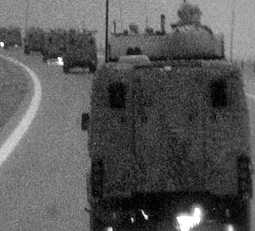
Altogether, over 1000 men took part, including a 250-strong Danish contingent, deploying 14 Challenger II MBTs, 28 Warriors, an unknown number of light armoured vehicles ("Snatch" Land Rovers and Danish MOWAG "Eagles", based on the Humve chassis - illustrated right) and ten assault boats. In support were USAF F-15s which carried out overflights as a diversion and "a show of force".

Mercifully, unlike the 24 November raid, no one was killed. That alone may have justified the scale of the force, which was not unopposed.

But if the size of the force deployed was not excessive (under the circumstances), there was certainly something so gloriously OTT about the Telegraph coverage. It not only included a huge map, occupying the best part of half a page, but was announced by a headline spanning two pages reading: "'Armoured fist' smashes into Basra at dawn, capturing five terrorist leaders." One suspects that the writer (our old friend Thomas Harding) and the editorial team harbour secret ambitions of being comic-strip writers.

Behind the MoD-supplied details (and photographs), the problem is, as always, that the newspaper presents a breathless view of events which avoids any depth, understanding or analysis. This is not what one would expect from grown-up journalists.

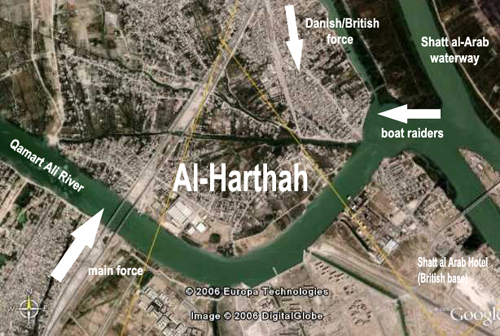
Any such analysis, of course, would not necessarily accompany this piece – and we learnt not from this but from the BBC that one of the objectives of the raid was to deal with "criminals" who were mounting attacks on British bases. Interestingly, the Telegraph's location map miss-positions the Shatt al-Arab Hotel base. It shows it closer to Basra Palace than anywhere, rather than its correct place – well within mortar range of al Harthah. And, as recently as Wednesday, the base was at the receiving end of yet another mortar attack. Was al Harthah the source?

So, here we go again. In June we wrote a piece noting that we have been here before. We remarked on how between 1972 and 1980, mine protection technology emerged, which has been refined and developed as the basis of today's blast-protected vehicles.

But, if the colonials were there before, we were there even before that. A remarkable website shows that in Oman between 1970 and 1973, British forces were operating modified 4-tonners with armour plate fitted to deflect blast from mine strikes.

But even more fascinating is the website of Barry Dunning recounting his exploits in the 10th Royal Hussars (Middle East Land Forces) in Aden in 1965, riding in a Saladin armoured car.

As a boy I recall this vehicle (illustrated). Built on the same chassis as the Saracen armoured personnel carrier, it was specifically designed for mine protection and could continue operating with any one wheel blown off by a mine. For their party trick, Alvis, the manufacturers, used to drive the vehicle round a test track on demonstrations, with one of the front wheels missing.

Anyhow, Dunning writes:

The 12th of September is a day I will never forget!! Coming back from Dhala we went on ahead to pick up the Infantry whom were up on the ridges (to cover the convoy through the wadi). We had just passed Mile Stone 36 when we hit two anti-tank mines and 25lb of plastic explosives. It picked the 14 tons of armoured car and threw us about 25 feet into the air, leaving a crater 30 foot wide and 10 foot deep. We were very lucky the armour did not split open as we were fully loaded with all our shells and bullets... It would have been a real fireworks display if they had gone off, and we were lucky no one was hurt.

Mick had a cut on his cheek where the Browning rounds wrapped around his face. Geordie hit his face on the front driver hatch as he was thrown forwards. It knocked him silly for a moment and he had a bloody nose. Because of the shock the medics could not take any chances with us so they flew us out on an Army Scout helicopter back to camp. The Saladin was brought back on a low loader.
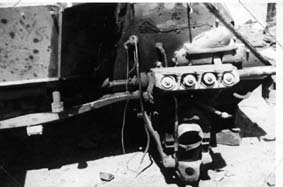
And above right is a close-up picture of the front wheel bay, which took the full force of the explosion. Now imagine if that had been a "Snatch" Land Rover.

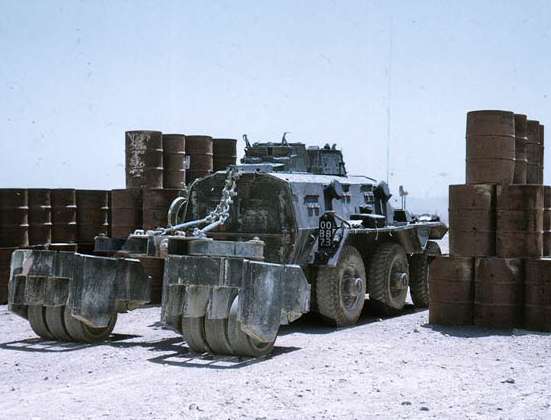
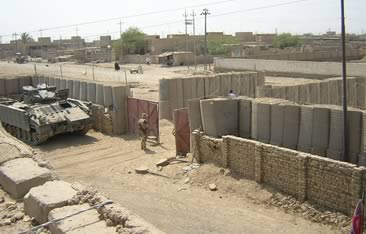
As relevant to the predicament of our troops in Basra, however, are the experiences of British forces attached to the Sultan of Oman's army in 1970. Amongst other things we see in another fascinating website is a Saracen APC pressed into duty as a mine clearance vehicle at RAF Salalah. One feature of this vehicle is that it could be driven easily in reverse, a feature used in the illustration, where it is rigged to push a mine roller. Interestingly, we also see sand-filled 40-gallon drums stacked up as blast protection – the predecessor to the "Hesco" containers currently used. There is nothing new under the sun.

Just as relevant though was that the base came under continuous mortar attack. To counter this threat we see the predecessor of the current Mamba and Cobra counter battery sets – the "Green Archer" counter mortar radar in place (in the foreground). Behind the radar is a 25-pounder in a gun pit, ready to return fire once the mortar location has been identified.

But it did not stop there. Out on the tarmac were pairs of Strikemaster light jets, aircraft based on the then RAF basic trainer, the Jet Provost. Despite their provenance as trainers, these were formidable ground attack aircraft and were, in the hands of their RAF pilots, potent weapons.


And, of course, there were the helicopters, also on quick alert ready to transport Omani Scouts to a trouble spot and deal with the insurgents - yes insurgents - who were seeking to overthrow the government.

These, being the Omani's choice - and free from the strictures of the RAF and the then MoD (which hardly seems to have changed) were Bell UH1Ds, the famous "Hueys" of VietNam fame. Now, of course, the RAF has a few, in the form of the Augusta Bell 412, but only for air-sea rescue in Cyprus and for training aircrew. But the Army is not allowed to have them.

There we have it. Over thirty years ago, nearly all the elements of COIN warfare were in place, right down to the mine/blast protected vehicles, which are now no longer on charge. In many respects, therefore - with our inadequate "Snatch" Land Rovers instead of the Saracens (which were also used in Northern Ireland), the absence of light (or any) ground attack capability and an acute shortage of helicopters - we are less well equipped than were our own and even the Omani armies all those years ago.

But there another major difference. Unlike Oman with its wide-open spaces (more like Afghanistan in some respects), weapons like mortars and Katyushas are being fired from highly congested urban areas, with the terrorists using civilians as a screen.

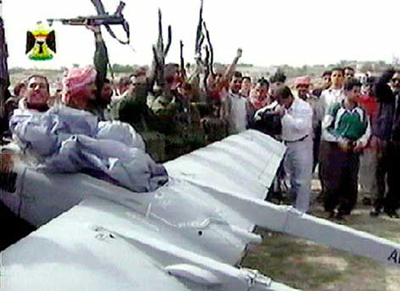
To deal with that, we have other weapons - the C-RAM (and even that is based on 70s technology) and UAVs armed with precision, small-warhead guided weapons. We have no C-RAM though and, as to our UAVs, we have none capable of being used for this function and our attempts at flying off the wrongly-named Phoenix (it does not rise from the ashes) have met with embarassing failure (illustrated above).

For want of the right equipment, therefore, it seems we must send a 1000 men, backed by tanks, armoured vehicles and aircraft smashing into Basra at dawn, all to arrest five men, before scuttling back to our fortifed bases and the daily barrage of mortars and rockets.

Oddly, Gateway Pundit on Friday hailed as "good news" the optimistic account of the situation in Basra by Iraqi-American Haider Ajina, citing Major General Ali Hamadi chairman of the tri-security agencies in Basra. He claims that operation Sinbad, for security and reconstruction, has achieved important results.

Yeah right. That's why we need a small army to arrest five men, while all our bases are under constant daily attack. Yet, in June 2003, our troops were walking the streets in soft hats. Every which way, in my book, we're going backwards.

COMMENT THREAD

Sunday, 5 November 2006

What will we have gained?

Not only the content but the date also of this article in the Sunday Times is relevant. Written February last, it confirms the view that security forces cannot deal effectively with terrorism without the use of modern, properly equipped helicopters.

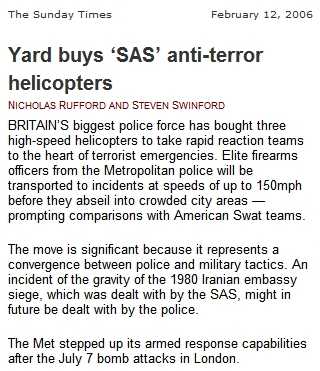
Thus does this newspaper record that London's Metropolitan Police has bought three high-speed helicopters (Eurocopter EC 145s) to take rapid reaction teams to the heart of terrorist emergencies - just the sort of thing that would be ideal to deal with the hit and run mortar teams that are causing such havoc in Basra.

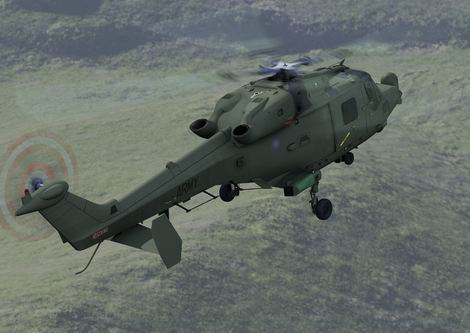
To provide 24-hour coverage of the city and environs in an insurgency situation, however, you would probably need about 12 helicopters, the number shown below. That represents less than a third of the fleet operated by the British police and twice the number of tactical helicopters operated by the Army in the whole of southern Iraq. It also represents just over half the price of one Eurofighter or Apache attack helicopter, either of which cost around £60 million each - and one tenth the cost of the failed Phoenix UAV programme.


The point is not lost on American Thinker, with James Lewis picking up the report that a Catholic bishop has entered the news by insisting that it is "morally reprehensible" to fail to equip British troops properly – something we also discuss on the blog.

Of the MSM though, only Booker sees the point. Picking up on our posts here, here, here and here, he writes in his Sunday Telegraph column today, adding his own distinctive touch to the argument:

Nothing should have brought home more chillingly the failure of our military presence in Iraq than the fact that last week we had to evacuate all our 200 civilian officials from the Basra Palace complex, refurbished at a cost of £14 million (including an upgrade of the swimming pool) to enable them to bring the area peace and democracy. Saddam's former palace is also the British Army's headquarters, and it is a measure of its impotence that it can no longer defend its own HQ against insurgent mortar attacks.

To do so would require a combination of counter-battery radar equipment, to detect where the bombs are coming from, with helicopters on patrol to provide the necessary instant response. We have the radar, the Mamba, but the Ministry of Defence has not seen fit to provide our troops with the helicopters. In the whole of Iraq we have only six Lynxes, used for a range of roles, not including protection of the army's headquarters, which is why our command staff have to spend much of their time hiding under tables from 15 or more mortar attacks a day.

The MoD does plan to buy 70 "Super Lynxes", at £14 million each. But these will not be available until 2012, to help us play our part in the European Rapid Reaction Force (ERRF). Meanwhile the US Army in Iraq buys off-the-shelf commercial helicopters at less than £4 million each, to play precisely the supportive role our own troops are so desperately in need of, in the real war they are engaged in; while the MoD pays nearly four times as much for machines to equip our men to take part in some fantasy army of the future.
Booker then refers to this blog and points out that Britain's police forces are now better equipped with helicopters than the British Army. "It is hardly surprising", he concludes, "that it can no longer even defend its own headquarters." He believes the lack of interest in ensuring that the Army can do the job is a precursor to Blair pulling out of Iraq altogether. My co-editor posits that it is a cock-up, while American Thinker writes of a "cultural conspiracy" in the sense that the Left has controlled the British media, educational system and much of its politics for almost a century:

The British Left isn't nationalist, but internationalist. Undermining the armed forces by propaganda and funding cuts is a basic part of the socialist faith: "no troops, no war" is the reasoning, if one can call it that. You don't need conspirators when it is done every day by the BBC, the Guardian, and much of the Labour and Liberal Democrat Parties.
Whatever the reasons, and American Thinker has more, we are observing an Army that is being undermined through lack of equipment. The lack of response to that had us worried, to the extent that we had to do a reality-check, concerned that we might be trapped in a private fantasy.

But we are not wrong. Without the kit – in this case the helicopters – the Army simply cannot perform, for want of which performance, Iraq must eventually be lost. And, writes Charles Moore, "If we do pull all our troops out, mock Blair and Bush, and hail some deal with Iran as "peace", we shall have a few weeks of self-congratulation, but that is all."

COMMENT THREAD