Showing posts with label Saracen. Show all posts

Saturday, 20 June 2009

Road rage


Covered only briefly by the British media was an incident on Wednesday when three Danish soldiers were killed by an IED in Afghanistan.

As the 700-strong Danish contingent in the country is under British command, and operates closely with British forces, these could so easily have been British soldiers, in which case there would have been a great deal more attention given to this small tragedy.

Here, what is remarkable is that there are uncanny parallels between this incident and one which occurred on 25 February of this year. Then, three soldiers from the 1st Btn The Rifles were also killed by an IED. They were riding a Wimik near Gereshk, engaged on "routine escort duties" along the notorious Highway 1 when they were hit by a culvert bomb estimated at 250Kg.

As to the current incident, the Danish troops were reported to have been riding in a "lightly armoured jeep" – most probably a Mercedes G270 CDI (pictured) – which is a direct equivalent of a Wimik. They too were engaged on routine escort duties near Gereshk along the same Highway 1, and were also hit by a culvert bomb, this time estimated at 350Kg.

Highway 1 is the main artery in Afghanistan. It runs from the eastern Pakistani border through Kabul and Kandahar, onwards to Herat in the west, passing Camp Bastion, the main coalition base in Helmand province, and thence on to the Iranian border.

Unsurprisingly, given its strategic importance, it is a key target. And, as one of the few paved roads in the country, is difficult to mine. Therefore, the Taleban – as did the Iraqi militias and the IRA before them - have resorted to the tactic of using culvert bombs, taking advantage of culverts which number into the thousands in some provinces, spread out over hundreds of miles of road.

And, according to Time magazine, not only has the frequency of such attacks increased, the power of the bombs employed has gone "way up." Twenty-pound charges have been replaced by oil drums packed with hundreds of pounds of explosives, set off by trip wires and pressure plates, that are capable of destroying up-armored humvees.

In Northern Ireland – where the IRA used on occasions 1000lb bombs - to deal with such formidable weapons, the British Army were forced to abandon the roads altogether, resorting to helicopters and foot patrols, a decision which was taken shortly after a Saracen APC (pictured) was destroyed by a culvert bomb near Crossmaglen on 9 October 1975.


Unfortunately, the option of relying entirely on helicopters is not available to the coalition forces, and not entirely because there are insufficient helicopters. The roads – and in particular Highway 1 – are needed to move large quantities of supplies and are used heavily by Afghan security forces and civilians. To abandon those roads to an enemy which is indiscriminately slaughtering civilians as well as the security forces is also to abandon any attempt at winning "hearts and minds".

On the other hand, foot patrols and direct intervention is proving extremely hazardous. At the beginning of this week, a Canadian combat engineer died while trying to defuse an IED in a culvert beneath a roadway about 12 miles southwest of Kandahar City. Also killed in the blast was an Afghan policeman. An interpreter was injured and evacuated by helicopter.

Once again therefore, technology is having to provide the answers, one application of which is the mine protected vehicle. Despite the increased size of bombs, many still believe they are saving lives although no one pretends they are the complete answer.

Danish defence Chief of Staff Tim Sloth Jørgensen believes that more losses from IEDs are "unavoidable". "We're never going to find them all," he says. "There is no safe way to do so, and the enemy is always coming up with new tactics."

Others, offering arguments redolent of those we heard during the Snatch debate, defend the decision to transport troops in lightly armoured vehicles. Despite the incident in February, they cite the relatively safe conditions along Highway 1. They also point out that if soldiers began travelling in armoured personnel carriers, the Taleban would begin planting larger bombs.

This argument for "safety" is not shared by Time magazine, recording that the section of Highway 1 between Kabul and Kandahar is littered with "brutal evidence" of the Taliban's IED offensive.

The road is a showcase US-funded project, meant to connect two of the country's most vital commercial centres, but it is now an automotive graveyard, littered with burned-out carcasses of vehicles and disrupted by crumbled bridges.

One infamous stretch is lined with the wreckage of 40 transport trucks, the remains of a 90-minute enemy ambush dubbed the "jingle-truck massacre." (Afghans hang chains and coins from their truck bumpers, which create a jingling sound.) "Every few miles, craters of varying size pock the pavement, interspersed with suspicious patches of dirt that compel patrol convoys to make off-road detours or dismount to investigate before proceeding."

The problem, however, is not new. Similar conditions were experienced in Iraq and there US forces developed engineering solutions to reduce the risks. This included a programme of clearing road verges, compacting the road shoulders, replacing manhole covers to drainage systems and fixing grates on the ends of culverts.

Route clearance was also practised in Iraq, using equipment such as the Buffalo - although these will not be delivered to the British zone until next year at the earliest.


Other equipment which has been used are mast and aerostat-mounted surveillance cameras, which allow for the continuous observation of vulnerable sections of road which cannot be achieved with UAVs. This principle has been extended with the use of mast-mounted observation cameras and other sensors on vehicles (pictured above).

As much as anything, this is an engineers' war - a game of three-dimensional chess where technical expertise and innovation is as important as firepower. When it comes to "boots on the ground", therefore, more infantry are not necessarily the answer. We need more combat engineers.

COMMENT THREAD

Thursday, 18 December 2008

"Same old failings"

The starting point of this piece is the assertion that we will never get sensible military procurement until or unless MPs and the media start to take the subject seriously.

Only then, do we assume that they will make the effort to understand the issues and put the pieces together. And, if they do so, they will be able to target their criticisms accurately and fairly. But they must also come up with clear ideas of what should be done. There is no point whatsoever relying on the MoD – or the military. Time and time again, it has become demonstrably clear that they have very little idea of what they are doing.

The illustration of this broader thesis comes with today's media coverage of the annual National Audit Office (NAO) report on MoD project management, which has featured, amongst other things, the problems in bringing "Terrier" battlefield engineer vehicle into service – a project slated at £300 million, each vehicle costing £5 million.

The focus on this machine in the report has prompted three media articles dedicated specifically to the subject of the Terrier.

In no particular order, there is a piece by Chris Irvine, in The Daily Telegraph, another in the same paper (online both) by Thomas Harding and a piece in The Daily Mail by Matthew Hickley. Then, in each case there is comment by an MP, Edward Leigh, the Conservative chairman of the Public Accounts Committee.

To understand the scale of the problem, we first have to look at each article individually. Then we need to look at the bigger picture, Leigh's response to the newspapers and the role of the NAO.

Taking Hickley's Mail piece first, the headline (which would not have been written by the author) proclaims: "Army forced to buy JCBs and paint them in camouflage colours to clear warzones." The message, however, accurately reflects the copy, which tells us:

Plans for new armoured bulldozers to help British troops to clear obstacles in warzones have been hit by such long delays that the Army has had to buy JCB diggers instead and paint them in camouflage colours.


This assertion is then reinforced by the picture (above), which shows a line of ordinary, commercial JCBs.

Taking that one point (we will return to the others) – that the Army is, in effect, using ordinary JCB diggers, with a new paint job - this is a cheap shot, and wholly wrong. The vehicles being bought are the state-of-the-art JCB High Mobility Engineer Excavator (HMEE) - pictured below, right.

They were purpose-designed, initially for the US Army and are custom-built military machines. Furthermore, the version to be fielded is armoured, which adds to the differences – although we have reservations about this, as these machines are not mine protected. Nevertheless, they bear no more relation to the civilian machine than does an Army truck to a Tesco delivery vehicle.

Moving on to Chris Irvine's Telegraph piece, he also writes in similar terms that "The Army had to buy JCB diggers and paint them to camouflage them after plans for new armoured bulldozers to clear warzones were met by long delays."

The issue we need to address here is the inference that the Army bought the HMEE because of the delays in procuring the "new armoured bulldozers" – the Terriers (picture, below left) to which the NAO report refers.

Once again the assertion is wrong. Although ostensibly based on the NAO report, that is not what the NAO actually says. The passage is here:

2.17 Terrier will replace the Combat Engineer Tractor that was withdrawn from service in March 2008 because of concerns about the safe integration and operation of the Bowman communications system, reliability and obsolescence problems. The delays to Terrier will extend this capability gap; but users have been willing to accept that the vehicles will not be available to support operations until 2012 rather than risk a lower level of reliability. The Department does not believe that the delays will have an operational impact in the short term because of Urgent Operational Requirement action to purchase alternative engineering vehicles for current operations, including the JCB High Mobility Engineer Excavators.
The most relevant sentence here is the last, where the MoD argues that the delays in the Terrier procurement will not affect operations because, inter alia the HMEE has been bought. From this, it is a long way to go to assume that the HMEE was bought because of the delays in the Terrier programme. And, in fact, that was not the case,

Those that have followed this issue will know that the HMEE is to be purchased as part of the £96 million Talisman package, devised as a "specialist route clearance system", which "will provide a new high-tech way of dealing with the IED (Improvised Explosive Device) threat."

In this role, the HMEE brings to the table capabilities which the Terrier cannot supply. Specifically, the HMEE is a development of the JCB Fastrac, a machine which is optimised for (relatively) high-speed road use. It is thus capable of travelling long distances at convoy speed, keeping up with other vehicles without the need for specialist transportation. It can also operate freely on a wide variety of roads.

Strangely enough, when the concept was first announced in 2005, it was much lauded, not least by Sean Rayment in The Sunday Telegraph as the US Army's "latest secret weapon in the war against terror". How times change. But it is a pity that Telegraph writers do not read the Sunday version of their own newspaper.

The contrast with the Terrier, to anyone who thinks about it, is obvious. A tracked vehicle, if it is to travel any distance, has to be transported on a low loader. Furthermore, it is not by any means ideal for working on metalled roads – tracks tending to tear up the tarmac. It may have a limited role in Afghanistan, its design use being to carry out engineering works in the "indirect fire zone". But it is not an equivalent to the HMEE (and vice versa).

At best, the two machine types have overlapping capabilities, which is probably what the MoD was getting at when it argued that there would be no "operational impact" from the delay in the Terrier. Most of the jobs the Terrier would have been called upon to do, the HMEE can also do. But the HMEE can perform tasks for which the Terrier would be wholly inappropriate.

With that, we now come to the next point, majored on by Thomas Harding, his article headed: "Mine clearing vehicle that could save lives of British troops delayed for two years." Unfortunately, he has been misled both by the MoD and the NAO, which position the Terrier as a "mine clearance vehicle", which is actually only a secondary role.

Harding thus writes: "The armoured vehicle can clear minefields and make routes safe for following armour and is likely to have proved a significant asset in Afghanistan where dozens of soldiers have been killed by roadside bombs." He then goes on to say, "As a result of the hold-up the MoD has been forced to buy 10 off-the-shelf Buffalo route clearance vehicles as part of an urgent £96 million project."

The juxtaposition of these two issues is not altogether a happy one. In the mine clearance role, the Terrier is mainly what is known as a "breach" vehicle. Usually, to clear mines, it tows a bit of kit called Viper minefield breaching system (now replaced by the Python) which it uses literally to blast a way through a known minefield, paving the way for armour.

In insurgency warfare, the mine is used as an ambush weapon and, therefore, a different approach is used, needing equipment to investigate suspect locations, to determine whether there is an explosive package hidden there. Once one is detected, it is then identified and dealt with.

Thus, the distinction is between "breach" and "clearance". The Terrier is used for the first, the Buffalo for the second - as one of a suite of vehicles, providing part of the detection capability. There is no comparison. The Terrier can be used for the one (as an ancillary function) but cannot perform the role of the Buffalo. There can be no question, therefore, of being "forced" to buy Buffaloes because of delays in the Terrier programme. The two are completely different animals, used for different jobs.

However, as between the Terrier and the HMEE, there can be an overlap. Both vehicles can be fitted with mine clearance rollers (pictured right). But this kit is also currently fitted to Mastiffs and can be fitted to virtually any other armoured vehicle (in Oman, rollers were fitted to Saracens), so one hardly needs a £5 million, specialist engineering vehicle for the purpose, especially as the Terrier is not mine protected. Futhermore, this equipment - unlike the Husky detector gear - will only deal with pressure-plate activated devices, and not those triggered by command wire or other remote actuation mechanisms.

This brings us to the problem of the "bigger picture". The limitation of the NAO is that it looks at individual projects, mainly from a cost perspective. It does not look at projects in context (how they relate as part of a system, with other equipment), nor does it consider whether they are necessary or whether an alternative would be more appropriate. It simply looks at the situation "as is".

The trouble is that no one else is looking at the bigger picture either. Perhaps the Defence Select Committee should be doing this, but it does not. And neither does the media. As we see with this story, it dissects the information served up to it on a plate and goes no further. But, if you examine the "system" as a whole, a different and altogether more disturbing picture emerges.

Looking specifically at the HMEE, the question has to be asked, what is it for? An excavator, with or without armour, cannot be used to look for mines or other explosives. That is the job of the Husky (see left) in combination with the Buffalo. You would not expect an excavator to dig up a mine or explosive device once found. For a start, the HMEE armour (and design) is not up to that, which would make it far too dangerous. Explosive devices, invariably, are hand-cleared or blown up in situ. The only role one can think of, for which the HMEE is particularly suited is filling in the craters after a device has been blown up.

The question that devolves is why, in the £96 million Talisman project, the Army is buying HMEEs - 13 of them at a cost of £6.2 million – when it is not buying Huskies, an essential component of any route clearance operation? Another question is why the Army is spending £6.2 million on buying HMEEs at all, when it has already has a fleet of 25 armoured mine clearance vehicles, which it is now trying to sell off, unused, at the knockdown price of less than £4.5 million.

If the NAO is interested in value for money – which is its purpose in life – then it needs to look a bit closer at the Talisman project. Tucked into that, as Ann Winterton discovered, are some additional Mastiffs. Their role will be to function as armoured bomb disposal vehicles.

Only last year though, the MoD replaced its entire overseas fleet of bomb disposal vehicles, spending £7.5 million on 18 Swiss-built Bucher Duro vehicles, called the "Tellar" (pictured right). As we pointed out at the time, these unarmoured vehicles are totally unfit for purpose and now, surreptitiously – disguised by another project – these are being replaced.

Thus, we find ourselves in a position where, after the waste of nearly £20 million, we are going to end up with route clearance teams which still lack the essential Huskies to make them truly effective. But the NAO has no comment about that, and the media – entirely heedless of what is going on – is chasing after hares, making false points about JCBs, missing the real story.

That leaves Edward Leigh, who comments on the NAO findings. He complains of the "same old failings", which threaten to leave British troops poorly prepared for frontline action. He condemns what he calls "a lack of realism" and then declares: "This is about more than money. This kit will sooner or later be operated, perhaps in anger, by our men and women in the forces."

That latter sentiment is one with which we would agree. But, instead of offering any more detailed critical evaluation or himself looking at the bigger picture, Leigh is mouthing sound bites in response to an agenda dictated by the NAO. We are indeed – to use his words – dealing with the "same old failings", but there are far more failings than those identified by the NAO. As an MP, and chairman of the Public Accounts Committee, it is his job to root them out.

Instead, from our parliamentary representatives, we also get the "same old failings", which means that money will continue to be wasted and "our men and women in the forces" still won't get the right kit.

They – and we, the taxpayers – deserve something better.

COMMENT THREAD

Saturday, 9 December 2006

Going backwards

When the news started coming in yesterday about the raid by coalition forces in Basra, details were sparse and I thought it better to wait until we knew more.

A day later and we are not much the wiser. The whole of the publicity seems to have been generated, and is therefore controlled, by the Army. We know what the Army wishes us to know – no more and no less.

One should not be too churlish I suppose. If the Army is to be believed, five "terrorist leaders" were captured, together with a quantity of arms and explosives and some documents of "intelligence value". However, that does seem somewhat small compensation for a raid described as the biggest military operation since the end of the war on 1 May 2003.

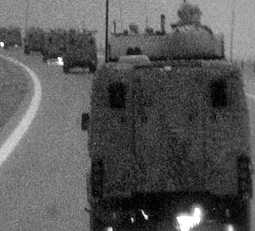
Altogether, over 1000 men took part, including a 250-strong Danish contingent, deploying 14 Challenger II MBTs, 28 Warriors, an unknown number of light armoured vehicles ("Snatch" Land Rovers and Danish MOWAG "Eagles", based on the Humve chassis - illustrated right) and ten assault boats. In support were USAF F-15s which carried out overflights as a diversion and "a show of force".

Mercifully, unlike the 24 November raid, no one was killed. That alone may have justified the scale of the force, which was not unopposed.

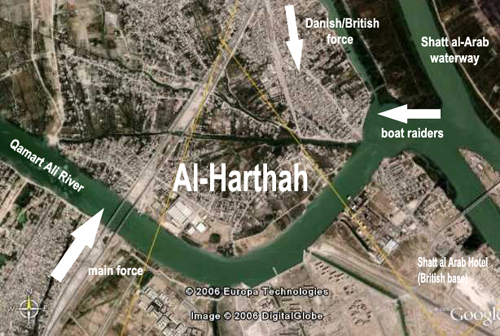
But if the size of the force deployed was not excessive (under the circumstances), there was certainly something so gloriously OTT about the Telegraph coverage. It not only included a huge map, occupying the best part of half a page, but was announced by a headline spanning two pages reading: "'Armoured fist' smashes into Basra at dawn, capturing five terrorist leaders." One suspects that the writer (our old friend Thomas Harding) and the editorial team harbour secret ambitions of being comic-strip writers.

Behind the MoD-supplied details (and photographs), the problem is, as always, that the newspaper presents a breathless view of events which avoids any depth, understanding or analysis. This is not what one would expect from grown-up journalists.

Any such analysis, of course, would not necessarily accompany this piece – and we learnt not from this but from the BBC that one of the objectives of the raid was to deal with "criminals" who were mounting attacks on British bases. Interestingly, the Telegraph's location map miss-positions the Shatt al-Arab Hotel base. It shows it closer to Basra Palace than anywhere, rather than its correct place – well within mortar range of al Harthah. And, as recently as Wednesday, the base was at the receiving end of yet another mortar attack. Was al Harthah the source?

So, here we go again. In June we wrote a piece noting that we have been here before. We remarked on how between 1972 and 1980, mine protection technology emerged, which has been refined and developed as the basis of today's blast-protected vehicles.

But, if the colonials were there before, we were there even before that. A remarkable website shows that in Oman between 1970 and 1973, British forces were operating modified 4-tonners with armour plate fitted to deflect blast from mine strikes.

But even more fascinating is the website of Barry Dunning recounting his exploits in the 10th Royal Hussars (Middle East Land Forces) in Aden in 1965, riding in a Saladin armoured car.

As a boy I recall this vehicle (illustrated). Built on the same chassis as the Saracen armoured personnel carrier, it was specifically designed for mine protection and could continue operating with any one wheel blown off by a mine. For their party trick, Alvis, the manufacturers, used to drive the vehicle round a test track on demonstrations, with one of the front wheels missing.

Anyhow, Dunning writes:

The 12th of September is a day I will never forget!! Coming back from Dhala we went on ahead to pick up the Infantry whom were up on the ridges (to cover the convoy through the wadi). We had just passed Mile Stone 36 when we hit two anti-tank mines and 25lb of plastic explosives. It picked the 14 tons of armoured car and threw us about 25 feet into the air, leaving a crater 30 foot wide and 10 foot deep. We were very lucky the armour did not split open as we were fully loaded with all our shells and bullets... It would have been a real fireworks display if they had gone off, and we were lucky no one was hurt.

Mick had a cut on his cheek where the Browning rounds wrapped around his face. Geordie hit his face on the front driver hatch as he was thrown forwards. It knocked him silly for a moment and he had a bloody nose. Because of the shock the medics could not take any chances with us so they flew us out on an Army Scout helicopter back to camp. The Saladin was brought back on a low loader.
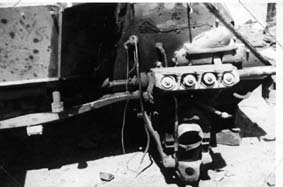
And above right is a close-up picture of the front wheel bay, which took the full force of the explosion. Now imagine if that had been a "Snatch" Land Rover.

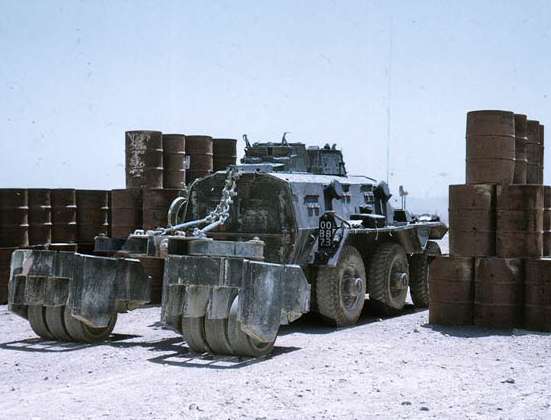
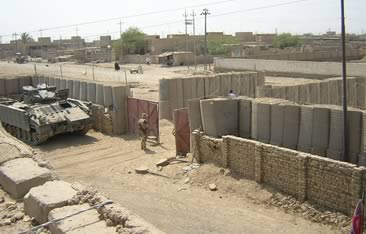
As relevant to the predicament of our troops in Basra, however, are the experiences of British forces attached to the Sultan of Oman's army in 1970. Amongst other things we see in another fascinating website is a Saracen APC pressed into duty as a mine clearance vehicle at RAF Salalah. One feature of this vehicle is that it could be driven easily in reverse, a feature used in the illustration, where it is rigged to push a mine roller. Interestingly, we also see sand-filled 40-gallon drums stacked up as blast protection – the predecessor to the "Hesco" containers currently used. There is nothing new under the sun.

Just as relevant though was that the base came under continuous mortar attack. To counter this threat we see the predecessor of the current Mamba and Cobra counter battery sets – the "Green Archer" counter mortar radar in place (in the foreground). Behind the radar is a 25-pounder in a gun pit, ready to return fire once the mortar location has been identified.

But it did not stop there. Out on the tarmac were pairs of Strikemaster light jets, aircraft based on the then RAF basic trainer, the Jet Provost. Despite their provenance as trainers, these were formidable ground attack aircraft and were, in the hands of their RAF pilots, potent weapons.


And, of course, there were the helicopters, also on quick alert ready to transport Omani Scouts to a trouble spot and deal with the insurgents - yes insurgents - who were seeking to overthrow the government.

These, being the Omani's choice - and free from the strictures of the RAF and the then MoD (which hardly seems to have changed) were Bell UH1Ds, the famous "Hueys" of VietNam fame. Now, of course, the RAF has a few, in the form of the Augusta Bell 412, but only for air-sea rescue in Cyprus and for training aircrew. But the Army is not allowed to have them.

There we have it. Over thirty years ago, nearly all the elements of COIN warfare were in place, right down to the mine/blast protected vehicles, which are now no longer on charge. In many respects, therefore - with our inadequate "Snatch" Land Rovers instead of the Saracens (which were also used in Northern Ireland), the absence of light (or any) ground attack capability and an acute shortage of helicopters - we are less well equipped than were our own and even the Omani armies all those years ago.

But there another major difference. Unlike Oman with its wide-open spaces (more like Afghanistan in some respects), weapons like mortars and Katyushas are being fired from highly congested urban areas, with the terrorists using civilians as a screen.

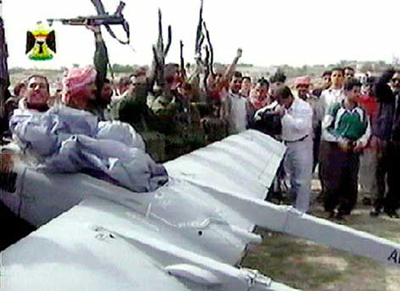
To deal with that, we have other weapons - the C-RAM (and even that is based on 70s technology) and UAVs armed with precision, small-warhead guided weapons. We have no C-RAM though and, as to our UAVs, we have none capable of being used for this function and our attempts at flying off the wrongly-named Phoenix (it does not rise from the ashes) have met with embarassing failure (illustrated above).

For want of the right equipment, therefore, it seems we must send a 1000 men, backed by tanks, armoured vehicles and aircraft smashing into Basra at dawn, all to arrest five men, before scuttling back to our fortifed bases and the daily barrage of mortars and rockets.

Oddly, Gateway Pundit on Friday hailed as "good news" the optimistic account of the situation in Basra by Iraqi-American Haider Ajina, citing Major General Ali Hamadi chairman of the tri-security agencies in Basra. He claims that operation Sinbad, for security and reconstruction, has achieved important results.

Yeah right. That's why we need a small army to arrest five men, while all our bases are under constant daily attack. Yet, in June 2003, our troops were walking the streets in soft hats. Every which way, in my book, we're going backwards.

COMMENT THREAD