Thursday, 13 October 2005

A succession of failures

For anyone who wants an example of how a combination of useless MPs and the gross amateurism of the media can given a totally distorted view of a subject, go no further. Today's report from the Public Accounts Committee on "defence overspending" – mentioned in my earlier posting – would be very hard to beat.

The report itself, available here is entitled, "Ministry of Defence: Major Projects Report 2004". To produce it, the committee – headed by Edward Leigh - examined the cost, time and technical performance in the year ended 31 March 2004 for the 20 largest MoD procurement projects where the main investment decision had been taken. It also examined the ten largest projects in the assessment phase.

For the 20 largest projects, the MoD forecast the costs at £50 billion, an increase of £1.7 billion in the last year (compared to £3.1 billion in the previous year), bringing them to £5.9 billion over the target cost set at approval (or 13% of the total forecast set at approval). The 20 projects have also had further delays, totalling 62 months, to their expected delivery dates, bringing the cumulative delay to 206 months.

Cumulatively, said the committee, these in-year cost increases and delays place additional pressures on an already-stretched defence budget and mean that the Armed Forces will not be getting the most effective capability at the right time. There will be further cuts or cancellations in equipment, and the Armed Forces will have to operate older, less-capable, less efficient equipment for longer.

At face value, all of that looks good, critical stuff and what is said is not inaccurate. But it is childishly superficial.

Firstly, the MPs took the MoD at its own face value, coming to its conclusions after taking written evidence solely from the MoD and oral evidence from two MoD officials. They did not look outside the loop, and seek wider views of the failures of the Department.

Secondly, a failing shared with the Defence Select Committee, the MPs only looked at the situation "as is". In other words, they looked at the projects which the MoD was implementing and assessed its performance in dealing with them, in order to gauge whether money was being wasted. What it did not do was attempt to second-guess whether those projects should have been undertaken in the first place - whether they made the right choice of equipment and, if not, why not.

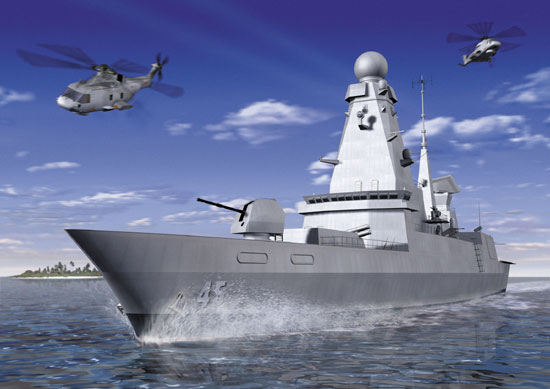
This is especially significant in that the most expensive of the projects the committee looked at was the Type 45 Destroyer (pictured above) contract, which is costed out at £5 billion for six ships, despite the MoD's website stating that they cost £1 billion each.

This is a contract we have looked at very closely on this blog and our conclusion is that the UK should never have attempted a unique, national design for such a small number of highly complex ships. That is the option the Australians chose, selecting a more capable US design, building the ships in their own yards at 60 percent of the UK costs.

If that assertion is debatable, then at least it should be debated, and that represents the ultimate failure of the MPs – that willingness to take each decision "as is" without looking beyond it. But even following its own limited framework, the committee fails in its task. It is not always clear, it says:

…whether changes to the scope of projects are the result of cost increases or changes to requirements or both. For example, it was originally planned to purchase 12 Type 45 destroyers when the project was approved in 2000. The Department is now planning to acquire only eight ships. The reduction in numbers was not attributable to any one factor but to a combination of getting greater capability from each destroyer; the need to contain costs after increases in parts of the project (mainly on the Principal Air-to-Air Missiles to be fitted to the destroyers); and the reduced threat from enemy aircraft and missiles.
Leaping out from this verbiage is that crucial phrasing: "…the need to contain costs after increases in parts of the project", mainly on the Principal Air-to-Air Missiles (PAAM). Nowhere is this mentioned that this is a French designed and built missile, which is late, with the costs spiralling out of control. It was the insistence of the MoD that we kept PAAM that forced us to resort to a unique design in the first place, but there is no mention of that. But what it does remark is that:

The Department aims to match appropriate procurement strategies to individual projects on a case-by-case basis. The different strategies employed include Private Finance Initiative / Public Private Partnerships, leasing, multi-nation collaborative programmes, partnering, and Alliancing. The decision to adopt a particular strategy will be affected by factors such as affordability, technological risk, and the possibilities of sharing technology, risks or rewards with industry or other nations. But different strategies carry different risks. The multi-nation collaborative route, for example, has often led to delays while other partner nations reach agreement on the Memorandum of Understanding or the contract.
This, says the committee, has happened on the Eurofighter, the Meteor missile and the A400M heavy lift aircraft in each case resulting in significant time and cost overruns. But it also happened with the Type 45, which the committee does not include in its list.

Putting this all together, some of the projects are indeed down to mismanagement, but much of the waste identified by the committee stems directly from the choice of European equipment. This is not "mismanagement" per se, but the effects of selecting the wrong suppliers or the wrong equipment in the first place. And this applies to other equipment, the procurement of which in the committee's terms, was not "mismanaged", but still cost more than it ought to, or was simply the wrong choice.

Yet, when it comes to the media, they all report roughly the same thing. The Guardian picks up the theme of "overspending" and then follows the committee line that:

The cost increases and delays will lead to "further cuts or cancellations in equipment, and the armed forces will have to operate older, less capable, less efficient equipment for longer", the Commons public accounts committee warns.
Exactly the same line is taken by the BBC, which reports the MPs saying: "the armed forces may be left without vital equipment because of the Ministry of Defence's 'woeful' management of major procurement projects."

And then there is the Telegraph which reports on "the woeful performance of the Department in procuring defence equipment and its inability even to follow its own broadly sensible procurement rules."

This is not journalism – it is copy editing. The mindless hacks have simply edited the committee press release. Some have embellished it with a couple of quotes, and then they all have regurgitated the script and called it a news story.

The point of course, is that the select committee have done a bad job in scrutinising the government. But, in a working democracy, the check on the poor performance of MPs is the media, which should have savaged the report. They have not, and therefore, as a result of this succession of failures, the government gets off the hook. No wonder it performs so badly.

COMMENT THREAD

Monday, 5 September 2005

The realignment continues

Last month, I posted a story about how Australia, militarily, was becoming more closely aligned with the United States, and slipping away from the orbit of the Euro-obsessed British. This was followed by a posting from my colleague on the nascent Anglosphere, which confirmed this dynamic.

Now, from the The Australian comes yet further evidence in an article headed "Australia to share US secrets".

US President Bush, it reports, has issued a decree changed US national disclosure policy, upgrading Australia to the highest rank of intelligence partner that the US has in the world. Australia's new status is equalled only by Britain and vastly expands the quantity and quality of US intelligence our agencies receive.

In the 50 years of the US-Australia alliance, writes The Australian, Australia has never before enjoyed this level of access to American intelligence. The agreement ranges from tactical and operational military information through to comprehensive national assessments.

Increasingly, Australian agencies will have direct access to US intelligence systems. Australian military personnel in the Middle East, for example, can already directly access US intelligence databases and real-time battle space imagery.

The new relationship occurs at many levels. Canberra now has a permanent senior officer stationed at the US Strategic Command in Nebraska (pictured right). US Strategic Command is responsible for integrated intelligence, surveillance and reconnaissance, space and global strike operations, information operations, integrated missile defence and command and control.

It is the most sensitive intelligence hub in the US military network and to have Australians stationed there at high levels of seniority is a sign of the depth of the intelligence relationship. Australia gains access at all levels - to US raw intelligence, to US assessments of the intelligence and to real-time operational information and planning.

This has meant Australia further upgrading its own security because the US is extremely sensitive about who shares such information. Australia's new status is a sign of the growing trust the US has in the Australian military and intelligence community. Co-operation between Canberra and Washington in these fields has grown exponentially as a result of both the war on terror and the joint operations in Iraq.

In an editorial today, The Australian elaborates on this development, declaring that the change in Australia's status shows the reserves of trust that exist with our major ally. It is also a testament to the close relationship between Mr Bush and John Howard (pictured left), adding that: "the US alliance is, of course, the foundation of our security. Less well understood is the way the huge US defence budget subsidises our own military and intelligence spending, making it easier for Australian governments to provide the social services we value."

Continuing on this theme, it emphasises similar issues to those which have made the "special relationship" so valuable to the UK. "In recent times," the editorial says, "the closeness of this relationship, which is based on shared values and a history of helping each other out in times of conflict, has been expressed in many ways, including the free trade agreement signed last year and Australia's commitment to the liberation and rebuilding of Iraq. The new intelligence symbiosis, which among other things will help us fight terror in our region, is a further example of how the US alliance materially benefits Australia."

That "symbiosis" may be helping Australia now but, as far as the UK is concerned, informed sources report to us that British defence companies are experiencing "severe difficulties" in obtaining sensitive information from the US, suggesting that, far from enjoying equal status with Britain, in fact, Australia is now in a more privileged position.

This can hardly be a surprise. Amongst the more dubious articles of the "secret treaty" which we highlighted last month is "mutual recognition" of security clearances for the personnel from the signatory states.

Thus, according to the innocuous-sounding "Framework agreement" concerning measures to facilitate the restructuring and operation of the European defence industry, Part 4 (Article 23) defence workers from France, or Germany or German or any other of the signatory nations who have been given security clearance by their own country can be allowed full access to British defence secrets, and without even the British authorities having to be notified.

There plenty of examples of US sensitive technology having leaked from European firms to China, so there can be no surprise that things are getting tougher for Britain. As we cannot even control access to our own secrets, why should the Americans trust us? But, when Australia is cementing serious relationships with the US, and we are left out in the cold, it really is time to ask where we are going. Can we really afford to accept an Anglosphere that excludes the UK?

COMMENT THREAD

Sunday, 4 September 2005

Short-changing the Army

The series of "Booker is wrong" letters to the Sunday Telegraph, attempting to rebut his pieces on the Europeanisation of the UK armed forces, continues apace. This week, we have Andrew Simpson of Bath, who offers what must qualify as the most bizarre contribution to date.

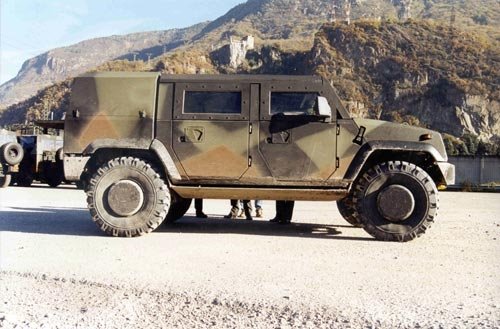
The Panther Command and Liaison VehicleUnder the heading, "I helped pick the Panther", Simpson reveals that he was formerly the MoD desk officer who initiated the Future Command and Liaison programme, which resulted in the procurement of the Panther vehicle (illustrated right), but he also tells us he is currently a consultant to Iveco – the builders of the vehicle.

Mr Simpson now feels so strongly about his employer's product, that he writes to tell us that he "cannot allow the gross errors of fact in Christopher Booker's article on defence procurement to go unchallenged." He is, he tells us, "the only person to have been intimately involved in this programme from initiation to contract award."

With such splendid qualifications, Simpson then takes Booker to task for referring to his employer's product as being "obsolescent". "Nothing could be further from the truth," he asserts. "Development of the base vehicle was started by Iveco as recently as 1999. It is as close to a state-of-the-art vehicle as is currently available, featuring a highly innovative protection system." Before dwelling on this specific point, it is as well to acquaint ourselves with what this "state-of-the art" Panther is replacing.

Firstly, it will take over close combat reconnaissance from the Combat Reconnaissance Vehicle (Tracked) (CVR(T)) series, better known as the Scorpion/Sabre series (illustrated left), vehicles which have done good service but are now urgently in need of replacement.

But, it is also being supplied to combat engineers, as their reconnaisssance and liaison vehicle, replacing the venerable but perfectly servicable FV 432, an example of which can be seen on the left. From the illustration can be seen the kind of kit that engineers carry into battle, and this is – theoretically – a ten-man vehicle.

The "state-of-the-art" Panther is, at best a five-seater and, in order to fit the radio, one or two seats have to be removed. Thus, it comes as no surprise that the Panther is already believed to be suffering from space constraints and the Engineers are rumoured to want a trailer.

None of this, of course, is mentioned by Simpson, who focuses on Booker's reference to the US up-armoured Humvee, which could have been bought for £100,000 as against Simpson's employer’s £413,000 Panther. "Humvee-based designs were considered and rejected by the MoD because that vehicle lacks the necessary protection and reliability for the role," writes Simpson. "Indeed, the Humvee itself is widely recognised as being obsolescent.”

The Sika Combat VehicleNeedless to say, Simpson misses the point. It is not so much the design of the Humvee or even the Panther which is obsolescent. It is the concept – the idea of having a general purpose vehicle to carry out a wide range of different tasks. We already showed you one possible alternative to the Humvee, the M1117 Guardian - which even at twice the price slated is still cheaper than the Panther. But the proposed replacement for the CVR(T) series should actually look something like the Sika Combat Vehicle (pictured above).

This is the fruit of the US Future Scout and Cavalry System (FSCS)/UK Tactical Reconnaissance Armoured Combat Equipment Requirement (TRACER) programme - a joint US-UK venture, originated in 1996, with an in-service date of 2007.

In February 2000, however, the project was cancelled when the US Congress shifted funding from the FSCS to a more ambitious, all-embracing concept known as the Future Combat System (FCS). The British government could have continued with the project but chose not to, writing off an expenditure of £131 million. So, while the US continued its development, the MoD issued a specification which led to its purchase of the Panther.

Interestingly, when the MoD came to shortlist the contenders for the contract, the Pather was not included in the selection. The Iveco vehicle was only entered after the short-list had been announced, at the insistence of the MoD, which then went on to select it as the winner, despite cheaper and probably better contenders, not least the South-African-built RG31, used by the US forces and £124,000 cheaper than the Panther.

Whichever way you look at it, the Army has been short-changed, and so has the taxpayer. Still, there is always a silver lining – at least Mr Simpson has got a nice little earner with the winner of the contract he helped to award.

For our latest report, see here.

COMMENT THREAD

Saturday, 3 September 2005

Which one would you prefer?

The online journal Defense Industry Daily criticises Booker for attacking the MoD’s decision to buy the Italian-built Panther light armoured vehicle at £413,000 each instead of the up-armoured Humvee at £100,000 each.

Even the US, writes DID, is upgrading its armoured fleet, buying in vehicles such as the M117 Guardian (illustrated left). As it happens, the US recently purchased 724 of these vehicles on a fixed-price contract of $258.8m, which equates to $357,458 or £194,092 each - i.e. less than half the price of the Panther.

If you were a soldier in hostile territory, exposed to bombs, mines and gunfire, which would you prefer? The Panther (right), or the Guardian (above)? And, if you were – as you most certainly are – a taxpayer, which would you prefer, £413,000 or £194,092? Well, you have not been given a choice. The MoD have already decided that the Pather is the best vehicle for the British Army.

That, dear readers, is part of the price we are paying for European defence integration.

COMMENT THREAD

Tuesday, 30 August 2005

Oh for a grown-up newspaper

It is rather curious that The Daily Telegraph seems more interested in US military equipment than the kit bought for our own forces, hence a story in yesterday's paper, reporting that the "Humvee comes to the end of the road".

Iraqi insurgents, the paper reports, have mortally wounded the humvee. At least 350 American soldiers have been killed while riding in humvees in Iraq, about a quarter of all combat casualties. Many hundreds of vehicles have been wrecked. The Pentagon, therefore, has decided to bring forward by a decade the hunt for a successor.

What makes this report specially curious is that, just as the Americans are deciding that the Humvee has had its day, the MoD has bought 401 Italian-built Panthers for the British Army. These, it turns out, are based on a 1977 design put up to compete for the contract from which the Humvee emerged, paying four times the price that the US pays for the up-armoured vehicles that it is about to make redundant.

The plot become even more convoluted when one learns that, as an interim measure, the US forces have bought a number of the South African designed RG31s, which at, £289,000 each are £124,000 cheaper than the Panther, yet these same vehicles were rejected by the MoD even though they are built by a wholly owned subsidiary of BAE Systems.

Yet, apart from the Booker column, not one British newspaper has thought to mention these curious developments.

Nor, indeed does any newspaper – apart from The Financial Times - seem to be at all interested that a battle royal seems to be being played out over the fate of MoD contracts for the FRES system. The Telegraph last mentioned the system (but not by name) in October 2003 when it announced then that all or part of the contracts would be awarded "within the next few months". It now seems entirely incurious that it is two years later that we are coming to the stage of contract awards, with the cost having increased from £6 to £14 billion.

Yet, as reported on this Blog, where the MoD awards the contracts will be a crucial litmus test as to which way defence policy is going.

At stake are not only are the "platform" contracts – the description given to the basic armoured vehicles – but the electronic "architecture", the various electronic systems which equip the vehicles and can account for up to 80 percent of the final price.

The MoD has not named the companies involved, but it is expected that US aerospace giant Lockheed Martin and the French-owned Thales UK each will receive contracts to look at potential electronic systems. If Thales gets a contract, it looks likely that it will be fronting a Swedish-built Hägglunds CV90 vehicle which has been converted to hybrid electric drive for FRES demonstrations.

Hägglunds is wholly owned by BAE Systems and, intriguingly, its officials are saying that the vehicle is in Sweden, "where it is doing work for the MoD." "What work?", one might ask, but it would be useful if grown-up newspapers also started asking about the most expensive equipment project ever undertaken for the British Army.

COMMENT THREAD

Sunday, 21 August 2005

Lying for Tony

Nothing is true in politics until it has been denied by a minister. And, in the wake of Booker's column last week, we have Minister of State for the Armed Forces, Adam Ingram, writing to The Sunday Telegraph to say that Christopher Booker is, yet again, wrong.

The MoD has not embarked on a secret programme to "Europeanise" our forces through the backdoor of equipment procurement, he claims. "The basis of our procurement process is clear: in an open competition, any company (UK, European, American or otherwise) can bid for a MoD contract. Ultimately, contractors are chosen on the basis of value for money for the UK taxpayer."

Interestingly, I am just reading Peter Oborne’s book, The Rise of Political Lying, in which he declares:

Britain now lives in a post-truth political environment. Public statements are no longer fact based, but operational. Realities and political narratives are constructed to serve a purpose, dismantled, and the show moves on. This is new. All governments have contained liars and most politicians deceive each other and the public from time to time. But in recent years mendacity and deception have ceased to be abnormal and become an entrenched feature of the British system.
It is in that context that Ingram's statement and the rest of his letter must be read. He is writing a "political narrative" constructed to serve a purpose. Its aim is to deceive.

Take for instance, his phrasing: "The basis of our procurement process is clear: in an open competition, any company… can bid for a MoD contract." Read superficially, it would appear to suggest that all MoD competitions are "open", but if you read the words carefully, he does not actually say that. He simply makes an assertion to the effect that, if MoD competitions were open – which is not always the case – any company could bid.

Of course, not all competitions are "open" and, in any case, it depends what you mean by the word. The Type 45 Destroyer competition was open in the sense that bids were invited to build the ships. But, a complex system like an air-defence warship is basically a platform for the radar and missiles and the government had already decided on that equipment. Thus, any potential supplier who already had his own package would not be interested in just building the platform. The options were already closed down before the bids were invited. Was that an "open" competition?

Then there is the Panther contract. Bids were invited and three companies were short-listed, who submitted four vehicle types for assessment. Then, at the behest of the MoD – after the shortlist had closed – another vehicle was entered – the Italian-built Panther – which subsequently won the contract. Was that an "open" competition, where the MoD selects the very vehicle it enters for the competition?

As for the claim that contractors are chosen for "value for money for the UK taxpayer", the Panther is as good example as any of how that is not true. Purchased at £413,000 each for what amounts to an armoured SUV, the contract cost £166 million when the same number of up-armoured Humvees would have cost the taxpayer £40 million. How is that value for money?

In his column this week, Booker just happens to address this very subject of value for money, the cost of the government's "Europe first" policy. At the time of writing, we had worked out this had wasted just over £5 billion, which is serious money. To that must also be added the £830 million wasted on the Storm Shadow, which brings it up to over £5.8 billion.

But, writes Booker, all this pales beside the proposed £14 billion cost of the 3,500 Swedish-made vehicles equipped with French-made guns we are buying to equip three brigades of the British Army under the FRES (Future Rapid Effects System), at a cost of £4.6 billion per brigade. The US Army is to equip 36 brigades with its comparable but vastly superior FCS (Future Combat System) at a cost of only £1.8 billion each. Yet until 1999 we were equal partners with the US in developing this project. That is another £8 billion down the drain.

Returning to the egregious Ingram, his letter goes on to challenge Booker about the 2000 "Framework Agreement", with him claiming that the agreement "aims to remove barriers to industrial co-operation in the European defence market." He continues:

This is a sensible agreement, which encourages nations to examine the possibility of co-operative procurement programmes in order to avoid wasteful duplication. Encouraging this is something we seek to do with many of our allies, not just these five European nations.
This, in the style of mendacity employed by this government, is not altogether untrue, but the "agreement" is a lot more than that. For a start, it is a formal treaty and, as we pointed out, it commits the parties to:

…establishing a long term master-plan that would present a common view of their future operational needs. This would constitute a framework for harmonised equipment acquisition planning and would provide orientation for a harmonised defence related R&T policy.
In this context, the use of the word "encourage" is far too bland, to the point of being positively misleading. The Treaty imposes – I stress imposes – specific obligations, to whit, "at each stage of the acquisition process, the Parties shall undertake regular and comprehensive exchanges of Documents and other relevant information and shall undertake co-operative work." Note, twice in one sentence, the word shall is used. The treaty provisions are not optional.

Ingram then goes on to say that the "Agreement" was not signed in secret. This is the "straw dog" ploy. Booker did not say it was signed in secret. What he did write was:

…everything about the way it was drawn up seemed calculated to hide its true significance. Signed by Geoff Hoon, as Defence Secretary, at the Farnborough Air Show on July 27, 2000, it was given the blandly misleading description of a "framework agreement" concerning "measures to facilitate the restructuring and operation of the European defence industry".
In his letter, Ingram continues the process. Never once does he refer to the Agreement as a Treaty and he makes no reference to the fact that it imposes specific and detailed obligations on the signatories. All he can offer is that the House of Commons Defence Committee reviewed the Agreement and was content for ratification to proceed – as if the approval of a Labour-dominated committee made any difference

To conclude, Ingram argues that "we are not embarked on a programme of cutting our Defence ties with America in pursuit of a 'European Army'". In his original, unedited letter, he says this is "is plainly and ludicrously wrong," calling in aid, "last year's Defence White Paper" which, he says, was "quite clear":

The most demanding operations could only conceivably be undertaken alongside the US, either as a NATO operation or a US led coalition. Cooperation with our European allies on humanitarian or peace-keeping operations is not occurring at the expense of our close relationship with the USA.
This passage is true, but it bears no relation to the denial preceding it, which makes it a particularly clever lie. What Ingram says applies only at the moment. It is undeniably the case that "the most demanding operations" could only be undertaken with the US, which is why the EU set out the European Capabilities Action Plan and the 2010 "Headline Goal" to redress that situation in order that the EU could mount autonomous military operations. What applies now will not apply in the future, if the "colleagues" can help it.

Furthermore, it is not the "humanitarian or peace-keeping operations" which are affecting our relationship with the US. It is the process of re-equipping the armed forces to take part in the European Rapid Reaction Force, with the intention of carrying out "peace-making" operations, that is doing the damage.

But then, Ingram is a government minister in an administration that believes in "constructing the truth". A good and faithful servant, he is simply, as Oborne would put it, "lying for Tony".

COMMENT THREAD

Wednesday, 17 August 2005

The tragedy of the Type 45

Of all the many defence projects that we have looked at in the last months, few approach the scale of insanity and expense of the UK's current plans to provide air-defence ships for the Royal Navy. Just about every decision taken has been flawed, with the result that we are to receive fewer, less-capable ships, later than anticipated, at a vastly increased cost.

We are, of course, referring to the Type 45, currently under construction, about which we wrote briefly in an earlier post. But the sheer scale of the disaster – which is effectively wasting £2.4 billion of our hard-earned money – deserves a separate post, not least because of the baleful effects of European co-operation in the project.

The project itself actually has its genesis in 1985, with the ill-fated NFR-90 (NATO Frigate Replacement for 90s) programme, a multi-national attempt at designing a common frigate for several Nato nations, including France, Germany, Italy, the UK, the United States and Canada.

Inevitably, with such an ambitious project and with such disparate requirements, the project could not succeed and it was abandoned in the early 1990s, after US and the UK had withdrawn, the latter in 1989 after fears that the design would not meet the requirements for replacing its ageing Type 42 air-defence destroyers.

Not deterred by the difficulties inherent in multi-national projects, however, the then Conservative government opted for a "European" solution, setting up in 1992 the Horizon "Common New Generation Frigate" project with France and Italy.

The project comprised two separate but linked projects – the basic platform (ship), and the missile/radar complex. And while the platform was a common venture, and the British elected for their own radar, the missile system – known as the PAAMS (Principal Anti-Aircraft Missiles system) – was to be French-built by EUROPAAMS.

This is a company jointly established by EUROSAM, a joint venture company formed by the two French companies Thomson-CSF (now Thales) and Aerospatiale Matra (now part of EADS) and the Italian company Alenia Marconi Systems) and UKAMS (a subsidiary of Matra BAe Dynamics, UK).

The system comprises two parts, the missile itself, called the Aster, and the "Sylver" launcher. Aerospatiale Matra is responsible for the missiles and Alenia Marconi Systems for the launchers, actually built by DCN of France.

The project turned out to be a disaster, and in April 1999, the UK pulled out of the platform component. The National Audit Office estimated the loss to the MoD at £537 million, including the costs of refitting existing warships to cover the delays in procuring new equipment, leaving the Ministry with a problem it did not want. Unfortunately, however, it continued with PAAMS enabling the partners to sign up to a development and production agreement at a cost to the MoD of about £1 billion.

From the outset, the underlying thinking of collaborative development was sound, in that the development costs of building a relatively small number of ships (the MoD originally projected 12) was so high that it made absolute sense to try to spread the cost over a larger number of platforms.

But, having pulled out of the Horizon project, yet still being committed to the French missile system, there was no prospect of collaborative development with other partners and, by default, the MoD was left with no option but to commission a British design.

A "fixed price" contract was awarded to BAE Systems in April 2000 for twelve ships, scheduled to enter service by the end of 2014, with the entire programme budgeted at about £6 billion, including PAAMS. The target cost per ship (excluding missiles) was about £270 million,

Over term, however, delays and more delays occurred, with the first ship not now due for commissioning until September 2008. The MoD has only confirmed orders for six of the twelve ships and, currently, the Defence Procurement Agency is forecasting a price of £6 billion for just six ships, double the original cost.

In theory, the Aster missile is the most advanced in the world and the combination of the British radar and the missile gives the ships world-beating performance – again in theory. The system is, however, designed to deal with advanced Soviet systems which were on the drawing board when the Aster was first envisaged, but since have not materialised. Existing systems are more than adequate to deal with any known threats.

Against that, is the proven US system, the world-class AEGIS Combat System based on the Arleigh Burke DDG-51 platform, of which over 50 models have been built, making it a mature and trouble-free alternative,

As importantly, the current French launch system is capable of handling only anti-aircraft missiles. The US system can also fire Tomahawk cruise and ASROC anti-submarine missiles, making the Arleigh Burke class truly multi-purpose ships. Yet, to save money, the Type 45s are not even to be fitted with Sonar detection equipment. Our Navy is to be equipped with a single-purpose ship which, in a campaign where there is no significant air-threat, will be of little use.

Purchase of the US ships, at a cost of £600 million per platform, would have saved the British taxpayer £2.4 billion and, on the basis of the Australian deal, they could have been built in British yards, safeguarding jobs.

The tragedy of it all is that it is too late. The contracts have been signed and the funds committed. Once again, we are paying for the obsession with European collaboration.

COMMENT THREAD

Friday, 12 August 2005

The cost of Blair's vanity

Recently, I published piece under the title "the price of collaboration", pointing out that the UK government's participation in the abortive "Trigat" European anti-tank missile projects had cost us £314 million before we abandoned them and bought off-the-shelf US missiles.

As always though, this has turned out to be the tip of the iceberg and, with further research, it looks like the "Europeanisation" of our defence policy has so far cost us over £1 billion and looks set to cost us many billions more. And for the privilege of paying considerably more, we will end up with an inferior military capability.

One of the earlier cash drains was a project called the Multirole Armoured Vehicle (MRAV), a collaborative programme with the Germans and the Dutch. Hailed at the time as "a major boost to the European defence industry… a prime example of… collaboration with our allies," it was signed in November 1999 for the collaborative development and initial production of the family of next generation armoured utility vehicles.

However, the UK pulled out in July 2003, losing £48 million in the process, when it decided to pursue the FRES concept. MRAV – by then renamed the "Boxer" - at 31 tons per vehicle, was too heavy for the C-130 Hercules air transport needed for "rapid reaction" operations envisaged for FRES.

By defence procurement standards, of course, a mere £48 million is small beer, although it is still real money and it was poured down the drain. We got nothing at all in return.

In a slightly bigger league is the Panther debacle, where the MoD spent £166 million on 401 armoured Italian SUVs when, for £40 million we could have had the equivalent M1114 up-armoured "Humvees" – an excess expenditure of £126 million.

However, behind the Panther story is an even more fascinating tale as this was bought after the cancellation of a joint Anglo-American Project called TRACER/FSCS, started in 1996 to develop a high-tech tracked reconnaissance vehicle. In February 2000, however, the project was cancelled when the US Congress shifted funding to a more ambitious, all-embracing concept known as the Future Combat System (FCS).

The British government chose not to join in this venture, pulling out to develop FRES, losing £131 million that it had already spent. Within the framework of FCS, the US went on to develop the vehicle, known as the Sika combat vehicle, while we went on to buy the Pather which, supposedly does the same job.

On just those four projects, therefore – MRAV, TRIGAT, Panther and TRACER, we have blown just short of £620 million, for absolutely no gain at all.

This sum, however, pales into insignificance, against the costs of FRES, currently estimated at £14 billion – the largest Army re-equipment project in history. The US, on the other hand, is spending $120 billion on FCS – the project that we chose not to join. But, while we aim to equip three Brigades for our money, the US is planning to equip 36 with theirs.

By my reckoning, therefore, we will be paying £4.6 billion per Brigade, compared with £1.8 billion for a US Brigade, two-and-a-half times more than the US for formations which will not actually be as well equipped. Notionally, co-operation with the Americans - from which we withdrew - would have given us bigger bangs for fewer bucks: less than £6 billion as opposed to the projected £14 billion.

There is also, seemingly, another major loss-maker in the offing, in the form of a £10bn project called the "Future Offensive Air System" (FOAS). In a situation which has some parallels with TRACER, the UK has been working for the last seven years with the US on producing a high-tech Unmanned Combat Aerial Vehicle (UCAV) by around 2018 when the RAF's fleet of Tornado GR4s is expected to reach the end of its operational life.

Once again, however, this time in June 2005, the British government pulled out of the project, even though the "definition phase" was not due for completion until 2008. As yet no loss has been declared, though it is likely to be substantial and, meanwhile, the UK government is thinking about joining the French in its "Neuron" UCAV project – at an unspecified cost.

The one thing we do know about joint French projects, though, is that they always cost us a lot of money and – especially with missiles, as in Trigat – they do not always work.

Nevertheless, we have gone ahead with another joint project to produce the Meteor long range air-to-air missile to equip the Eurofighter. Supposedly offering advanced technology, its cost is estimated at £1.4 billion, chosen in preference to the "extended range" missile produced by US arms manufacturer Raytheon at a cost of £500 million. Although theoretically less capable, it had the merit of being a development of a battle-proven system, but Blair has chosen the "European" route.

Predictably, this has backfired. Although the Meteor was supposed to be in service in 2005, to match the introduction of the Eurofighter, it is now not expected to come into service until 2012 – at the earliest. As a stop-gap, therefore, the MoD has had to spend £200 million on Raytheon missiles, to give Eurofighter pilots something to play with. By my reckoning, therefore, the Meteor project – if it works - will have cost the taxpayer £1.1 billion more than the US option.

Just to tidy up the accounts, there is also the cost of the totally unnecessary Galileo global positioning system which will have cost the British taxpayer about £400 million by the time it gets into orbit, and – to add insult to injury – the Commission has recently announced a defence research programme, our contribution to which is at least £120 million, while most of the work will go to the French.

And all this because, at St Malo in 1998, Tony Blair wanted a seat at the European "top table" and offered to kick-start European defence integration in exchange. We cannot afford the cost of his vanity.

COMMENT THREAD

Wednesday, 3 August 2005

The price of collaboration

A few days ago the MoD issued a self-congratulatory press release announcing that the Army's new shoulder-launched anti-tank missile was entering service four months early.

This is the Javelin missile, which the MoD describes as "one of the most advanced anti-armour missile systems in the world". If the press release is taken at face value, then we can take some comfort in the MoD, after the many defence procurement disasters, having at least got this right.

However, as we have come to learn when dealing with New Labour and its "spin" machine, it is unwise to take anything from this government at face value. This is a case in point.

Contrary to the trend of "Europeanising" Britain’s armed forces, the Javelin is in fact a US-designed weapon, produced by Raytheon/Lockheed Martin.

Herein lies the first question mark. The missile was actually first issued to US forces in 1996 and ordered for the British Army by the MoD in January 2003, to replace the 20-year-old Milan missile. For the MoD to bring a missile, nearly ten years old, into British service, "six months early" does not, in itself, seem to be a great feat.

From here, though, the story gets murkier. The Javelin was not by any means the MoD's first choice of weapons system. It seems that its preference was for a European solution, to which effect, after a feasibility study had been carried out in 1980 and 1981, followed by a project definition exercise from 1983 to 1986, it set up a consortium called the Euromissile Dynamics Group, composed of Aerospatiale (France), MBD/UK (United Kingdom) and Daimler Benz Aerospace (Germany), to produce a missile known as MR (Medium Range) Trigat.

Belgium and the Netherlands joined the project later but, by June 1999, substantial delays had been experienced in the missile development. Nevertheless, the UK signed a "Memorandum of Understanding for the Industrialisation and Production" phase, announcing triumphantly in a press release how the decision also demonstrated "our determination to promote the restructuring of the European defence industry."

Other partners, however, were not so determined and, concerned that the project was going nowhere, refused to agree to the manufacturing phase. With that, the UK was now dangerously exposed as existing stocks of the Milan missile were running down. In July 2000, therefore, the MoD reluctantly announced that it was withdrawing from the project, leaving it no option but to buy an off-the-shelf system.

Only later, tucked in on page 29 of an obscure 32-page document did we learn the cost. There, a bland statement revealed that "a constructive loss estimated at £109,314,000" had been incurred during the development of the MR Trigat.

Nor indeed was that the full extent of the loss. There was another project in the offing, a missile system to arm the UK's Apache attack helicopters. Instead of the battle-proven US-built Longbow/Hellfire Weapons Systems, the MoD had decided to go "European" and procure the LR (Long Range) Trigat. That project also collapsed, with an estimated loss of £205,010,000, when the MoD finally decided to go ahead with the US weapons system.

Altogether, therefore, the grandiose project, fittingly named "Euromissile", cost the British taxpayer over £314 million - more than the £300 million cost of the Javelin contract - with absolutely nothing to show for it. We ended up buying proven US weapons which we could have had earlier, without the enormous costs and delays brought about by the attempt at European collaboration.

As for Euromissile, it has gone from strength to strength. Now a wholly-owned subsidiary of EADS, it has gone on to produce the Milan 3 and is now offering a missile system based on the Milan 3 firing post combined with the MR Trigat missile, to be known as Trigan. Built in France, with a substantial amount of its development costs found by the British taxpayer, it is intended as a replacement for the MR Trigat missile system for the French and German Ministries of Defence.

In a way, this typifies the whole European project – expensive, late and ultimately useless. And, in the final analysis, when it doesn't work, we end up running to the Yanks to bail us out, while the French are the ultimate beneficiaries.

Tuesday, 26 July 2005

The New European Army

Dawn breaks. Out of the belly of an Airbus A400M "Eurolifter" military cargo transport whines a squat armoured vehicle. Powered by an innovative diesel-electric motor, this Swedish-built "SEP" vehicle is equipped with a high-power French built cannon and turret, and the magazine is stacked with French shells, manufactured to EU CEN standards. The vehicle bristles with high-tech sensors and threat detectors, also Swedish built, and is protected by a new generation of "electric armour", made by an European armament consortium.

The "Eurolifter" took off from Eindhoven, the headquarters of the European Air Transport Command, under commands issued through the EU military headquarters Command Information System (CIS), the Permanent Joint Headquarters for EU military operations, in Northwood, North London, and was guided en route by the EU's Galileo satellite global positioning system.

To reach its destination, it was refuelled from a European-built Airbus A330-200 and its passage was safeguarded by Eurofighter patrols, each aircraft armed with next-generation European medium-range air-to-air Meteor missiles. Tranche 2 Eurofighters now fly overhead, launching French-built Storm Shadow/SCALP-EG air-launched cruise missile at targets over the horizon.

Already, in the distance, Italian-built Panther reconnaissance vehicles are roaming the countryside, while French-built, high-endurance unmanned aerial vehicles (UAVs) scour the hinterland for potential threats. As more "Eurolifters" land, they disgorge from their holds the first of many German-built MAN tactical supply trucks, which immediately move to the designated positions shown on their in-cab, German-built logistics support system screens.

Meanwhile, officers, schooled in tactics and European doctrines at the EU Military college, gather in their hastily set-up command centre, consulting the latest intelligence from the GMES earth observation satellite, beamed via the European Union Satellite Centre in TorrejĂłn de Ardoz, Spain, while awaiting final orders from Force Command in Brussels.

Above the command centre flutter two flags. One is blue with a ring of 12 yellow stars, symbolising the first full-scale deployment of the European Rapid Reaction Force. The other is a Union Jack. It is only this flag - which was made in China, as were the soldiers' uniforms – that identifies the British Army contingent, in action circa 2020 as an integral part of the ERRF, the New European Army.

That is the reality of what awaits us - not fiction, not a Eurosceptic fantasy but fact, based on my analysis of current MoD equipment procurement plans and co-operation agreements. The result will be that, as British armed forces undergo major re-equipment and transformation over the next decade, not one of the major systems will be of British design or manufacture.

In physical as well as organisational terms, the British Army will be wholly integrated into the European Rapid Reaction Force - the New European Army - no longer able to act independently without permission from Brussels.

Sunday, 17 July 2005

You can't have everything

It is perhaps a refection of my totally distorted news values that the most interesting article I found today in the press was the Sunday Telegraph piece reporting that: "Soldiers forced to shout 'bang' as the Army runs out of ammunition".

This contrasts rather neatly with some bizarre information unearthed by one of our readers (thank you) about the British Army's new Command and Liaison Vehicle, the Panther, subject of our previous posting.

It turns out that this grossly over-priced piece of Italian machinery, a cool £413,000 each – even before you add the "go-faster" accessories and the machine gun – is based on the Lamborghini LM002. This was a failed attempt by the parent company Fiat to capture the US military light utility vehicle market, that was eventually taken by the General Motors Humvee.

Having failed to interest the Yanks, the LM002 re-emerged as high-priced boy-racer "wheels", a version of which was marketed in Russia under the name of "Rambo", illustrating perhaps its intended market.

It then metamorphosed again to become an Italian Army runabout, complete with its three-litre engine, six-speed, automatic racing gearbox and all the trimmings, and thence to the FCLV contender. No wonder the boys in the MoD loved it. Now the brown jobs can go racing around the countryside in their glamorous new "wheels", at a cost to the taxpayer of half a million quid each – by the time the accessories have been added, and the tank has been filled.

And of course, adorning the rig is the latest "must have" fashion accessory, the "Enforcer", remote controlled weapon station, fitted with a 7.62mm or 12.7mm machine gun (Doncha just luv the macho name).

Of course, given the parlous state of defence spending, the MoD won't be able to afford any ammunition for it, so the brown jobs will have to tear around in their shiny new Lamborghinis shouting "bang! bang!" at the nasties. But then, if you are shelling out near-on half a million quid for your "wheels", you can't have everything.

Saturday, 16 July 2005

And even murkier…

At the risk of offending some of our readers, who might prefer shorter, snappier posts and a diet of trivia, we return once again to the saga of the MoD procurement of the British Army "Panther" vehicles, featured in yesterday's post - with some truly mind-blowing additional revelations.

As we left the story, the MoD had pushed a British manufacturer, in preference to its own product, to enter the Italian Iveco Panther into an MoD trial aimed at selecting the best Future Command and Liaison Vehicle (FCLV), after the short-list had been closed and the competitors had already been chosen.

Then, against world class competition, this untried, untested design was selected – by the same MoD which had insisted on its inclusion. It then went on to order 401 vehicles at a cost of £166 million - working out at £413,000 each – with an option for another 400 vehicles. Afterwards, it pretended that they were British-built, until forced to admit that the vehicles were wholly Italian-built, with the exception of minor roof modifications (necessary to fit a machine gun).

In our previous post, we also observed that, at the time, the clear favourite – which was expected to win the order - was the South African built RG32M, produced by a company which now calls itself Land Systems OMC, previously owned by Vickers Defence Systems and now a subsidiary of BAE Systems – the premier British aerospace and defence manufacturer.

What we lacked, when this post was written, was any idea of cost comparison which, in the defence equipment sector, is notoriously hard to obtain. However, with further research, the Swedes have come to our rescue as it now transpires that in May of this year, the Swedish Defence Force placed an order for 102 RG32s.

Interestingly, the version supplied - the RG32M, the same model as intended for the British Army - had been extensively customised to meet customer and regulatory quality standards, including "homologation" for Sweden and Europe. Modifications included changes to axles, wheels and tyres, bonnet and louvres, steering wheel and instrument panel. The vehicle was also given "winterisation" for Sweden's –35°C temperature extremes.

But what is absolutely devastating is the cost, the total contract coming to "almost" 180 million Rand. At current conversion rates, this equates to a contract value of £15.49 million, working out at £152,000 per vehicle as opposed to £413,000 for the Panther. On a directly equivalent basis – without any discount for quantity – buying 401 RG32Ms would have cost the MoD £60.78 million, as against the £166 million it is paying for the Italian vehicles.

Now – as we all know - cost, especially in terms of military equipment, where performance is crucial, is not everything. If there were significant performance benefits to the Panther, then there could be a case for buying the more expensive vehicles.

Here, however, it must be recalled that, at the time of the selection, the Panther was a new, untried vehicle, with no combat record. That is not the case with the RG32 and its similar but larger cousin the RG31. With the latter vehicle, for instance, its capability is endorsed by none other than the US armed forces. Despite their notorious reluctance to "buy foreign", in February last they bought 148 vehicles (at £289,000 each, i.e., £124,000 less than the Panther).

The order came after an incident in 2004 in which a RG31 in Afghanistan was destroyed by a mine. Five US soldiers in the vehicle were able to exit with only light injuries. The soldiers wrote a letter of thanks to Land Systems OMC, saying the vehicle had saved their lives. "If it was not for its superior design and manufacturing we would not be able to write this letter today," the soldiers wrote.

Land Systems MD Johan Steyn responded by saying that, "This order simply confirms what we have always known - that in its class the RG-31 is the best mine-protected vehicle in the world." That is what you would expect from the MD of the company that makes the vehicle, but no military expert would disagree. It simply is the best in its class.

As for the RG32, 75 were recently purchased for United Nations use in Kosovo, with a further 20 for service elsewhere, and the vehicle has seen service in Malawi, Mozambique, Georgia, Israel, the Lebanon, Tajikistan and Burundi, attracting the same high reputation and glowing testimonies.

All that affirms that Land Systems has a strong track record, and is an acknowledged leader in mine protection and light armoured vehicles. Furthermore, the company itself has a good record for the "Africanisation" of its workforce. It has an 25 percent local equity partner in South Africa, DGD Technologies (Pty) Ltd, a local "Black Economic Empowerment company". Furthermore, its component purchases support a considerable number of local South African firms, making it a key industry in an under-developed country, and just the sort of enterprise that Tony Blair should be supporting.

Furthermore, when in June 2001, Vickers Defence Systems announced it had won the contract for the MoD assessment phase of the FCLV, being one of three companies paid £500,000 for entering the trials, it offered a choice of the RG31M and the RG32M, stating that the RG31M exceeded the load carrying and mine protection requirements whilst the RG32M offered "the stealth attributes associated with a compact design combined with anti-tank mine protection."

As yet unexplained is, at the time, the MoD's total requirement was for "more than 500 vehicles", and it was offering not a direct purchase contract but a PFI deal – which would have included in-service maintenance, at a total programme value of £370 million. Somehow, in between nominating the shortlist and selecting the Panther, the contract turned into a direct purchase arrangement, with £166 million being allocated to buying outright the 401 Iveco vehicles.

However, had the proven RG32M design been bought, the MoD would have saved the taxpayer over £100 million and if it takes up the additional 400 Panthers on option, the taxpayer will be over £200 million out of pocket.

Looking at the images of the three vehicle (from the top), the RG32M, the RG31M and the Panther, with what we know so far, it is very hard to see an adequate reason why the MoD is, to all intents and purposes, throwing £200 million down the drain on Italian vehicles, manufactured by a firm whose parent FIAT is, incidentally, on the brink of financial collapse.

Friday, 15 July 2005

A dark and murky tale

In a posting at the end of June we drew attention to an extraordinary deception perpetrated by the Ministry of Defence, in relation to the procurement of a new type of armoured vehicle for the British Army, then known as the Multirole Light Vehicle (MLV).

With its announcement in July 2003 of the "preferred bidder" – and subsequently – the MoD sought to give the impression that the vehicle was British-made. It was only through persistent questioning from Conservative back-bench MP Anne Winterton that it emerged that the vehicle was not only entirely Italian-designed but was also to be manufactured (all bar the roof) by the Italian firm Iveco in Italy.

Not least of our concerns was the extraordinary price of each vehicle, at £413,000 – twice the price of a Rolls Royce limousine – but what particularly aroused our suspicions were the lengths to which the MoD had gone to conceal the European origin of the vehicle. After the award of the contract to supply trucks for the British Army to the German firm MAN-Nutzfahrzeuge, this we felt might be more evidence of what appears to be a covert quest by the MoD (at the behest of the Blair government) to achieve European defence integration.

What has since emerged is the depth of the deception, evidenced by the press release issued by the MoD at the time of the final contract award on 6 November 2003. It states, "The Ministry of Defence today signed the contract for the manufacture of the new Future Command and Liaison Vehicle (FCLV)…", then continuing: "The contract, worth £166 million, will see Alvis Vickers Ltd manufacture an initial order of 401 vehicles, with an option for up to 400 more."

Lord Bach, then defence procurement minister, was cited as saying that: "The award of this contract to Alvis Vickers Ltd (wich had been formed when Alvis acquired Vickers Defence) is excellent news both for our Armed forces and the defence industry. It will sustain approximately 35 highly skilled jobs at the Alvis Vickers Ltd factory at Telford, and a further 25 within other UK companies."

But an even more deceptive press release was issued by Alvis Vickers Ltd, (link above) which announced that it had been awarded "a prime contract" for the project, then stating that the company had signed a sub-contract with Iveco SpA "to supply major vehicle sub-assemblies" - er... like the whole damn vehicle.

A year later, Alvis Vickers was acquired by BAE Systems, to form a new armoured vehicle manufacturing company called BAE Land Systems, and this company has taken over the contract.

From here, the plot thickens. When we explored the British Army truck contract awarded to the German firm, we found that it had been awarded in preference to two other bids from two American-led consortia, both of which had a much higher British manufacturing component, and both of which appeared to be technically superior.

Curious as to whether something similar was at play here, Ann Winterton put down another parliamentary question (12 Jul 2005: Column 861W), asking what other designs were considered in the assessment phase of the contract.

According to defence minister, Adam Ingrams, three designs were considered, from three companies: Alvis Vehicles Ltd proposed the Iveco vehicle; Vickers Defence Systems proposed a vehicle called the RG32M, and United Defence Limited Partnership proposed the ACMAT "Ranger", otherwise known as the VLRB – a French armoured vehicle.

However, that was at a very late stage of the process. In the initial phases of the selection, six companies were invited to tender by the MoD. Alvis Vehicles was one, but not with the Iveco vehicle with which it was to win the contract. Initially, it submitted its own private venture design called the Scarab (and here). First launched in September 1999, the Scarab had its origins in a collaborative development with Mechem from South Africa; a company respected for its expertise in mine protection technology. A British manufactured vehicle, it was later to win a Belgian Army contract.

Vickers Defence Systems submitted the RG32M, Hunting Engineering (later to be re-named Insys) fronted the ACMAT "Ranger" and Iveco was in the bidding on its own account, with a completely different vehicle called the Puma. The final contender was NP Aerospace, a Coventry firm which is believed to have been offering an armoured Land Rover.

Also considered at an early stage seems to have been the Turkish-built Cobra, manufacturered by Otokar, with the significant advantage of incorporate the mechanical components of the US HMMWV vehicle.

On 15 June 2001, though, the MoD announced that the competition had been whittled down to three. According to its own news release in June 2001, it placed contracts with Hunting Engineering, Alvis Vehicles, and Vickers Defence, worth about £500,000 each, for a year-long Risk Reduction and Trials programme, from which the winner would eventually be selected.

The clear favourite at the time was the RG32M, and rightly so. Actually designed and manufactured by BAE Systems SA – the South African subsidiary of BAE Systems – over 1,000 had been produced and were in service, a testament to a firm which is the world leader in the production of mine hardened vehicles. In a website dedicated to the British Army, it was obvious that this vehicle was expected to get the contract.

However, as early as 14 May 2001, Janes Defence Weekly intimated that there might be another contender, reporting that the MoD Defence Procurement Agency were pushing Alvis Vehicles or Vickers Defence Systems to take on the Iveco MLV "Panther" which at the time was undergoing trials in Italy. In the event, Alvis did the deal and by September had signed an agreement with Iveco Defence Vehicles to offer the Panther (together with the Scarab) as an FCLV contender.

With that in place, on 31 January 2002, the MoD was able to announce the unveiling of the contenders for its "new fleet of armoured cars". The three original firms are named, but the picture in its press release shows not three but five armoured vehicles. Although the picture is poor definition, one is clearly the Iveco Panther. In the text of its release, the MoD states: "The prime contractor will be expected to have a UK base and, although place of manufacture is yet to be decided, it is expected that the programme will have significant British content." It also stated: "The FCLV will play a leading role in the Joint (i.e., EU) Rapid Reaction Force."

Back in June 2001, therefore, we had a situation where the MoD had limited its choice to three vehicles from three companies. One was wholly British designed and built, based on South African experience, one a world-leading South African design from a British-owned company, and another a French design, to be built by a British company.

Less than three years later, the contract goes to an untried Italian design, a vehicle that was not even in the original selection - entered at the specific behest of the MoD. And instead of being entered by its Italian manufacturer, it was fronted by a British firm - again at the behest of the MoD - that had its own vehicle rejected, and had since been acquired by another firm which had also submitted a world leading design that had also lost out.

Somebody please try and convince me that everything was above board and the best vehicle was chosen. Otherwise, it looks suspiciously like a covert "work sharing" arrangement, whereby contracts are being shared between members of what is intended to be a European Army using common equipment.

And, as a coda, when Ann Winterton asked the defence minister how much BAE Land Systems are paying for the Panther vehicles they buy from Iveco (at the instigation of the MoD) and sell on to the British Army, she was told that "the information requested cannot be provided given the confidential nature of the contract…".

Sunday, 10 July 2005

Booker is back

Following the loss of the column last week, displaced by a "souvenir edition" on the Live8 concert, Booker is back with a vengeance, this week leading with a story on European defence integration.

The issues raised, however, will be entirely familiar to Blog readers, having been rehearsed last week in this blog. However, given that the MSM seems to have almost given up reporting on defence issues, Booker's coverage – which focuses on the hike in the costs of FRES, from £6 to £14 billion - is both timely and necessary.

Booker also manages to raise the issue of the Panther and also the purchase of German trucks for the British Army.

Frankly, I find it worrying how little attention is given to these defence issues for, even if there is no interest in the hardware and the broader political implications, the government is commiting to enormous expenditure. As Booker points out, the procurement cost for FRES now equates to £600 for every taxpayer in the country.

Furthermore, as we pointed out, the system originally involved 900 vehicles with a total "lifetime cost" over 30 years of £49 billion. Booker last week asked the MoD for the "lifetime cost" of the 3,500 vehicles now proposed (which pro rata should be over £100 billion), but they failed to reply.

In what must rank as one of the most bizarre events in the history of British defence policy, therefore, Booker observes that what makes it even more startling are the lengths to which our Government seems to be going to hide all this from view. Mind you, the way the media is behaving, they need not have bothered.

Friday, 8 July 2005

Who gives a rat's bottom?

If the media had managed to tear itself away from the Live8 crap for even a second this week, they might have noticed that a junior minister in parliament coolly revealed that, in less than a year, the cost of a key government project had increased from an horrendous £6 billion to an absolutely staggering £14 billion.

This was in a debate in Westminster hall last Tuesday – a place where journalists rarely venture and thus means by which the government can claim to have addressed an issue while ensuring that no one takes the blindest bit of notice. And, of course, our lamentable, trivial media duly obliged, by ignoring it completely.

The debate in question was on the new Army equipment that goes under the name of Future Rapid Effects System (FRES), and was brought by Ann Winterton, Conservative MP for Congelton – a back-bencher who is proving to be more effective than the entire Tory front-bench on defence questions.

It was in fact, nearly a year ago (28 July to be precise) that I first wrote on this Blog about FRES which, according to Geoff Hoon in his strategic defence review, was a new generation of medium-weight armoured vehicles for the British Army that was going to equip it for the 21st Century.

In a second piece, the following day, I explored the political implications of the decision to procure this equipment and ventured the opinion that we have a debate about it.

So it has come to pass that, 11 months later, we have had a debate, triggered by a back-bench MP in a side hall to the Parliament, on a day when all the defence team, bar the unfortunate who had to answer Ann Winterton, was at the Naval Review in Portsmouth.

In the meantime, with the exception of Booker and a few mentions in The Business, the project has been virtually ignored by parliamentarians and the media alike, as indeed they have all ignored last week’s debate.

Yet, it was in that debate that the Parliamentary Under-Secretary of State for Defence, Mr Don Touhig, revealed that the FRES system would involve the acquisition of 3,500 vehicles rather than the 900 originally planned, at a cost of £14 billion rather than £6 billion. Yet, until we heard this from the mouth of a junior defence minister, nothing of this had been revealed to the public.

That, incidentally, still makes for an average unit price for each vehicle at something like £4 million and, while Touhig did not specify the total costs of ownership, for a mere 900 vehicles it was about £50 billion. We must expect a proportional increase for the increased number of vehicles.

Anne Winterton, however, did not call the debate to complain about the increased costs – about which she had no information until the minister responded to her – but to air the concerns about the implications of the system with regard to European defence integration, and to question the military validity of the system.

Her speech, therefore, which admirably sums up the issues, can be read from this link (Col. 390WH et seq).

Needless to say, Touhig ignored most of the points raised but, on the possibility that the system would be built in co-operation with other nations' armoured vehicle programmes was not denied. But the minister did deny that FRES would be dependent on the European satellite navigation system, Galileo, repeating that stale old lie that it is "a civil programme under civil control".

Still, a minister lying these days is nothing new – hardly worth bothering about when the media cannot even get off its backside to report a little matter like a £8 billion hike in costs for yet another defence project.

But, with the man lying about the nature of Galileo, there can be no confidence that he is not lying about further European involvement especially when the last two Army procurement contracts, the supply trucks and the Panther command and liaison vehicle, went to European manufacturers.

Incidentally, the Panther story was one Booker would have run this weekend had not the new Sunday Telegraph editor, Sarah Sands, lost her marbles and junked the column in favour of the Live8 crap, but then who gives a rat's bottom about real news these days when there's a whole continent to save?

Wednesday, 29 June 2005

Europeanisation by stealth

In July 2003, the Defence Procurement Agency of the UK Ministry of Defence announced that the BAE Systems Land Systems' (formerly Alvis) Multirole Light Vehicle (MLV) had been selected as the British Army's Future Command and Liaison Vehicle (FCLV).

The first procurement contract was signed in November 2003 for an initial 401 vehicles, with an option for up to 400 more. The vehicle was named the Panther Command and Liaison Vehicle (CLV) and is to be built during the period 2006 to 2009 and will replace a range of vehicles which are reaching the end of their operational lives, for example the Land Rover, Saxon, FV432 and a number of Combat Vehicle (Reconnaissance) Tracked.

So far, so good – a minor piece of news about a new piece of hardware for the Army, although the costs might make you suck your teeth. For something little more than a GT runabout, the total cost (without radios) for 401 vehicles is £166 million, equating to £413,000 each. A top-of-the-range Rolls-Royce would come cheaper.

But the significant thing about the announcement is what it does not say. Any casual reader would gain the impression that this was a British-made vehicle, for the British Army, produced by BAE Systems Land Systems, a British company. The only hint of foreign involvement is a single line in the announcement stating that the Panther is "based on a design by Iveco Defence Vehicles Division of Italy".

This impression is reinforced by the Defence Procurement Agency data sheet which, under the category "International Collaboration" reported: N/A.

Given that the vehicle is based on an Italian design, however, that claim did not ring quite true so Conservative MP Anne Winterton put in a written question to the Department of Defence asking what the design, manufacture and licence costs were being paid to Iveco and other non-UK contractors. She got the reply on 8 June, which was a model of obscurity.

Defence procurement minister Adam Ingram simply stated that the licence cost paid to Iveco and to non-UK contractors "is withheld given its confidential nature."

At this stage, there was still no indication other than this was a British-made vehicle. Undaunted, Anne Winterton put in another question, this time asking whether BAE Systems Land Systems and would be purchasing any of the body (excluding armour) and drive components for for the manufacture of the Panther. She also asked what difference there was between the body, engine, gearboxes, drive mechanism and wheels of the Panther, and the Italian Light Multirole Tactical vehicle, on which it was apparently based.

Ingram replied on 27 June, stating that there would be “no significant difference in the body, engine, gearbox, drive mechanism or wheels.” He then went on: "BAE Systems Land Systems will purchase a complete base vehicle from Iveco. This will include the drive components and the vehicle body but will exclude the roof."

In other words, it is not a British vehicle at all, but one of Italian design, made in Italy, all bar the roof. And hey presto, looking up the the Italian Light Multirole Tactical vehicle, made by Iveco Spa Defence Vehicles Division in Bolzano, Italy, what do we see? A Panther.

On the back of the MoD purchase of German MAN trucks, this is yet another major defence contract that has gone to a European supplier. But what is so remarkable is the lengths the MoD has gone to conceal the fact. This is Europeanisation by stealth.

Furthermore, it is perhaps germane to note that the US equivalent is the armoured HMMWV (Humvee) which - against the unit cost of the Panther of £413,000 – cost approximately $180,000 each.

Friday, 17 December 2004

Join up the dots…

It was in the air before this Blog started, when on 5 April, defence ministers of the EU member states agreed in Brussels to continue with the implementation of plans to deploy rapid reaction "battle groups" in international danger zones. The groups, each consisting of 1,500 troops, were scheduled to be deployable by 2007 (see link here), forming a central part of the EU's broader defence ambitions.

The story re-emerged in May with the BBC reporting that the defence ministers had now committed themselves to forming seven such battle groups, all part of a broader strategic plan known as the "2010 Headline Goal" whereby the EU should, by 2010 be able to respond “with rapid and decisive action... to the whole spectrum of crisis management operations."

Then, on 21 November, we get the Sunday Times article telling us that Britain is "to commit more than 2,000 troops to a new 18,000-strong European Union army that will be deployed as a peace keeper to the world’s trouble spots".

Not only that, this force would expand by 2007 to comprise a multinational force of up to 12 elite rapid-reaction battle groups — each with 1,500 soldiers. At least two of these groups would be ready to deploy at 15 days’ notice to humanitarian or peacekeeping emergencies, primarily in Africa. Soldiers from the Parachute Regiment and the Royal Marines had been earmarked for the new force.

Three days later, we get a front page headline in The Times declaring that "Infantry reforms put historic regiments in the line of fire", putting detail to the expected restructuring of the infantry "to create larger regimental formations".

And what is the size of the "larger regimental formations"? Er… about 1,500 men, exactly the size of the "battle-groups" which are to form the core of the new EU Army.

We pointed out this EU dimension in our Blog, at the time, also pointing out that the groups, which would have to a air-portable, would be structured around the FRES concept, which is essential for rapidly deployable expeditionary forces.

As recently as yesterday, we again pointed out the EU dimension and now we are able to look at the text of Hoon's announcement in the Commons yesterday, and what does he say? This is his opening text:

In July, I announced a re-balancing of the Army designed to make it better able to meet the challenges and threats of the 21st century. The changes that I announced then reflect the need both to complement our existing heavy and light-weight capabilities with new medium-weight forces, and to ensure that the Army is equipped, trained and organised to meet the demands of multiple, concurrent and above all expeditionary operations across the full spectrum of military tasks. Reductions in heavy armour, heavy artillery and the infantry will be accompanied by an increase in the number of key specialists, without whom the Army cannot deploy on operations. Our objective is therefore to develop a more deployable, agile and flexible force.
He then goes on to give more detail, in a lengthy quote, which needs careful study:

The future Army structure is underpinned by two complementary changes. First, a move towards a more balanced force organised around two armoured brigades, three mechanised brigades, a light and an air assault brigade, in addition, of course, to the Royal Marines Commando Brigade.

We are moving ahead quickly with the changes required to put that in place, and 19 Mechanised Brigade, based in Catterick, will start its conversion to a light brigade in January. The brigade will be ready for deployment on operations if required in the first half of 2006, when it will serve as the contingent NATO response force. Based in Germany, 4th Armoured Brigade will convert to a mechanised brigade in 2006, and the other brigades will adopt their new structures in a similar time frame. The key foundations on which the future Army structure is to be built will be in place by 2008.

However, it is important to emphasise that we cannot use front-line soldiers if they cannot be deployed and sustained on operations because we lack sufficient supporting forces. In parallel, therefore, we are moving ahead with the second element of the re-organisation—making the Army more robust and resilient and able to sustain the enduring expeditionary operations that have become commonplace in recent years. The overriding requirement is to make significant enhancements to the key specialist capabilities—communications, engineers, logisticians, intelligence experts and other key capabilities. At the same time, we want to make fighting units, including the infantry, more robust by ensuring they have adequate numbers.
The lie – or deception, if you prefer – is in the second paragraph where he talks about 19 Mechanised Brigade being “ready for deployment on operations if required in the first half of 2006, when it will serve as the contingent NATO response force.” Actually it is deception, because what he doesn’t say is that Brigade will be "double-tasked" and will also serve as the first of the EU "battle groups".

Furthermore, everything Hoon tells us about the Army restructuring shows us that it is being tailored specifically to fit the operational demands of the expeditionary warfare of the type envisaged in the "Headline 2010 Goal" set by the EU. We are, therefore, shaping our Army to an EU agenda and that is why he is cutting the regiments. If there was any shadow of doubt, he then reveals it further into his statement. The capabilities are not being cut, he says:

They are being backed up by an impressive re-equipment programme, introducing new communications equipment such as Bowman and Falcon, enhanced intelligence collection assets such as the Watchkeeper unmanned aerial vehicle and Soothsayer electronic warfare capability, modern vehicles such as the Panther armoured reconnaissance vehicle, and looking further ahead, the ambitious FRES armoured fighting vehicle programme, which will modernise the armoured vehicle fleet and form the basis of the medium-weight capability.

These enhancements will directly improve the ability of the Army to deploy, support and sustain itself on the range of operations that we envisage. That can only be achieved as the result of the planned reduction by four in the number of infantry battalions, which will release around 2,400 posts for redeployment across the force structure.
Yet, as we remarked yesterday, Soames, the conservatives and the seried ranks of MPs all missed the point. Obsessed with the detail of the regimental cuts, they all missed the bigger picture.

Yet, in July, when we raised this subject, we remarked that all this was happening without a single debate on the implications, which seemed to be bringing Mr Monnet’s dream of European integration to fruition in a manner that he could not even have imagined. Should not we have had at least a debate about it before Hoon commits us to yet another massive round of European integration, we asked.

Strangely enough, that is effectively what The Telegraph is asking for in its leader today. "It is time we had a proper defence review," it says. "If the Government will not hold one, the Conservatives should." But, as we remarked yesterday, that would mean that the Conservatives would have to confront the implications of the ongoing EU defence integration – and that they are not prepared to do. For the rest of us, however, all you have to do is join up the dots, and it is obvious what is happening.