Showing posts with label kiowa. Show all posts

Friday, 24 August 2007

More friendly fire

Stand by for an orgy of recriminations and barely-disguised anti-Americanism as the news sinks in that, yet again, British troops have been killed by US air power in a friendly fire incident.

At this point, details are sketchy, but we do know that three soldiers from 1st Battalion The Royal Anglian Regiment were killed, and two seriously injured – one very seriously – after being hit by a bomb delivered by a US Air Force F-15 (pictured above) acting in close support.

All of the soldiers, we are told by the MoD, were taking part in a fighting patrol to disrupt Taliban activity and reassure the local population north west of Kajaki, Helmand Province, when the incident occurred at approximately 6.30pm local time.

Their patrol was attacked by Taliban insurgents and during the intense engagement that ensued, close air support was called in from two US F15 aircraft to repel the enemy. One bomb was dropped and it is believed the explosion killed the three soldiers.

To the predictable claim that, once again, British soldiers are being slaughtered by "gung-ho" or "trigger happy" Americans, the response is straightforward.

Firstly, although there is an RAF presence in Afghanistan, by far the overwhelming preponderance of firepower is provided by the USAF and US Navy. Therefore, on the basis that they supply most of the support, statistically, it is more likely that their aircraft will be most frequently involved in "friendly fire" incidents.

Secondly, whichever way you look at it, close air support, as it is called, (often abbreviated to CAS) is inherently dangerous.

As in this case, you are asking aircraft to intervene at short notice in a free-flowing firefight, where troop positions are not always clearly defined and where the ground situation can be highly fluid. Under such circumstances, tragic mistakes are inevitable and the rationale is that, on balance, air power saves far more friendly lives than it destroys.

That said, there are underlying issues here, which you can be assured the media will not address. One of those, gleaned from the many battle reports to come out of the theatre and from discussions with people who have actually been out there, is that we are overly reliant on air power.

In part, perversely, this reflects a strategy to avoid casualties. Often, in set-piece attacks, there is a choice between a classic infantry assault or standing back and calling in air power to neutralise a target before the troops move in. Since coalition forces – rightly – are casualty averse, the air power is usually the preferred option, when it is available.

But another reason why air power is so often used is that UK forces lack suitable armour to carry out their duties. And we are not referring here to protected vehicles, but to basic military tools such as Warrior MICVs and main battle tanks.

While the Canadians have both their LAVs (albeit that these have certain vulnerabilities) and Leopard tanks, British forces are reliant mainly on light Viking APCs, Mastiffs and a few Scorpion light tanks. These are not up to the job, which means that air power is called in to make up for the deficiencies in ground force equipment.

However, not only is air power being over-used – the wrong sort of aircraft are being employed. Cue now all sorts of interjections, on how sophisticated targeting equipment has become, and how precise ordnance delivery is. I am unimpressed.

I have actually flown jets at low level, albeit trainers. Everything moves too fast, the workload is too high and everything happens too quickly for mistakes to be eliminated. You have your work cut out just flying the aircraft and keeping yourself alive. It takes almost superhuman skill to fight the machine as well.

Here, we have the fast jet syndrome. The F-15 was originally designed as an air superiority fighter and is in its second career as a ground support aircraft. For CAS, it is too damn fast to do the job safely. The reason it is used, of course, is the same reason we are using Harriers and will, probably, use Eurofighters – because we have them. In this, the US and British militaries are as bad as each other.

We have, of course, rehearsed this issue before, arguing for the introduction in theatre of low speed turboprop aircraft such as the Super Tucano, which can deliver smaller munitions, more precisely, avoiding the collateral damage and civilian casualties that have become a distressing feature of this campaign. Even this should not be discounted.

Neither is it just a matter of speed. The Tucano-type aircraft have modern targeting equipment but they also have two crew, who can share the workload that can defeat a fast jet pilot. As importantly, the aircaft have a long endurance – up to six hours on station – so that they can orbit above an area of operation, allowing the pilots to become fully integrated into the battle plot, acquiring situational awareness far superior to that of a "visiting fireman" in a fast jet.

That the aircraft are constantly overhead will almost certainly act as a deterrent to attack – especially as the pilots can provide extra, highly capable eyes, and warn of potential ambushes. But there is another factor. Because the aircraft can remain on station for long periods, often – despite their slower speed – they can intervene faster, whereas it can take twenty minutes or longer to wait for fast jets to arrive. Delivered earlier, the lighter ordnance of the turbo-jet can prevail before the tactical situation deteriorates.

There are, of course, alternatives. One such is organic helicopter support – light gunships such as the Kiowa or even the MD500 series, attached to every patrol. However, the British Army has never been able to get its brain round this idea, despite the obvious and proven tactical advantages.

Another alternative is the AC-130 gunship. Based on the Hercules transport aircraft, it too can remain on station for extended periods and can deliver a variety of ordnance with incredible precision and devastating effect, using its highly sophisticated targeting equipment.

These aircraft, however, are expensive - almost as costly as a Eurofighter – but between the flashy fast-jets and a lumbering AC-130, I know which I would prefer to have on station.

Unfortunately, that is not the way air forces think. CAS is always (and always has been) a poor relation, with the fly-boys obsessed with their shiny toys in which they can do their "steely eyed killer" routines as they roar around the skies.

Once again, therefore, we are in familiar territory – the never-ending friction between obtaining the "toys" which keep the chaps happy and acquiring the equipment that we need to fight the wars in which we are actually engaged.

Unfortunately, all too often, the "boys and their toys" mentality prevails. For all their skill and outward gravitas, show your average military man a shiny new toy and his brains will dribble out of his backside as he goos and gurgles in delight at the prospect of playing with it.

Meanwhile, men die.

COMMENT THREAD

Sunday, 14 January 2007

And so to Gerald…

I promised to respond to Gerald Howarth's e-mail, which we published on the blog yesterday. The exercise is useful and valid, not least because Gerald, as shadow minister for defence, is a senior Tory politician and his views give a remarkable insight into the mindset. So, here goes.

From the outset, it must be said of the man that it must take a real in-depth understanding of the political process in order to send an e-mail in which you have insulted the co-editor of one of the leading British political blogs, and then give the recipient carte blanche to circulate it. Not that I have any problem about being insulted in such a way as clearly, in Gerald, we have a master at work, and we can only stand back and admire his political skills.

Actually, that is a bullshit, clever-dick response which is not true. I wrote it in the first draft of this piece, but I have left it up as an example of the line I could have taken – jokey and sardonic. But I mind very much indeed being slagged off by this low-grade example of a politician who cannot even be bothered to get his facts right.

Yes, we know he launched my pamphlet on Galileo at the House of Commons, as he is prone to tell everyone at every opportunity, and we acknowledged this fulsomely. From July 2004, when he hosted the launch, through to November of that year, we mentioned Gerald no less than five times on the blog, each time in glowing terms. During that period, he also enjoyed two favourable mentions in the Booker Column.

But, declares Gerald, "Richard North has some good ideas but gives no credit to anything anyone else does". Well, we gave him ample credit for his action on Galileo and much else. In all, this blog has made 32 mentions of Gerald Howarth (not including this one), most of them favourable, right up to May 2006 when, in a general commentary about defence issues and MPs' involvement, we noted:

It has been left largely to the likes of shadow procurement minister Gerald Howarth and back-bencher Ann Winterton to make the running. Admirable though their efforts have been, they have not been enough, without the support of the wider House.
However, there was another aspect to the way the blog treated Gerald. We have been known, on occasions, to be pretty vicious about some of our subjects, but until recently, Gerald got off exceptionally lightly. For instance, we found it extremely difficult to keep quiet in April 2005 when the government announced an order for over £1 billion-worth of MAN-Nutzfahrzeuge trucks for the Army. This was an order which went to the German firm despite the trucks not meeting "defence planning assumptions" and the home-built vehicles being better, but did Gerald Howarth complain? Well, not exactly. He complained that the MoD had not bought enough of them.

I really had to bite my tongue on that one – this was and remains a betrayal of the Army, dumping substandard equipment on it, for what were evidently political reasons. And Gerald dropped the ball.

Perhaps he might have been more on the ball if he concentrated on his two jobs – the one as constituency MP and the other running his portfolio as defence procurement shadow. But a man who, by his own admission, is far too busy to read EU Referendum, manages to find time to do other day jobs, including having worked in the role of "consultant" for a brace of executive jet charter brokers, Aircraft Zone and European Business Jets Ltd.

Still, if he really was that busy, he could always have asked his assistant Mike Wood to brief him on the essentials - which would have been one way to get publicity - from The Independent on Sunday, at least.

Anyhow, the fact that the Tory group has been so bad at projecting it agenda has not stopped Gerald laying the charge that I have "little understanding of the - often extremely frustrating - political process, or of the power of the Opposition to get the media to focus on the issues we are tackling." Leaving aside his observations about my understanding of the political process for the moment, I readily concede that I have not (recently) got myself on the front page of the Independent on Sunday but who was it that got "Snatch" Land Rovers on the front page of The Sunday Times, to say nothing of several mentions in the Booker Column?

And so to the substantive part of Gerald's critique.

He starts by claiming that "the Opposition has been doing precisely that - opposing." He adds, "Not mindlessly, but intelligently where we believe the Government is wrong." And right here, we fall out with the man. Even in their Parliamentary tactics, we see them fail but, even more fundamentally, they fail on any number of key issues.

Take for instance, the issue of the shortage of helicopters, about which the "Opposition" has been voluble. Yet, although the shortage is here and now, in June last we got a government announcement about the Future Lynx committing the government to a long-term £1 billion project to buy 70 helicopters – averaging £14.2 million each. But, incredibly, they will not be in service until 2014. This was at a time when the Army was down to six Lynx multi-role tactical helicopters in the whole of Iraq and desperately needed (and still needs) more capability.

We had therefore, a situation where the Army was having to wait nearly eight years (longer than the Second World War) for new helicopters. And, while the US Army was paying £3.6 million each for their OH-58D Kiowa Warrior helicopters, we were to pay four times as much. And did we get any complaints from the Opposition? Not a murmur.

The British Army policy on helicopters (largely enforced by a dog-in-the-manger RAF) is insane - the insistence on a single, multi-role aircraft type with the airframe shared with the Navy (combined with an industrial policy of home design and build) means you end up with a camel of an aircraft that is really too expensive for some jobs, too big and heavy for others and not big enough for other roles. In the final analysis, this means you end up with a £14.2 million Rupert taxi which is not big enough to carry a fully-equipped section.

If ever there was something which cried out for full political examination and debate it is this - and this is directly Gerald's responsibility. Yet, as far as I know, he has not asked a single question on the validity of the Future Lynx (even though he hopes it will be his party in government when it comes to paying for the machines). In my view, in addition to a sustained questioning campaign, he should have been pressurising for a Select Committee investigation, forcing the (Conservative) chairman to get off his backside.

Then there was the episode of the Vipir thermal imagers, the lack of which was causing serious complaints amongst our troops in Afghanistan. Did we get any complaints from the Opposition? Well, the Lib-Dems intervened. But we heard nothing at all from Gerald Howarth, or any other Conservative.

Take the appalling episode of the four service personnel killed by a bomb while being transported in an unprotected water taxi, subsequent to which it was established that the passengers were highly vulnerable, not least because there had been 16 previous attacks. But did Gerald or any other Conservative complain? Once again, silence.

We raised the issue of the unarmoured WMIK Land Rovers in Afghanistan, leaving our soldiers dangerously exposed, while other national contingents benefited from armoured vehicles, even the Estonians. Did we hear anything from the Conservatives? Not a thing.

Yet this here is not our only litany of complaint. We set out one here, remarking on Conservative silence on FRES, on their silence on the government's disastrous record on unmanned aerial vehicles, on Gerald's lacklustre performance over the "Snatch" issue and his promotion of the dangerously inadequate Pinzgauer Vectors.

There was also the continuing issue of the Army's inability to deal with hit-and-run mortar raids. Howarth was more than informed. He was invited to supply this blog with a 1000 word piece setting out the Conservative policy on this and allied issues – with a promise that it would gain a reference in the Booker column. Promise there was but response there was none.

Against all this, and much, much more, Gerald tells us that Liam Fox held a press conference on Tuesday which was extremely well-attended, including by George Jones of the Telegraph. He then complains that "very little coverage followed, the Telegraph running not a single column inch."

Yet I set out in this piece how you, as a minority party, set about getting publicity. The one thing I would not do is waste my time with a press conference. Except on very rare and special occasions, they almost never yield results. Despite that, according to the great Gerald Howarth, I am the one that "has little understanding of the … power of the Opposition to get the media to focus on the issues we are tackling."

If I had been handling the publicity for the Conservatives, over Christmas I would have published a wish list. If it had been issued in the name of the Party, instead of this blog, the media would still be talking about it and it would be dominating the agenda.

So, we are supposed to be impressed that Liam spelled out forcefully in a series of PowerPoint displays the extent to which the Armed Forces have been betrayed by this Government? Big deal. Where was Liam months ago – where was he on the detail?

And so far out of touch with the debate is Gerald that he asks us to approve of Fox, when asked if he would increase defence resources if he were Secretary of State today, replying emphatically "yes", thus pre-empting the Prime Minister's remarks. Yet, read The Sunday Telegraph today. Remarkably, Rayment has managed to write something halfway intelligent (it happens occasionally), citing both Maj Gen Julian Thompson, and Col Tim Collins, both agreeing that money must be found from somewhere to upgrade the Armed Forces. But Collins argues that that doesn't mean there is not enough money in defence. “It is just not being spent properly," he says.

We would tend to agree with that. When you have a defence establishment spending £14.2 million each on light attack helicopters, when you can actually buy them – if you are really pushed – for less than £1 million. Throwing money at defence is not the answer. First we have to look at the waste, and the gross overspending.

That sort of makes the rest of Liam's little homilies rather flat and redundant, and it is not surprising that he got little publicity on them. From the sound of it, he had very little of interest to say. But, on other things said during the press conference, it looks like Liam made a bit of a fool of himself, so much so that he got himself in a spot of bother.

However, Gerald feels he could "go on and on" giving examples of what we – the team - have been doing, but confined himself to let me give you just three specifics.

He claims he was the first to raise the issue of armoured vehicles. This he did on his return from Iraq in September 2005. He told John Reid privately that he had to do something to get better protection for the troops facing roadside bombs (privately because he represents a garrison town and knows how careless politicians can cause increased anxiety). According to Gerald, Reid said they (the MoD) were aware of the problem and actively seeking solutions, but would not be specific. Since then, he claims, "we have raised the matter repeatedly."

It is true that once pushed, the Conservative team did have an effect, but it took some pushing, without which, doubtless, the Conservatives would have achieved nothing. That apart, Gerald cannot resist a snide little dig about my expertise, on the comparison between the RG-31 and the Mastiff (actually, the Mastiff is far superior in protection afforded) and he preens himself about establishing that only four have been delivered.

As far as the Pinzgauer Vector is concerned, Gerald is more than a little disingenuous. The vehicle is potentially a killer and has no redeeming features. Yet, while he has given the marque a puff, at no time has he raised the dangerous vulnerability of this machine with the minister, or at all in parliament.

Gerald's second claim to fame is the problem of troop air transport. The RAF is operating clapped-out 40 year old VC-10s and 35 year old Tristars half of
which, he says, we have just established (through Parliamentary Questions, our principal means of trying to get information) are not fit for purpose. That is as maybe but, in raising the issue with the Telegraph, he got it wrong.

We can give him the third issue – the procurement failure of the Landing Ships Docks project, and the appalling management by the MoD. But, in terms of the immediate concerns for our troops in Iraq and Afghanistan, the issue is an irrelevance. One commends the work, but not the sense of priorities.

However, says Gerald, the brutal truth is that we are not in power and not responsible for today's calamitous defence policy. But there he is also being more than a little disingenuous. Which government ordered the Eurofighter? Which government ordered the Storm Shadow – the "million pound bomb"? Which government ordered the EH 101, now called the Merlin, and under whose watch was the disaster that is the Type 45 Destroyer first set in train? Much of the current procurement budget, you will find, is dominated by decisions which were made by previous Conservative governments.

Thus while, say, one would like the opposition to oppose the continued purchase of the Eurofighter, Gerald is not only in favour of it, he is also hopelessly compromised and, therefore, silent. Not from him, therefore, would you get calls for the purchase of, say, a number of AC-130s. In fact, not ever can I recall any Conservative politician coming up with ideas for new kit that had not already been suggested by someone else. And not ever has Gerald pointed out the amount of money wasted on European projects. He simply does not agree that our defence priorities have been distorted by pursuing a European agenda.

Therefore, he tries to ignore the issue and, instead, tells us that the Tories understand the challenges which face our Armed forces and are incomparably best placed to meet them. He claims 14 MPs and Lords with military experience of one sort or another. But, what have they done? The list of the things they have not addressed is endless.

So, coming to a conclusion, Gerald tells us that the team will not always get it right and must be subject to criticism if we get it wrong. But, when he gets criticism, he either ignores it or, as in this case, rejects it outright – not conceding one single element of error. Where, from the torrent of material produced by this blog, has Gerald actually admitted – even once, on one issue, that his fabulous team got it wrong or could have done better?

Yet goodwill he wants. But where is the reciprocation Gerald, the famous quid pro quo? You actually had a great deal of support from us – more than you deserved. You frittered it away, you ignored us, behind the scenes you briefed against us and now, publicly you deride and insult me. And you want goodwill to support and encourage you?

Thus you tell us that the most disastrous outcome would be for the UK to have inflicted on it a Labour Government led by a dour Scottish redistributive socialist who has consistently starved the Armed Forces of the resources they need to do the job and who until recently has distinguished himself by his complete lack of interest in our servicemen and women. That outcome, you say, will be assured unless people get behind the Tory party and rally to our flag.

We have answered you on that. But the odds are, you will not read our answer and, in the unlikely event that you do, you will not accept what we say and act on it. And because of that, Gerald Howarth MP, Member of Parliament for Aldershot & Shadow Defence Minister, you will be a loser.

COMMENT THREAD

Wednesday, 6 September 2006

Dying of ignorance

A crop of letters in the Telegraph today (double-click to enlarge), under the heading, "Armed Forces deaths are the result of a lack of equipment", attests to the fact that the this blog is by no means alone in its view of the MoD's procurement performance – not that we ever thought we were.

But a recurrent theme in the debate is the issue of "underfunding". For instance, Telegraph correspondent James Heitz Jackson of London sees a direct correlation between the overstretch and underfunding imposed on our armed forces and the deaths of service personnel.

This is a charge made by former soldier Michael Moriarty in the "comment is free" section of the Guardian last week. Moriarty actually claims that soldiers are paying with their lives for the MoD’s incompetence, declaring that, "escalating commitments, budget squeezes and big equipment programmes have left Britain's forces fatally overstretched". He argues that:

Iraq and Afghanistan are stretching our forces - the army in particular - beyond the limits of the assumptions on which their funding is based. This situation has arisen through a combination of the government's enthusiasm for use of the armed forces to support its foreign-policy aims and the failure of defence chiefs to adequately highlight the limitations of military force and to demand that the government properly resource its military ambitions. There is a real risk that the armed forces could fail in their politically appointed tasks, with terrible long-term consequences for both them and Britain's world standing.
Des Browne, defence secretaryThis has had defence secretary Des Browne rushing to the ramparts with what he thinks is a rebuttal, denying that British troops are ill-equipped and that the defence budget is insufficient.

At the heart of Bowne's rebuttal is his claim that the Afghan operation is fully funded from the Special Reserve and, therefore, the defence budget is not threatened by operational costs. Furthermore, he claims, the annual defence budget has risen by five billion pounds over the last five years - well in excess of inflation.

One has to say that this sort of charge and counter-charge gets us nowhere. It is little more that the "yah-boo-sucks" type of exchange that you can get any day in any school playground, lacking as it does any detail upon which to chew.

The Eurofighter - white elephant extraordinaireActually, both are wrong and both are right – and neither has got to the key point. Yes, the defence budget has increased, and yes British forces are underfunded. And the reason both are right is that the money is going on useless projects like the Eurofighter, the Type 45 Destroyers and the Storm Shadow (the million pound bomb) – none of which are any use to the troops committed in either Iraq or Afghanistan.

But there is another all-important issue which neither of the proponents seem to have recognised. That is the value for money issue, which must also be assessed with regard to the tactical need.

Taking the second point first, outside a very narrow group of military specialists, there is very little debate as to what precisely is the right type and mix of equipment needed for counter-insurgency operations. Yet this issue is too important to be left to the specialists and – especially – the military establishment, which has a glorious and virtually unbroken record for getting it wrong.

Red coats and muskets - left to the military establishment, one somethimes thinks, these would still be frontline equipmentWhether it was the introduction of the rifle in the Napoleonic wars – which was strenuously resisted – the change from red tunics to khaki in the Boer War, and the tardy issue of machine guns, or failure to develop a suitable tank (or armoured personnel carrier) during the Second World War, the record is dismal.

One of the current, most vibrant arguments at the moment is the role of armour in counter-insurgency, one that came to the fore in the battle for Fallujah (see here and here), which has had the US military reappraising the role of Main Battle Tanks (MBTs) and committing to a major programme of upgrading their Abrams fleet to improve its survivability in urban warfare.

Similar thinking is influencing the Israeli military. Before the Lebanon war, it was a given that the IDF would halt production of the latest mark of its Merkava MBT.

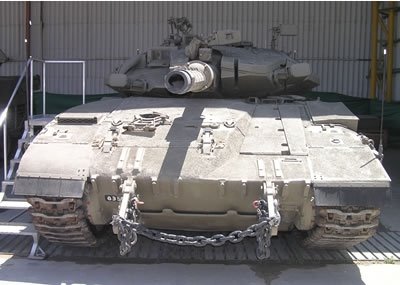
A Merkava Mk 3The view now – according to DefenseNews - is that the tank acquitted itself well in the recent fighting, not only in its primary role but in support missions such as escorting infantry, delivering supplies and even extracting battlefield casualties. The tank, therefore, is expected to evolve into a multi-purpose vehicle and its continued production looks assured.

Not only is the tank version undergoing a transformation, however, the Israelis are funding a project to develop the Merkava chassis into a dedicated armoured personnel carrier, called the Namera, building on their experiences with the Puma and its limitations.

All this is happening though at a time when the British Army is undergoing a major transformation, cutting back on its heavy armour and planning to replace much of its capability with medium-weight, wheeled armour, under the aegis of the £14 billion FRES programme, all to fit in with the EU concept of the European Rapid Reaction Force.

One can only marvel at the thought that the two armies which are most actively engaged at the sharp end with so-called "asymmetric warfare", in deadly counter-insurgency campaigns are opting for more and heavier armour while the British military establishment, imbued with the ethos of European integration, is going the other way.

A Namera APCBut, if the choice of equipment is suspect, what about the costs? One of the main disadvantages of the Israeli Namera, we are told, is the cost – at a cool $750,000 each. But that, in sterling, is £398,631 (at current exchange rates) yet this compares with £437,000 each for lightly armoured Pinzgauer trucks.

No one is saying that the Namera would be the most appropriate equipment for the British Army in Afghanistan – although I suspect that some commanders would not turn them away if they were offered them – but surely the MoD can do better than spend nearly half a million for a truck that offers little if any better protection than that afforded by a "Snatch" Land Rover.

Then, as we have reported before, while there is a crying need for tactical helicopters in both Iraq and Afghanistan, the MoD is committed to buying the " future Lynx" at an average cost of £14.2 million each, which means that they cannot be brought into service until 2014. Yet, the US Army is quite content with the well-proven Kiowa variant, at less than £2.3 million each.

The 'Panther' - at £417,000, more expensive than the NameraAll this and much more (such as the near £200 million on 400 useless Panthers – which cannot be used in Iraq - see also here) suggests that, not only is the MoD buying the wrong equipment, it is also paying far too much for what it does buy – the worst of all possible worlds. It also suggests that the problem is much more complex than the simple issue of "underfunding".

On the one hand, we have committed far too much on equipment that is of no use for the current campaigns and, on the other, much of what we do buy for the respective theatres is either overly expensive, under-performing or too late – or any combination of the three.

Echoing Booker's lament in his column last week: "Oh, for a properly clued-up media and an Opposition worthy of the name," we urgently need a properly informed debate both in Parliament and in the media.

Steve Bell in The GuardianWe have no great hopes of the former and, as for the latter, even if there were journalists around who were capable of understanding the issues, the likelihood is that they would not be allowed to write even half-way detailed stories (as we found to our cost here). Their editors, wedded to their dumbed-down diet of political soap operas and Diana-esq, human interest stories, can rise to the occasional cheap quickie - after the event – (or the occasional cartoon) but would judge detailed analyis too "boring" for their precious readers.

Thus is the public condemned to ignorance and, as we keep pointing out, the consequences are all too evident. Ironically, during the early '80s, when the killer disease AIDS made its appearance, the Department of Health advertising slogan – to increase awareness – was "don't die of ignorance". Decades later, this looks to be the fate of many of our soldiers. The horrible reality, though, is that it will not be their ignorance which does for them – but ours.

COMMENT THREAD

Thursday, 29 June 2006

Jam tomorrow...

A Lynx helicopter on patrol in Basra - an increasingly rare sightA critical shortage of battlefield helicopters reported last year is to remain, year while the MoD commits to a long-term £1 billion project to buy 70 helicopters – averaging £14.2 million each – which will not be in service until 2014. This is at a time when the Army is down to six Lynx multi-role tactical helicopters in the whole of Iraq and desperately needs more capability.

The Americans, on the other hand, are paying in the order of £3.6 million each for their OH-58D Kiowa Warrior armed reconnaissance helicopters, which are providing invaluable service in supporting US troops in Iraqi counter-insurgency operations.

Their value has been graphically recorded by the award-winning free-lance war correspondent, Michael Yon, who writes of his first-hand experience as an embedded reporter in some of the "hottest" areas of Iraq. Of the Kiowa, in the battle for Mosul, he wrote:

A US Army Kiowa - Sometimes, they fly so low they are practically lawnmowers
Intelligence warned that another car bomb was looking for us, so the soldiers decided to go hunting for it. American helicopters were helping with the search and a Kiowa flew so low that we could literally have hit it with a rock at times. By flying so low they can spot threats to us, but the danger to the pilots is severe: for instance, a Kiowa was just shot down near Baquba, killing two Americans. One of the helicopters with us started taking fire. I heard a pilot on the radio asking if we needed him, he wanted to land, check for holes quickly and get back in the air. A soldier said to me, "I love those guys".
More generally, he posted another account where he describes how soldiers on the ground hold their helicopter pilots in extreme regard, writing, "I've never heard a real combat soldier calling pilots 'fly boys' or anything disrespectful." "Sometimes," he adds, "they fly so low they are practically lawnmowers. One Kiowa pilot came so low that I could read the time on his watch in the photograph. I was not using a telephoto lens. Just a 50mm prime."

This is highly relevant to the current controversy about the inadequacies of Snatch Land Rovers as even the most ardent advocate of better armour protection for our troops will agree that any effective strategy for defeating the insurgents is multi-tiered. And there are few better weapons than light tactical helicopters which can escort patrols and convoys, scouting ahead to warn of potential ambushes and to attack insurgents when they break cover.

A Kiowa watching over a Stryker APCWhen the shortage of helicopters was again raised in the House of Lords by Viscount Brookeborough in May this year, he noted that, at the height of the troubles in Northern Ireland, we had 72 helicopters in operation in the province.

Lord Drayson – none other than he – denied that there was a shortage of helicopters, only then revealing that the total number of helicopters in Iraq was two Chinooks, eight Sea Kings, seven Merlins, five Pumas and six Lynx, 28 in total, with all but six being transport helicopters.

However, what we once again see with this MoD contract is "jam tomorrow" and nothing today. The new helicopters will be a central component of the EU's fantasy European Rapid Reaction Force and, in good European style, will be built by the Italian owned Finmeccanica subsidiary AgustaWestland. But when it comes to the real army, currently engaged in combat, the troops must go begging.

Kiowa photographs stolen from Michael Yon, for which theft he will undoubtedly sue me.

COMMENT THREAD

Tuesday, 27 June 2006

We've been there before

The aftermath of a mine attack in RhodesiaYesterday, Parliament finally woke up to the scandal of the inadequately armoured Land Rovers used by our troops in Iraq. In defence questions, the Conservatives mounted a spirited attack on dismal Desmond, the current secretary of state for defence.

It is a measure of the inability of the clever-dicks to understand the issues involved, though, that all we got in the print media was a tiresome little piece from The Times. That was in the form of a parliamentary sketch by Ann Treneman, which did not even begin to do justice to the subject.

As I research this issue more fully – rather in the manner of peeling an onion – the stakes, which were always high – now seem stratospheric. The real issue, when you think about it hard enough, is whether we take the current campaign in Iraq to be representative of further campaigns, or whether it is an aberration and in no way typifies the tasks that will confront our Army in the future.

An early Rhodesian mine protected patrol vehicle - the 'Cougar'Trying to answer that question is not easy but all the signs are that Iraq does represent the future. And, if that is the case, then we have to confront the stark reality that our armed forces have the wrong structures, the wrong equipment, and the wrong tactics.

To gain some insight into this, I have been revisiting the "liberation" struggle in Rhodesia where, like the insurgents in Iraq, the guerrillas' weapon of choice was the landmine and the IED. It has, in fact, been speculated by some that more vehicles in then Rhodesia struck landmines during the seven year war than by all the Allied forces in Europe in WWII from D-Day until June 1945.

The figures are stark. Between December 1972 and January 1980, 2405 vehicles struck landmines, 632 people were killed and 4,410 were injured. By the end of the war, things had escalated to such a degree that between 5-6 vehicles were hitting landmines every day.

The Stryker armoured patrol vehicle showing the anti-RPG slatted armourThis is set out in a remarkable narrative, which offers some fascinating photographs of the types of countermeasures which were developed (an examples of which is shown above), the basis of which are currently being applied by US forces in Iraq but, significantly, not by the British. An extract from a technical manual also shows how the scientific principles are well understood, further reinforcing how ill-equipped British forces are.

But, if mines and IEDs are the greatest threat to our forces, they are not the only one. We learnt today of an attack on British forces in Afghanistan, in which two British soldiers were killed after a rocket-propelled grenade – no doubt the ubiquitous RPG7 - destroyed their vehicle.

The Kiowa light tactical helicopterThis weapon itself is derived from the German Panzerfaust of World War II vintage, which was a deadly killer of tanks. But, even then, Russian troops had devised their own home-made remedy, one which caused some surprise as victorious T-34s rolled into Berlin in 1945 bedecked with spring mattresses, looted from German houses. It had been found that the coiled springs prematurely triggered the shaped charge of the Panzerfaust, disrupting the projectile and causing it to expend itself against the tank armour.

This has found its modern format in "slatted armour" which can be seen on American Strykers (pictured above left) and British Warriors but, inevitably, cannot be applied to lightly armoured vehicles. Countermeasures here, therefore, remain a major technical challenge for military vehicle designers.

Part of the answer, though, is not in passive protection but the use of UAV escorts for convoys and patrols and also by using light tactical helicopters as escorts to warn of impending ambushes. The both, and particularly the latter, can also intervene in firefights, the US using, amongst other things, the light Kiowa helicopter (a militarised version of the Bell Jet Ranger - pictured above right) to such effect that troops have declared their pilots "honorary infantrymen" because they fly so low as they "mix it" with insurgents at close range.

Humvee air-defence trucks converted to use as 'gun trucks'Against RPG7 ambushes and the ever-present threat of suicide bombs, drivers of explosive-laden vehicles ramming trucks in a convoy, the US have also revisited the Vietnam war where, to counter convoy ambushes, they devised "gun trucks" able to lay down high rates of accurate fire against attackers. And only this week, we learnt that an updated version of this idea was becoming available, an air-defence Humvee converted to the "gun truck" role (pictured above left).

It is by contrasting the US measures with the British that illustrates quite how reluctant the British government is to invest in the Iraqi war and the safety of our own troops, but increasing political and media pressure may change that. But, in order to do the job properly, the government is going to have to recognise that it can no longer afford its grandiose schemes of equipping a rapid reaction force and divert that funding to the here and now requirements of counter-insurgency.

And strangely, if it does, it will be adopting many of the weapons and tactics pioneered by colonial settlers in Rhodesia who learned the lessons the hard way. We could do no better than to recognise their skills and apply them in the current theatre of operations, not least because, if Iraq is the way of the future, we will need them again.

COMMENT THREAD