Monday, 26 June 2006

Coffins on wheels

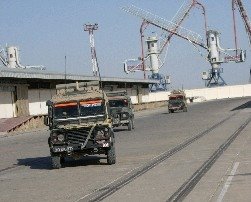
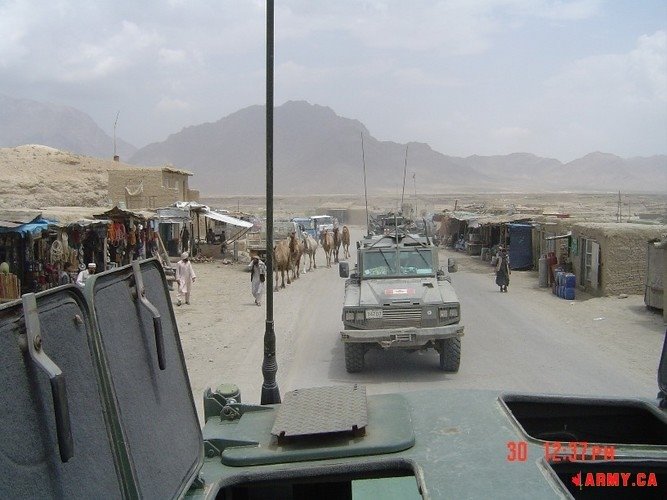
A Canadian RG-31 on patrolAn energetic discussion on the issue of force protection for our troops in Iraq is being conducted on the unofficial Army forum, together with our own forum and a particularly pompous intervention from Mick Smith on his Times blog.

The Smith piece is worth noting as it is a classic example of "clever-dickery", combining establishment thinking with know-it-all superiority, a condescending attitude and a basic lack of fundamental research, all with a complete failure to put the story in its broader political context.

Of course, the RG-31s are 'too big for Basra', where only Land Rovers can goHeaded, "too big for Basra" it takes on the themes which finally emerged in The Sunday Times yesterday, with the opening declaration that, "No-one should suggest or suspect that either Tony Blair or Gordon Brown wants British soldiers to die needlessly." Smith then adds, "The senior British Army officers who are trying desperately to find a solution to the problem certainly do not want soldiers to die needlessly."

That is the establishment line but, as has been rehearsed on our forum, the deaths arise in part as the consequences of decisions made by Tony Blair (and, one presumes, Gordon Brown). Whether they want soldiers "to die needlessly" is not the point. The fact is that some are and the reason is that money which should have been put urgently into devising counter-measures for IEDs is being spent on equipping a fantasy army for the European Rapid Reaction Force.

Similarly, although we can accept that "senior British Army officers" are "trying desperately to find a solution" – and we can certainly accept that they do not want soldiers to die needlessly – that again is not the point. Those senior officers, first and foremost, have to work within the budgetary constraints set by the MoD so their "desperation" is heavily qualified by the amount of money they have available.

Thus, when Smith then moves on to ask, rhetorically, "So why three years after the problems with IEDs first surfaced in Iraq are our troops still dying?", he has already conditioned the debate to exclude the main reasons for the situation.

Instead, we get a knowing but unsubstantiated assertion, combined with heroic name-dropping, with Smith recruiting Brigadier Bill Moore, Director Equipment Capability (Ground Manoeuvre), to his cause.

Moore is "in charge of the programme to get a new vehicle", and says the MoD had done "a significant amount" to improve the situation and “was continuing to try to do so”. I love that word, "significant" and use it all the time. It is the King of weasel-words because it implies "an awful lot" but is in fact meaningless. In fact, it actually means "not an awful lot", otherwise one calls a spade a spade, and says, "a great deal". But then, we know a great deal has not been done because troops are still patrolling in lightly armoured Land Rovers.

Nevertheless, the Warrior, at three times the width of the Land Rover, is idealThen comes the spin. The "use of heavy armour had to be balanced with the need for soldiers to interact with local communities," says Moore. Yup… we agree. And if "Snatch" Land Rovers are too dangerous to use so you end up patrolling in Warriors and Challengers, for want of an intermediate vehicle like the RG-31, what price interacting with local communities, Mr Moore?

But that question is neither posed nor answered. Instead, Brig. Moore argues that protection from threats (such as IEDs) is 30 percent equipment, 60 percent tactics, techniques and procedures and 10 percent luck. Again, this is more weasel words. For sure, avoidance of IEDs requires that mix – although the precise mix ratios can be argued over – but when all that has been accounted for, and an IED goes off next to a vehicle, whether the occupants survive is 100 percent equipment.

Nevertheless, Moore claims that, "We work constantly to ensure that our tactics, techniques, procedures and equipment meet the demands of the operational environment. We have done a significant amount to enhance existing equipment and continue to do so."

But that is a matter of opinion, and Moore does not substantiate his claims. As I point out on the Unofficial Army forum, a successful counterinsurgency strategy is more than a question of improved armour for patrol vehicles. Looking at the measures available, I argue that the vital role of humint (human intelligence) could be enhanced. We know that the Army has cut down on language courses for troops being deployed to Iraq, but we definitely need more native language speakers. There could be more funding for informers and rewards and even such incentives as offering British citizenship and an emigration package to those informers who put themselves in harms way to assist HMG.

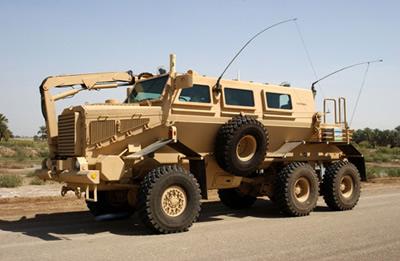
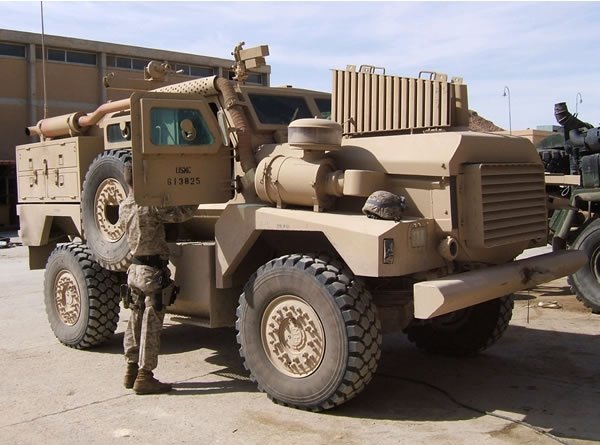
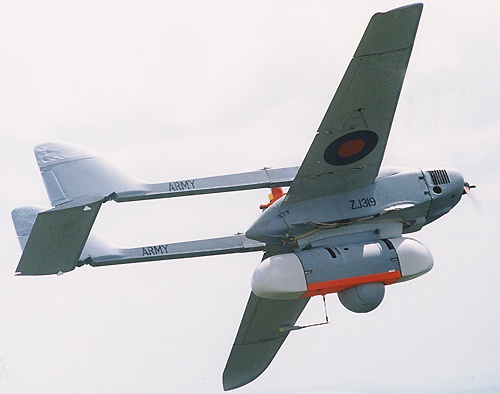
The Buffalo - IED hunter extraordinaireIn terms of terms of technical countermeasures, we need greater use of UAVs – which are very limited in the British sector, but which the US are exploiting with great success. On the horizon are techniques like "environmental exception mapping", using computer-aided analysis to compare "before and after" video films taken by UAVs, to pick up things like disturbed soil by the side of a road, which might indicate that a bomb has been hidden there. Then there is an urgent need for more light helicopters, the current fleet of Lynxes being described as "knackered" and far too few in number. Then we could certainly employ vehicles such as the Buffalo and Cougar to hunt out IEDs.

Yet, as far as we know – and we know a great deal – nothing like this is happening in the British occupied sectors.

But finally, Mick Smith down get down to money, but in a mealy-mouthed way. We have an RAF Chief of Defence Staff, he writes:

Air Chief Marshal Sir Jock Stirrup is a good man but I wonder how he would defend the cost of the RAF’s expensive Eurofighter/Typhoon aircraft, large numbers of which we don’t need, alongside the amount of money allocated to Moore to try to sort out the problem of the inadequate armour protection on the Snatch Land Rover.
But then comes yet more spin. "The simple truth," adds Smith:

…is that putting a large amount of armour on a small vehicle is extremely difficult. The British Army looked at a number of different options, including the Nyala RG-31, a South African mine-protected vehicle produced by BAE Systems. Ministers say that – at just 50 cms wider than the Snatch Land Rover - it is not manoeuverable enough to be used in the streets of Basra, has then wrong profile for peacekeeping and that an earlier version was used before by the British Army in Bosnia where it proved to have maintenance problems.

The army used it in Bosnia for "route-proving", quite literally going out in front of a convoy and using the safety of its protective armour to ensure that there were no landmines on the route. The "maintenance problems" were in fact caused solely by attempts to put heavier armour on it. The engine and suspension couldn't cope with the extra weight.
The "route proving" bit is wrong, and so is the comment about "maintenance problems", but never mind.

Smith then remarks that the Canadians have bought the RG-31 for use in Afghanistan but, strangely, does not mention that the US has bought 148 for use in Iraq for protection against IEDs. "Ministers still defend the decision not to go for the RG-31," he then tells us, "It might have proven effective against land mines. It might be good enough for the Canadians. You might even be able to get it on the ground very quickly. But its profile is all wrong and it's just that bit too big for Basra."

That is the impression we are left with… "it's just that bit too big for Basra." But, of course, the Warriors and Challengers are not – and they really do have the right profile, don't they.

Now, as we reported quickly, earlier today, the secretary of state for defence, Des Browne has stated that he has asked for a review of the Land Rover question. For once, Tory MPs have done their stuff, Roger Gale MP having demanded in defence questions to know what vehicles are being considered to replace them.

With success possibly on the horizon though, now is the time to step up the pressure, not least to make sure the right decision is made. As Smith points out in his piece:

Earlier this year, as the British prepared to deploy to Afghanistan's southern Helmand province, the Taliban began copying the insurgents in Iraq using the same sort of IEDs. The need for a vehicle that had improved armour protection above that afforded by the Snatch Land Rover became increasingly urgent and ministers agreed to pay £35m for 80 armoured Pinzgauer Vectors as part of an "Urgent Operational Requirement".
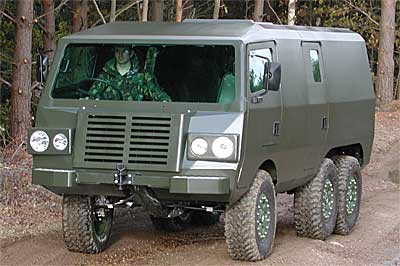
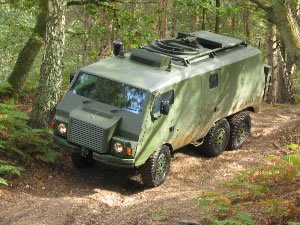
The Pinzgauer - a 'coffin on wheels'?This is where Smith displays his ignorance and lack of research. The Pinzgauer is not a patrol vehicle but a 14-seat troop transport.

Furthermore, the level of protection is no greater than the "Snatch" and, with its slab sides and flat floor, it is not a mine protected vehicle. It is described as being designed "to withstand two NATO L2A2 hand grenades detonating simultaneously only 150mm below the floor pan. These grenades would normally carry a lethality radius of 5 metres." Compare and contrast the RG-31 specification, which can withstand the equivalent of two anti-tank mines exploding simultaneously under any wheel – 14Kg of TNT - or 7Kg under the cabin.

In March of this year, 14 US Marines and a civilian interpreter were killed when their amphibious assault vehicle struck an IED about a mile south of Haditha, Iraq. The "Amtrak", as it is known, affords a level of protection similar to the armoured Pinzgauer. And one feature of these lightly protected vehicles is that an IED may penetrate one wall but not have the force to break through the second, the armoured enclosure thus containing the blast with fatal consequences to all the occupants.

These Pinzgauers, far from making troops safer, could end up being "coffins on wheels". When it comes to new patrol vehicles for Iraq, therefore, the MoD cannot be trusted to make the right decision. The battle must continue.

Tip of the iceberg

The heart of enemy territory - the MoD building in LondonThis weekend, I had dinner with a very senior politician – one who had had direct and prolonged experience of the innermost workings of the Ministry of Defence and close working contacts with prime ministers.

Amongst other things, my politician confirmed that which we have worked out for ourselves , that there is, and has been for many years – before even the Blair regime – a "Europe first" defence procurement policy. However, I heard details of how this extends right through the procurement process to a degree which is quite staggering. Quite deliberately, at times, inferior, old fashioned and more expensive European equipment is bought, even where the more modern and effective equipment from the United States is actually cheaper.

What confuses the outside observer, though, is that the MoD is riven with factional infighting between competing tribes and not a few purchasing officers have found ways of circumventing the policy and breaking the "Europe first" rule. This allows gainsayers to leap triumphantly on the few exceptions and dispute its existence, even though it is well established and supported at the very highest level.

But what also emerged was confirmation of the thesis that we ourselves on this blog have been struggling to put together – that there are two separate and distinct defence policies being conducted by this government. The one – to which all the resources are being devoted is the "European" defence policy while the poor relative is the "trans-Atlantic" policy which is at its most visible in our support for the US-led coalition in Iraq.

When this is put together with the flurry of media coverage over the weekend about equipment inadequacies, we are able to draw the incontrovertible conclusion that the government is simply not prepared to finance the war effort in Iraq. Further, so poor is the equipment and so lacking in numbers are our troops, that we are able to draw down increasing evidence from the public domain that, into order to minimise politically embarrassing casualties, the Army has ceased to play any effective role in the policing of Southern Iraq.

Many areas of Basra and Al-Amarah have thus become "no go" areas to British patrols because they are simply too dangerous, leaving our presence confined to the safer and less populated areas in what is now a token operation. This is spelt out in some detail in the Independent on Sunday yesterday, which reports that British forces are facing rising violence among Shia Muslim factions in southern Iraq, but are powerless to contain it.

The paper also adds that both British and Iraqi authorities were seeking to play down the situation – each for their own reasons. For the British government, it is keen to project a charade that the Iraqi authorities are gaining in strength and competence so that it can hand over to them and declare "mission accomplished", bring the troops back in "triumph".

The reason for the inadequacy of the British forces is, as we continue to report, primarily due to the priority given to equipping the European Rapid Reaction Force. The essential problem is that the equipment required to take on and defeat the counterinsurgency is so specialised that it has no place in the EU's air-portable rapid reaction force structure. Set on withdrawing from Iraq at the first possible opportunity, the government is simply not prepared to invest in specialist equipment which will get limited use and will then not be suitable for the EU force.

We have seen already how this is putting our soldiers lives at risk, through the MoD insistence on keeping wholly inadequate Land Rovers in place, but this is only the tip of the iceberg.

This is brought to the fore by that stupid and ignorant piece in The Sunday Telegraph where correspondent Sean Rayment is quivering with excitement over the emergence in theatre of something entirely new to him, "the armour-piercing 'explosively formed projectile' or EFP, also known as a shaped charge." This, the excited Rayment tells us, "fires directly into an armoured vehicle, inflicting death or terrible injuries on troops inside."

And what particularly gets Rayment worked up is his "discovery" that, "Government scientists have established that the mines are precision-made weapons which have been turned on a lathe by craftsmen trained in the manufacture of munitions," probably originating from Iran. He tells us that, "a source from the American military, who has been working closely with British scientists, said that the insurgents have perfected the design of the weapon and know exactly where to place it to ensure maximum damage to coalition vehicles."

A TMRP-6 'shaped charge' mineThe ignorance manifest in this piece is simply demonstrated by the fact that these weapons are not at all new. As we have reported before, they appeared in Bosnia in the early 90s, in the form of the TMRP-6 mine.

The fact that it is called a "mine", however, should not be allowed to confuse the situation. The Serbs not only buried these devices, but became adept at fixing them to the walls of buildings alongside roads or hanging them from telegraph poles. Ready to be triggered by passing vehicles. In other words, these devices were being used in exactly the same way as Rayment's "explosively formed projectile" (which is exactly what they were), with like effect.

Nor indeed are these the most deadly devices in the Iraqi theatre. Not least of these is the standard BK-29 HEAT-MP round, a 125mm Russian shell used by the T 72 tank. In dumps and caches all over Iraq, there are estimated hundreds of thousands of these shells, already in the hand of insurgents. One of these shells, suitably positioned, and detonated by a remote device, can easily take out an Abrams or Challenger Main Battle Tank and, indeed, several Abrams have been lost to these and similar devices - one only last month.

Further, given that only an estimated 20 of the devices have been brought in, compared with 11,000 roadside bombings in Iraq last year (compared with 5,607 in 2004), this is by no means the devastating problem that Rayment makes it out to be.

It can be no accident, though, that Rayment believes this type of device to be "new" as other journalists are reporting the same thing, which suggests that are buying government "spin" on this. Together with what appears to be government-inspired propaganda that there is somehow no defence against it, this "spin" is particularly wicked.

So well known is this type of threat that, in April 1999, the then under-secretary of state for defence, John Spellar, actually hosted a press briefing on it. And, as we know, by then, successful counter-measures had already been developed.

But, by allowing ignorant and gullible journalists to run away with the idea that this is somehow a new and different threat, the government absolves itself from any failure to protect our troops from it and, by implying that there is no defence against, calls for introduction of counter-measures are sidestepped.

Once again, we are back where we started. Introducing counter-measures in theatre would be expensive and the money is already spoken-for. In order to pursue European defence integration, therefore, it is more expedient to let troops die, especially – as my political informant told me – the MoD is confident that it can always rely on an ignorant and indifferent media not to report the facts.

COMMENT THREAD

Sunday, 25 June 2006

The greatest enemy

A UAV picture of roadside bomb ambush in Iraq
So far this week, we've run an unprecedented five stories on a single topic, the unnecessary deaths of British soldiers from roadside bombs in Iraq, due to the inadequacies of their equipment. We started with this one, with follow-ups here, here, here and here, pointing out that, had the MoD provided our troops with armoured RG-31 patrol vehicles, some of our soldiers, like the more fortunate Americans pictured below, could have survived.

Today, the Sunday Times takes on the issue with an editorial headed: "Pay up and save lives", which we reproduce in full here:

It is of course a hugely sad matter that the toll of British soldiers killed in Iraq has been growing steadily to reach its current total of 113. Every military death is a blow for the country and a tragedy for the family and friends of those who fall victim. So it is reasonable to assume that the Ministry of Defence will do all it can to prevent the deaths or injuries of our troops. including providing them with the best weapons and armour to do such a dangerous job.

Now we learn that British soldiers have been patrolling the streets of Iraq in Land Rovers that offer almost no protection against lethal roadside bombs. Nearly a quarter of British soldiers so far killed in hostile action have been the victims of roadside bombs and were patrolling in these so-called "Snatch" Land Rovers. The vehicles, some up to 20 years old, were shipped to Iraq from Northern Ireland, where they were used to police a very different and much less bloody conflict. Their bodywork and floors offer only thin protection against the improvised explosive devices used by the insurgents. Aware of this, the terrorists have started to target the Land Rovers and the risks of more fatalities are increasing every day.

We would naturally expect the ministry to do something about this. Far from it. The bureaucrats are digging in. It is not as if there is no alternative. The RG-31, an armoured Land Rover built by BAE Systems, is being used by the Americans and the United Nations. Some deaths from roadside bombs can never be prevented but other countries’ soldiers seem better protected.

Complaints about inadequate equipment have dogged the British mission from the start. When Sergeant Steve Roberts was shot two years ago it emerged that the protective vest he should have been wearing was not available. The six military policemen killed by a mob three years ago had antiquated radios and inadequate ammunition. The scandal over Land Rovers not fit for their purpose is just the latest sorry example of Whitehall warriors sending our fighting men badly protected into the field.
This is in a week when the Tory Diary blog has been discussing such vital issues as a new logo for the Conservative Party and an interview between the Boy King and Jonathan Ross.

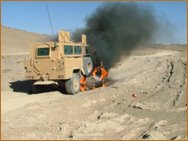
An RG-31 after a roadside bomb attackThe contrast perhaps speaks volumes for contemporary politics when even a defence debate in the Commons goes unnoticed by the chattering classes. Fortunately, the Sunday Times did not share the values of the "modern compassionate" Conservatives. In addition to its editorial, it has published the Land Rover story on its front page and also devoted a full-page to a focus analysis. The story cites a certain Richard North, "an author and internet blogger" who has been campaigning over the failure to invest in heavily armoured vehicles. He says:

It was an incredibly crass decision to reject the RG-31 and shows yet again the MoD's knack of creating a disaster of every procurement decision. The looked at whether to stick with cheap, second-hand Land Rovers that were not safe to use in Iraq at that time, or buy a vehicle that would save lives. What did they do? They stuck with the Land Rovers.
The crew escape unhurt - the caption to the photo is 'Thank you RG-31'The Times story follows in the wake of The Sunday Telegraph, with Christopher Booker continuing the story he started last week. Moreover, this is clearly an issue with which the public clearly empathise, the two lead letters in the Telegraph supporting the calls for better equipment.

That does not, incidentally, stop the Telegraph's dim excuse for a defence correspondent, Sean Rayment, pursuing his own line that "the policy of using Land Rovers" is due to the lack of Warrior MICVs. This, he admits, is a claim the Ministry of Defence denies, a denial that has substance as no knowleageable person will argue that the Warrior is a suitable patrol vehicle. And, at three times the width of the Land Rover, it most certainly cannot gain access to many areas in urban environments.

Nevertheless, for those who want to understand more about the real enemy which is threatening our democracy, this is a good starting point. Clever Dicks and Tory politicians, it seems (with some notable exceptions) need not bother.

COMMENT THREAD

Saturday, 24 June 2006

The ministers must lie

The Alvis 8 in Bosnia - claimed by Drayson to be an RG-31
Not that you would have known it from the MSM but, on Thursday there was a debate in the House of Commons on defence policy. You would have thought that a switched-on opposition could have made considerable political capital from the issue raised on this blog about the inadequate protection for our troops against roadside bombs, but there was not a squeak from the Conservative front benches.

It was left to a Tory back-bencher, therefore, to raise the issue. This was Lee Scott, MP for Ilford, North, who noted that:

The American soldiers and marines in Iraq have access to RG-31 Nyala mine-protected vehicles which enable the crew to survive the blast of an improvised explosive device. Canadian troops deployed in Afghanistan also use RG-31s. British soldiers and Royal Marines need to make do with lightly protected Land Rovers. That is not acceptable.
Traditionally, the minister responds to such points at the end of the debate but, before he could do so, Ann Winterton, another Tory back-bencher intervened. Addressing Adam Ingram, the minister of state directly, she posed a question "about equipment connected with Afghanistan":

As our forces appear to be winning the firefights in Afghanistan, does he expect those who oppose our troops there and in other theatres to revert to the use of improvised explosive devices? If so, what vehicles are our forces to be equipped with to counter the threat?
Because it was an "intervention", Ingram answered immediately and, from this you can see the way questions do not get answered. His response is a classic example of evasion - pure extruded verbal material:

We have been very effective in Afghanistan. We have a potent force in the Apache attack helicopters. We are up against intelligent and capable enemies, whether in Afghanistan or Iraq, and we know that they will continue to look for ways to attack land-based vehicles or air-based platforms. We have a lot of measures in place. The hon. Lady will understand that it is not appropriate to discuss all the detail, but where we identify a threat - be it a new or technological threat - we identify a quick way to deal with it. Sometimes that takes time as we come to understand the threat before developing the technical response. Our focus at all times is the protection of our personnel, whether it involves fixed-wing aircraft, helicopters, land-based systems or maritime systems.
So, don't you worry your pretty little head, dear. "Our focus at all times is the protection of our personnel".

At the end of the debate came the summing up by the parliamentary under-secretary of state for defence – there's glory for you - none other than Mr Tom Watson. He had an opportunity to deal with the Land Rover issue but chose to ignore it. Instead, what we got was:

Firstly, we need to ensure that our people, who do a magnificent job, are properly looked after. Secondly, we need to ensure that they have the equipment that they need to do the difficult and dangerous things that we ask of them. Our success depends above all else on our personnel…
And then…

They are making a unique and valuable contribution to help to bring peace and security to Afghanistan, Iraq, the Balkans, Northern Ireland and elsewhere in the world. I know that our debate will have reassured them that we have their best interests at heart and are all working to ensure that they have the finest support from the British Parliament.
I am not sure that our personnel will be that reassured, but I suspect not. According to the latest edition of Private Eye, British troops in Basra were distinctly underwhelmed by defence secretary Des Browne on his inaugural visit last month "Smug, sleek and fat - and every inch a New Labour apparatchick" one of them informed the magazine.

The hero of the hour, however, was a young squaddie who, while Browne was meeting and greeting, asked what he knew of the military. "Not much," the minister admitted, "but what do you know about politics?" "Well," said the soldier, "I can lie well".

Clearly, that is an essential attribute for a defence minister. Our picture above is further confirmation of the lie uttered by Lord Drayson on 12 June during the House of Lords debate. "We had 14 RG-31s in Bosnia, which we took out of service some time ago due to difficulties with maintenance." This is an official MoD photograph and the caption reads:

SFOR, Bosnia, April 1997: Alvis 8 Mine Protected Vehicle (MPV) of the Royal Engineers.
The Alvis 8 is the Mamba, an early version of the design from which the RG-31 was developed, and further developed, the current version being the Mk III. To imply, on the basis of a different vehicle, in service nearly ten years previously, that a current type is unsuitable is clearly dishonest.

Furthermore, we are unable to get any confirmation for the minister's claim about "maintenance difficulties". We have in fact been contacted by a soldier who was serving in Bosnia who actually drove the short-wheel-base version. His comments were:

…it was a pretty old fashioned vehicle with a 4 speed manual gear box, a huge delay on the steering, nightmarish brakes that really struggled to get the thing to stop (air brakes but the poorest I've ever come across). All in all it was a real challenge to drive, I got to love it in the end, but it put off many a driver during its time. It had its good points, the separately fuelled heater (easily coped with the Balkans winter), the sound of it, and of course it carried as much kudos as any vehicle in Bosnia!
Separately, we learn that decisions to use "Snatch" Land Rovers in Iraq have caused officers "untold anguish and mental suffering" because they knew "how vulnerable they were". One source told us that, "I have seen very senior commanders cry because of the decisions that have had to be made."

Being Army, they have no choice but to use the equipment with which they are provided, and to carry out the tasks assigned. Ministers, therefore, have a special responsibility "to ensure that our people… are properly looked after". But, they are not doing so. All they are doing is uttering cheap platitudes.

But, if they admitted the real reasons why troops were being ordered to use equipment that their officers knew was dangerously vulnerable, there would be a public outcry. Thus, the ministers must lie.

COMMENT THREAD

Thursday, 22 June 2006

"Mobility and protection"

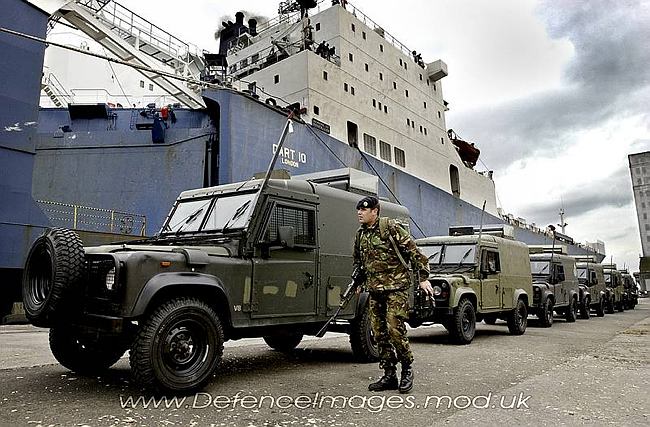
Continuing with our theme of how Blair is killing our soldiers, with this follow up, and this, we have found some remarkable MoD photographs of the despatch from Belfast of the "Snatch" Land Rovers and their arrival in Umm Qasar on October 2003 (double-click to enlarge), with the original MoD captions:

Snatch Land Rovers on the dock in BelfastDateline 11 September 2003: A row of armoured Land Rovers line up in preparation to board a merchant vessel in Belfast Harbour, on the first leg of their journey to Iraq. Bound for Iraq 178 armoured Land Rovers shall be leaving Belfast bound for Iraq. The Land Rovers, all drawn from reserve stock or currently surplus to requirement in Northern Ireland, will give much needed and potentially life-saving protection to army patrols in southern Iraq.

The Land Rovers on arrival in IraqDateline 4 October 2003: 180 armoured Land Rovers arrive at the Iraqi port of Umm Qasar. The wagons were delivered on Dart 10, a chartered roll-on roll-off ship. British peacekeeping troops will use the new batch of armoured Land Rovers alongside the dozens of civilian all-terrain vehicles already in use. Some of the vehicles await collection after being offloaded from the Dart 10 ship.

Snatch Land Rovers on patrol in BasraWith a daub of sand-coloured paint, the vehicles were soon put into use patrolling the streets of Basra and in other British occupied areas in what was to become known as "occupation-lite". But, if the Brits thought they knew counterinsurgency better, this year the light-touch was seen to go badly wrong as violence erupted in the streets and the militias ran riot. But, as lightly-armoured Land Rovers proved to be inadequate for the task, the MoD was not to be moved, hence:

Dateline 12 June 2006: Lord Drayson. My Lords, I do not accept that Snatch Land Rovers are not appropriate for the role. We must recognise the difference between protection and survivability. It is important that we have the trade-offs that we need for mobility. The Snatch Land Rover provides us with the mobility and level of protection that we need.
Yet, having dumped second-hand and distinctly battered "reserve stock" vehicles, and those "currently surplus to requirement in Northern Ireland" into the middle of a shooting war in Iraq, nothing was too much for our gallant lads who were set to joint the European Rapid Reaction Force. For them, the very best in Italian-built chic:

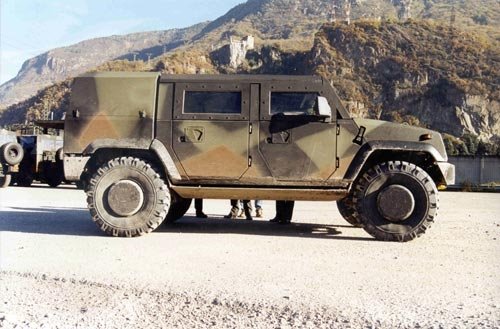
The Iveco Panther Command Liaison Vehicle
Dateline 6 November 2003: Lord Bach. We are pleased to announce that the Ministry of Defence has today signed a contract worth £166 million (including VAT) with Alvis Vickers Ltd, for the manufacture of the Future Command and Liaison Vehicle (FCLV).

The FCLV will perform the command and liaison role and replace the ageing and disparate vehicle fleet within the manoeuvre support brigades comprising elements of the 430 Series, Saxon, Land Rover and Combat Vehicle Reconnaissance (Tracked) fleets. From its planned in-service date of 2006, the FCLV will provide levels of crew protection and mobility commensurate with their roles in an increasingly extended ground manoeuvre area. It will offer protection against small arms, blast and anti-personnel mines.
There we have it – at £413,000 apiece, these are the Rolls-Royce of military SUVs, the very latest in fashion accessories for the image-conscious commander. Meanwhile, the peace-loving Swedes had different ideas:

The Swedish RG32M - called the Galten
Dateline 19 May 2005: South Africa's leading armoured and peacekeeping vehicle manufacturer BAE Systems Land Systems OMC has scored another export success with FMV, the Swedish Procurement Agency, confirming a production order for 102 specialist RG-32M patrol vehicles valued at close to ZAR 180 million.
At a mere £152,000 each, the Swedes are well-chuffed to have acquired the latest in mine-protected vehicles for their peacekeeping forces. The picture shows the vehicle being put through its paces by a Swedish motoring journalist, who declared himself "impressed". But such luxuries are not for our troops in Iraq. According to Lord Drayson, "The Snatch Land Rover provides us with the mobility and level of protection that we need."

COMMENT THREAD - JOINT POSTS

Wednesday, 21 June 2006

Canaries down the mine

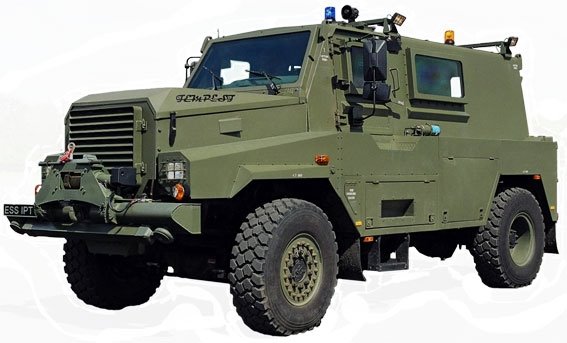
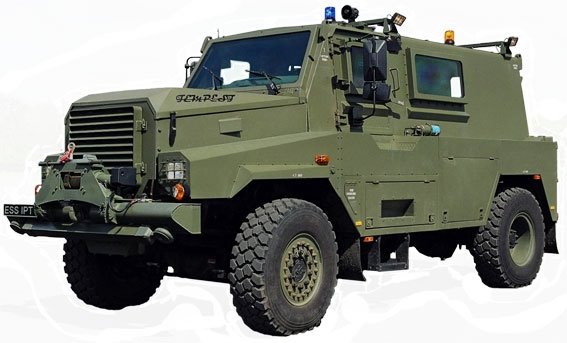
The British version of the Cougar - aka 'Tempest'According to the Rt Hon Adam Ingram MP, minister of state for defence, "we take all measures possible to ensure the safety and security of our troops deployed in Iraq". This is in response to an MP who had passed on a constituent's letter (a former serving soldier) expressing concern about "the safety of so-called armoured Land Rovers".

On the face of it, Ingram's statement is an out-and-out lie, except that in the weasel words that flow so easily from the civil service, to be signed off by their ministers, there is an important qualifier, in the use of the word "possible".

To the ordinary person, that word might encompass every measure known to man, certainly anything technically feasible, but in the dark halls of Whitehall, it would also include the issue of "affordability". Straight out of "Yes Minister", you can almost hear their honeyed words: "There is nothing allocated in the budget, Minister, so acquiring enhanced protection for our troops is not possible".

From there it is an easy step to write to the public, grieving relatives, worried parents, MPs and the rest, telling them: "…we take all measures possible". In strict terms, it is not a lie – but then it is not the truth either.

However, as we research this issue more deeply, inevitably the labyrinthine complexity emerges and what seems at first sight a straightforward black-and-white question of providing better armoured vehicles for our troops merges into complicated arguments about tactics, procedures, training and capabilities.

It is in this grey area that ministers are able to operate, obfuscating the issues and confusing readers of their letters, in which manner does Ingram soothingly declare, "mitigation measures are not just about equipment – all our forces undergo a comprehensive package of pre-deployment training to ensure that they are as prepared as possible for the specific operational environment they will encounter".

The sub-text, of course, is that it is not just about spending more money. In fact, implies the minister, our superb training, etc., etc., will prevail. Carefully does he avoid telling us, however, how any amount of training will protect a soldier in a lightly armoured vehicle from the blast of a concealed IED, triggered by an unseen operator.

It is here, therefore, that we pick up on the emerging story, broached in our two previous posts, here and here, which – on the basis of what we have so far found out - seem to show up the British at their very best and their very, very worst.

The Buffalo mine clearing vehicleBy way of background, we need to explore what is currently happening in the US-occupied areas of Iraq, where the scourge of the IED accounts for a full 68 percent of the battle casualties. To counter this threat, the Americans have been, since 2004 and now in increasing numbers, deploying new equipment, the Buffalo mine clearance vehicle (right) and the Cougar HEV/JERRV series (below left), together with the RG-31 series.

Bear with me briefly on the technicalities, but the basic strategy is, acting as a team, these vehicles are sent out onto the roads of Iraq to hunt out mines and IEDs and to destroy them. Then, as a final stage before the any particular road is cleared to allow ordinary patrols down them, the Cougar travels down it in a process known as "route proving" – on the basis that, if there is anything there, the mine protected vehicle will take the hit and the crew will survive.

Now, the thing is that this technique seems to have been pioneered not by the Americans but by the British in Bosnia, as early as 1999-2000. This is why the Mambas were purchased. But, even more intriguingly, it was there that the greater threat of the "penetrator mines" emerged, which led the development of British-funded counter-measures and the order of eight Cougar mine protected vehicles, in what is known as the Tempest project.

This, incidentally was in December 2001, in what appears to be the very first order for such vehicles, more than three years before the US forces placed their orders. Furthermore, the vehicles were upgraded to protect against the new mine threat. In other words, in a pioneering piece of research and development, we emerged with world-beating techniques and equipment, years before our more technically advanced cousins.

However, while the Americans have so far bought 122 Cougars - and have over a thousand more on order - we bought eight. I do not know yet whether they were deployed in Bosnia, but they do appear to have been sent to the Gulf, although I can find absolutely no reports of their having been used. According to one report, however, the vehicles are back in the UK being refurbished, prior to their despatch to Afghanistan where, it is claimed, the mine hazard is greater.

At a point, therefore, when the IED threat in the British occupied sector of Iraq is probably at its highest, the life-saving equipment pioneered by the British has been withdrawn, while the Americans are introducing it en masse, adopting precisely the tactics which our own Royal Engineers developed. You really could not make this up.

A Land Rover patrol in BasraIn the meantime, I have been sent an extract from the Regimental Journal of the King's Royal Hussars, which gives a graphic account of their recent deployment to Iraq. From this emerges that the current tactics adopted – unwittingly – are brutal and primitive. Quite simply, the troops are told to patrol their areas in lightly armoured Land Rovers until one or more of them are blown up. Then the Land Rovers are withdrawn and replaced by Warriors and Challenger tanks, until it is deemed safe to resume patrolling in Land Rovers again.

In effect – although they do so uncomplainingly – our soldiers are being used a "canaries down the mine" in a tactic redolent of the Red Army, in which punishment battalions were sent into minefields to clear the way for the assault troops.

Challengers and Warriors on patrol in Al-AmarahFrom a more strategic point of view, this means that the Army can no longer function effectively. While Warriors and Challengers do provide additional protection, as the King's Royal Hussars report testified, their use "caused a major change in the way the Squadron operated, limiting the distances we could cover and the routes we could use." At one point, movement in "Snatch" Land Rovers was "deemed too dangerous" in Al-Amarah and helicopters had to be used to lift fully crewed Land Rovers out to the Iranian border where the Squadron was responsible for conducting patrols.

Returning, therefore, to Mr Ingram's claim that "we take all measures possible to ensure the safety and security of our troops deployed in Iraq", clearly this is not the case. The equipment and techniques do exist and, since the US forces introduced them, their casualty rate from IEDs has halved.

The problem is that Mr Ingram does not have the money. The government is happy to commit £14 billion to the FRES programme, and billions more on other equipment to provide our component of the European Rapid Reaction Force but that leaves nothing extra for the forces in Iraq. To spend a few million on new kit for them is simply not "possible".

COMMENT THREAD

Tuesday, 20 June 2006

The wheels on the truck go round and round…

British Army Mambas in Bosnia

Following my post on Sunday on How Blair is killing our soldiers, the story – if at all possible – gets murkier and murkier. Before proceeding, however, I must thank all those website and blog owners who linked to the piece and the many readers who responded and are taking action. I will keep you abreast of the responses they receive.

And so to the story as we left it on Sunday, with an account of how Lord Drayson, the defence procurement minister, on 12 June this year had dismissed the idea of buying the mine protected RG-31s to replace the "Snatch" Land Rover. Not only did he assert that the "Snatch" provided us "with the mobility and level of protection that we need", he informed the House of Lords that:

We had 14 RG-31s in Bosnia, which we took out of service some time ago due to difficulties with maintenance. We have looked at the RG-31 alongside a number of alternatives for our current fleet and concluded that the size and profile did not meet our needs. Size is important in the urban environment. The RG-31 cannot access areas that Snatch Land Rovers can get to.
According to the minister, therefore – and there can be no other construction from his words – the RG-31s were basically too large for the "urban environment", hence the choice of the smaller Land Rovers.

Well, as it happens, we have found a photograph of the "RG-31s" used by the British Army in Bosnia, which is reproduced at the top of this post. In fact, they were not RG-31s but Mambas, an earlier version of the vehicle – and even then they were not the standard body. They were, in fact, a rare, short-wheel-base version, variously known as the "Commanche" or "Acorn", converted by Alvis PLC, the British owner of the South African manufacturer. You can judge for yourself from the photograph how much of a handicap the size of these vehicles might be.

However, since "the size profile" did not meet the MoD needs, it was decided to replace the vehicles and, around 2002, an alternative vehicle was in the process of being procured. We know this because there was a Parliamentary Question on 5 February 2002 by Mike Hancock, Lib-Dem MP for Portsmouth South, from which we learn that the replacement was called a "Tempest". These were to be used for:

...casualty evacuation and route proving operations where mines are present and provide high levels of protection from anti-tank/personnel mine blasts.
Dr Moonie, who answered the question, was extremely reticent about the price, withholding information "in accordance with Exemption 7a(2) of the Code of Practice on Access to Government Information, which relates to information whose disclosure would prejudice commercial or contractual activities."

The Tempest MPVAnyhow, we also managed to find a photograph of the Tempest (left)and some details from the Royal Engineers website. Known officially as "Truck, Mine Protected Vehicle" (MPV), as readers will discern from the picture, this is based on the chassis of an articulated truck. The Royal Engineers describe it thus:

The MPV, formerly known as Project TEMPEST. The planned role of the MPV is route proving and casualty evacuation (CASEVAC). The donor platform for the cab and chassis services is the Peterbilt 330 articulated tractor unit. The front and forward rear axles were removed and replaced by a Marmon Herrington 4 Drive conversion. MPV is a modified Commercial Off the Shelf (COTS) equipment procured against an Urgent Operational Requirement (UOR) and replaces the MAMBA vehicle fleet of the mine protected vehicles. The vehicles were assembled by Technical Solutions Group in the USA with the UK EOD specific requirements incorporated by Supacat Ltd.
The MPV in actionThus we see the MoD, having decided that the Mambas were too big, decided to replace them – at unspecified expense – with a truck at least four times the size, buying fewer of them into the bargain, for use in exactly the same role. And so desperate was their need that they bypassed the normal competitive contract process and acquired the equipment against an "Urgent Operational Requirement".

Now it begins to get interesting, and not a little murky as we follow two separate threads.

First, we follow Technical Solutions Group. It is owned by a US company, Force Protection Inc, which currently manufactures a range of mine protected vehicles for the US Army and Marine Corps. More of this company later but what is most interesting at this stage is one particular member of the management team, a certain Murray Hammick (below left), who joined the company on 12 February 2004.

Murray HammickAlthough on the company website as late as 6 June this year, he has suddenly disappeared from the line-up. But, through the marvels of the Google cache system, his details are still accessible, and fascinating reading they make. As "Vice President, Integrated Logistics Support":

Before joining Force Protection, Murray Hammick owned and managed UK-based Seafire Ltd., developers of specialist military vehicles; he was centrally involved in the 2001 sale of the Tempest MPV to the UK MOD. He was head of business development for UK defense contractor Alvis Vehicles Ltd, handling sales, marketing and new product development roles involving the UK MOD, US DOD, NATO, and the UN. He set up and managed the first international transfer of mine-protection technology out of South Africa covering the Mamba series of MPVs, and was ground forces editor for Jane's International Defense Review from 1990-93.

Mr. Hammick is a retired British Army major. He served over 24 years in regular and reserve armored and airborne units and ran armor anti/armor research trials. Mr. Hammick holds a bachelor of science degree, and formal qualifications in military design & technology.
From a separate website, we also see that Hammick's job was to oversee and co-ordinate all projects at both Force Protection and its wholly owned subsidiary, Technical Solutions Group, reporting directly to Michael Watts, the Company's then CEO.

We also learn from this website that Hammick not only won the contract to sell MPVs to the British Army but, while working for Alvis, had been appointed Product Manager, responsible for developing two armored vehicles and one Special Forces vehicle. He subsequently established Seafire Limited and went on to win a number of contracts, including some in partnership with TSG and Supacat.

What this demonstrates is that the very technology that went into the Mamba and subsequently the RG-31 was exploited by Hammick and used in the production of the Tempest, for which the British taxpayer paid a no doubt handsome – if unspecified - price. We also know that, armed with the knowledge of that design and the experience of having built the vehicle, Hammick joins Force Protection.

With that under our belts, let us now follow the second thread – the Tempest itself. A search for information on this vehicle eventually leads you to this site, a general site on "vehicle protection". However, it does have an entry for the Technical Solutions Group (TSG), under which is an active link marked "Tempest". When you click that, you arrive here.

The Force Protection CougarSurprisingly, there is no mention at all of the Tempest. The page is headed "Cougar", a mine protected vehicle made by none other than Force Protection Inc. Furthermore, helpfully, there is a picture of the Cougar (right). As you will see, for all intents and purposes, the Cougar is the Tempest, designed and paid for by the British taxpayer and handed on a plate to the American company by Mr Hammick.

Force Protection is doing very well out of the deal. Not only has it already sold a considerable number of Cougars to the US forces, it has teamed up with none other than our very own BAE Systems to produce a variant called the Iraqi Light Armoured Vehicle, acquiring a recent contract from the US Army worth $180 million for 378 models, which could increase to $445.4 million for 1,050 vehicles, if all options are exercised.

From all accounts, the money will be well-spent. The USMC who already have the equipment, speak very highly of it. In addition, one crew gave written testimony to Force Protection of how it had undoubtedly saved their lives:

The Cougar after an IED hit
Just wanted to write a quick note to all of you at your company to thank you for the hard work you put into the Cougar vehicle. We are stationed in [omitted] Iraq and about 2 weeks ago our JERRV Cougar ran over [deleted] mine coming back from a call downtown. It had been raining that night and the mines were placed in a hole filled with water. Right after the explosion, the Cougar was driven for two miles on the three remaining tires at speeds in excess of 20 mph so that we could make it to a safe area.

Once we got to the safe area we were able to survey the damage and everyone was amazed how far the vehicle had driven. The three of us inside were all okay other than slight concussions and a headache that lasted a few days. We know that if we had been in another type of vehicle that the outcome would have been much worse. We were also able to get a replacement Cougar within 24 hours. Thank you for everything and keep up the good work.
If that does not tell the story, the photograph (above) provides adequate evidence of the life-saving capability of this remarkable machine. And, unlike the RG-31s where, since their introduction, three vehicles have been destroyed by IEDs and enemy action, with five fatalities, as of June 2006, with more than 130 Cougars and the similar Buffalos in Afghanistan and Iraq, the vehicles have taken about 1,000 IED hits without a loss of life.

So far, therefore, we see a life-saving vehicle, designed and developed at the expense of the British taxpayer, being successfully introduced into the US forces, while our own defence procurement minister declares that a much smaller vehicle, based on the same technology, is far too big for our troops. They must continue to use lightly armoured "Snatch" Land Rovers. Of the eight Tempests still presumably in service in the British Army, we know nothing of their whereabouts.

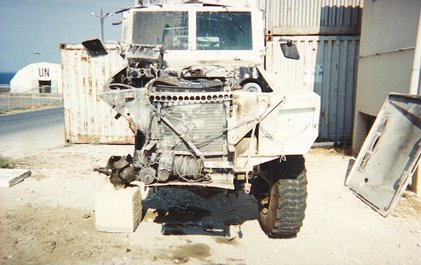
A Land Rover after a mine explosionIncidentally, when researching for what amounts to the first part of this story, I was puzzled by the absence of photographs of Land Rovers that had been hit directly by IEDs. I have since found one from a different conflict and can now see why. After a hit, there is often nothing left but smouldering wreckage, barely recognisable as a vehicle – compare and contrast (above right) with the picture of the Cougar above.

Even with this, though, the story does not end. To complete the saga we must go back to the British Army Mambas in Bosnia – those which the MoD was so eager to dispose of.

The Alvis ScarabWhile in the Balkans, the Army came across a new and more deadly type of mine – the TMRP-6 "shaped charge" mine - for which the Mambas provided no defence. A South African technology company therefore was commissioned to design counter-measures which were applied to the Mambas.

The lessons learned, however, did not stop there. Applying them and the technology that went into the RG-31, Alvis PLC set about building as a private venture a brand new, state-of-the art armoured patrol/ reconnaissance vehicle which emerged as the Scarab (above, left).

This vehicle was then offered to the MoD in the 2001 competition for the Army's Future Command and Liaison Vehicle (FCLV), alongside the RG-31 and its smaller brother, the RG32M and the Fench-designed ACMAT. We covered this competition extensively in earlier posts, here, here and here. Without revisiting all the details, suffice it to say that the MoD introduced another vehicle to the competition, the Italian-built Iveco Panther (below, right), after the shortlist had been closed in breach of its own rules. It then went on to select it as the winner, paying £166 million for 401 vehicles, equating to £413,000 each.

The Italian-built Iveco PantherAnd, as we now know, the MoD civil servant who was "the only person to have been intimately involved in this programme from initiation to contract award," a Mr Andrew Simpson of Bath, now works as a consultant for the Italian manufacturer.

Although a mine-protected vehicle in its own right, it is unlikely that Mr Simpson's Panther was any match for the Scarab – which has since disappeared after Alvis was taken over by BAE Systems. It is now marketing the Panther after it had been awarded the MoD contract for it.

While the Scarab, in its patrol or reconnaissance configuration, could have provided a valuable additional tool in both Iraq and Afghanistan – and given state-of-the-art protection - the Panther, barely if at all adequate as a command/liaison vehicle, would make a poor patrol vehicle. Not that the troops are likely to be given the opportunity to try it out. It is designated for the medium armoured brigades which are to form the heart of the British contribution to the European Rapid Reaction Force, in which Tony Blair has invested so much political capital.

With the money spent on this and other extravaganzas, there is no money left in the defence budget for new kit. British troops must make do with their lightly armoured "Snatch" Land Rovers. The US troops, on the other hand, can enjoy the comfort and security of their Cougars, designed and developed at British taxpayers' expense. But hey! What price soldiers' lives when European defence integration beckons?

COMMENT THREAD

Sunday, 18 June 2006

How Blair is killing our soldiers

A US RG31 after it has been hit by an IED.  The five-man crew survived
According to the official MoD website, as at 28 May 2006, a total of 113 British Forces personnel have died, or are missing presumed dead, while serving on Operation TELIC since the start of the campaign in March 2003. Of these, 84 are classed as killed in action, including as a result of hostile action.

Of those 84 dead, at least 23 – more than a quarter – have been killed riding or patrolling with unarmoured or lightly armoured "Snatch" Land Rovers, the most common cause of death being the improvised explosive device (IED), better known as the "roadside bomb".

A Land Rover patrol -backbone of the British effort in IraqThe incidents that I have been able to cull from the internet are as follows:

  • 14 August 2003: Two Queens Lancashire Regiment soldiers wounded and one – Captain David Jones – killed in bomb attack on a converted Land Rover military ambulance in Basra.
  • 18 November 2003: MoD spokesman Charlie Mayo reports two man crew of one Land Rover injured in one of four booby trap bomb attacks over previous seven days.
  • April 17 2004: Two Territorial Army soldiers shot in Basra and another soldier lost a leg when his Land Rover was hit by a rocket-propelled grenade.Another Land Rover patrol - note the confined spaces
  • 18 April 2004: Three PWRR soldiers injured, one seriously, in roadside bomb attack on Land Rover in Amarah.
  • 26 April 2004: One soldier injured by roadside bomb attack on six vehicle supply convoy in south east of Basra. Witnesses said the injured soldier was evacuated by helicopter.
  • 28 June 2004: Fusilier Gordon Gentle, 19, from Glasgow, died when a bomb exploded next to his Land Rover in Basra. Two others were injured.
  • 9 August 2004: Five soldiers from Prince of Wales Royal Regiment were injured and one – Private Lee O'Callaghan – was killed in attack on vehicles in Basra. Two Land Rovers were set on fire after militiamen fired rocket-propelled grenades at the patrol.
  • 28 September 2004: Two soldiers – Corporal Marc Taylor, Royal Electrical & Mechanical Engineers, and Gunner David Lawrence, Royal Artillery – killed when military convoy ambushed south-west of Basra. The two soldiers killed had gone to the aid of injured colleagues whose Land Rover was hit by a rocket propelled grenade (RPG).The aftermath of an attack - note again the confined spaces
  • 2 May 2005: One soldier injured and Guardsman Anthony John Wakefield 24, from the 1st Bn Coldstream Guards, killed during routine two vehicle armoured Land Rover patrol in Al Amarah.
  • 29 May 2005: Lance Corporal Alan Brackenbury of The King's Royal Hussars killed from an improvised explosive device in Kahla, near al-Amarah. He was in an armoured Land Rover, one of three vehicles heading to a liaison meeting with representatives of the Iraqi security forces. Four other soldiers were injured in the explosion.
  • 16 July 2005: Two soldiers injured and three killed - Second Lieutenant Richard Shearer, Private Leon Spicer and Private Phillip Hewett - all from the 1st Battalion the Staffordshire Regiment, during three vehicle armoured Land Rover night patrol in suburb of town of Al Amarah, 160 miles north of Basra.
  • 5 September 2005 A roadside bomb killed two British soldiers travelling in an armoured Land Rover in southern Iraq. The device exploded as a convoy passed through a mainly Sunni Arab district five miles east of a British army base known as Shaiba. The two dead soldiers were from the 2nd Battalion Royal Regiment of Fusiliers, based in Lisburn, Northern Ireland.And another burnt-out wreck - and confined spaces, once again
  • 11 September 2005: Three soldiers were injured and Major Matthew Bacon was killed when an armoured Land Rover was hit by an IED in Basra.
  • 20 November 2005: Four soldiers injured, one very seriously, in bomb attack on routine two vehicle armoured Land Rover patrol in northern Basra. Sergeant John Jones of the 1st Battalion The Royal Regiment of Fusiliers died in the attack.
  • 31 January 2006: Whilst on a routine patrol in Umm Qasr, the vehicle that Corporal Gordon Pritchard was commanding was struck by a roadside bomb; he died instantly. Three other soldiers were injured, one seriously, in the same incident and received medical treatment at Shaibah medical facility.
  • 28 February 2006: Two British soldiers were killed and another injured when their Land Rover was blown up by a roadside bomb while on patrol in the Iraqi town of Amara. The three soldiers were from 2nd Battalion The Parachute Regiment attached to the Royal Scots Dragoon Guards. The improvised explosive device is believed to have been hidden in an abandoned car which exploded when the soldiers passed on routine patrol.
  • 16 April 2006: Lt Richard Palmer, 27, of the Royal Scots Dragoon Guards was killed when his Land Rover was targeted by insurgents using an off-road mine near the town of Ad Dayr. Lt Palmer's unit, which was attached to a Danish battle group, was on vehicle patrol with the Iraqi army when it was attacked.And the all too common tragic result
  • 13 May 2006: Two British soldiers died after a roadside bomb attack in southern Iraq. The soldiers, from the 2nd Battalion Royal Anglian Regiment, were on routine patrol in an armoured Land Rover just outside Basra when the device exploded. The roadside bomb exploded as the patrol approached a bridge just north of Basra. A third soldier was injured in the same incident.
  • 28 May 2006: A British Army patrol from 1st The Queen’s Dragoon Guards (The Welsh Cavalry) was attacked by a roadside bomb in the Al Jezaizah district of North West Basra. The explosion hit an armoured Land Rover patrol on a routine task in support of the Iraqi Security Forces. The incident killed two members from A Squadron: Troop Leader Lieutenant Tom Mildinhall and Lance Corporal Paul Farrelly.
  • Collectively, the Land Rover incidents are the single most common cause of death for our soldiers in Iraq, yet - in our view - they are largely preventable. In today's Sunday Telegraph, based on research carried out by this Blog, Christopher Booker explains why they are allowed to happen.

    "One reason why British troops continue to be killed and injured in southern Iraq", he writes, "is that they are expected to patrol in lightly-armoured Land Rovers which give them no protection against roadside bombs and rocket-propelled grenades." He continues:

    Meanwhile their American counterparts walk away unscathed, even when their RG31 armoured patrol vehicles are hit by the same explosives, because these are designed to protect them against precisely the same dangers. Yet the Ministry of Defence has not seen fit to equip the British Army with the RG31, even though it is built by a British-owned company.
    That self-same RG31 is pictured at the top of this piece – taken at Camp Taqaddum, Iraq on 7 January 2006 by a photographer from the 8th Engineer Support Battalion, 2nd Marine Logistics Group. It is resting on its front axle after an improvised explosive device detonated under the vehicle the day before. The IED detonated directly under the vehicle; however, because the vehicle was an RG-31, the blast was pushed outward instead of straight up due to the unique v-shaped undercarriage. Of the five service members in the vehicle, two received concussions and two others received minor burns.

    Before continuing with Booker it has to be said that the government's procurement minister, Lord Drayson, does not agree that the RG31 should be used, or that there is anything wrong with the "Snatch" Land Rover. In the House of Lords on 12 June this year, in response to a question by Lord Astor of Hever, this is what he said:

    My Lords, I do not accept that Snatch Land Rovers are not appropriate for the role. We must recognise the difference between protection and survivability. It is important that we have the trade-offs that we need for mobility. The Snatch Land Rover provides us with the mobility and level of protection that we need.

    We had 14 RG-31s in Bosnia, which we took out of service some time ago due to difficulties with maintenance. We have looked at the RG-31 alongside a number of alternatives for our current fleet and concluded that the size and profile did not meet our needs. Size is important in the urban environment. The RG-31 cannot access areas that Snatch Land Rovers can get to.
    Another survivor - a mine-damaged UN RG31You may accord to Lord Drayson's statement any value you wish but it is germane to note that the vehicle is widely used in the world's trouble-spots, to which effect, one of its enthusiastic users, the United Nations, reports:

    The RG-31 "Nyala" mine and bullet-protected vehicle (MPV) with high mobility ease of handling and good crew comfort has been successfully deployed with the UN in Bosnia and Lebanon. It has become the MPV of choice of the UN and other peacekeeping and security forces and is finding favour with nongovernmental organizations requiring vehicle with nonaggressive appearance to protect their personal against the threat of landmines.
    More to the point, in addition to the United States which has purchased 148 for use in Iraq, the Canadian forces have bought 50 for use by their detachment in Afghanistan, with an option for another 25, having previously deployed three as part of their contribution to the International Security Assistance Force in Afghanistan.

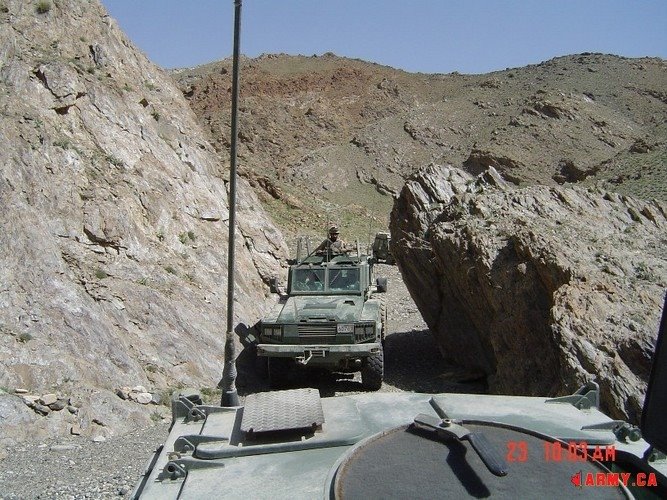
    A Canadian RG31 in Afghanistan - and in confined spacesThe vehicle was selected after a tightly-fought contest with other mine protected vehicles and, in the view of one commentator, won the contract because: "Familiarity aside, the RG-31 had advantages that all but ensured victory in the CF's APV contest – proven performance in a range of climates and terrains, relatively small size."

    Known variously as the "Mamba" and "Nyala" in Canadian service (the two are, in fact, different although very similar vehicles, the latter being the RG31), it has attracted the enthusiastic plaudits of its users. Says one:

    Having spend lots of time in both the Mamba as a Recce Driver on Palladium Roto II and the Nyala as the Engr Recce Sgt on Athena Roto III, I can't think of a more well rounded, safer and rugged vehicle.
    and another…

    Almost every contingent I worked with would have given their left arm for a Nyala, including those riding around in open top G-wagons. Open top vehicles bristling with weapons are no deterrent or concern to a pressure plate IED or a Spider Device initiated by a Cell Phone or FRS from a safe distance. The only CF Troops in the Kandahar area that require open top soft skins already have them. So if you really want to ride around in one, start doing your application for the farm.
    Lord Drayson offers no explanation as to what the "difficulties with maintenance" were, although it is hard to understand why they should have been intractable, since the vehicles used (Mambas) had running trains based on the widely-used Mercedes Benz Unimog and the design employs many readily available commercial parts.

    Another Canadian RG31 patrolAs to the importance of size, and Drayson's claim that, "the RG-31 cannot access areas that Snatch Land Rovers can get to," once again you can judge for yourself from the photographs provided. Altogether, we prefer the explanation that the Army is being short-changed, fobbed off with cheap, second-hand Land Rovers, designed for security operations in Northern Ireland and totally unsuited for Iraq.

    Returning to Booker, he writes:

    This is a small but chilling example of the extraordinary shambles the MoD is making of Britain's defences, thanks not least to the way Tony Blair is trying to pursue two totally contradictory policies at the same time, This has not been properly appreciated because media coverage of defence has become so scrappy that we have lost sight of the overall picture.

    We hear, for instance, about prosecutions of British soldiers for supposed "human rights abuses", the abolition of ancient regiments and some of the more ambitious defence projects on which the MoD is spending tens of billions of pounds, such as the Eurofighter or the two giant aircraft carriers planned for the Royal Navy. But no one fits all the pieces of this jigsaw together.

    On one hand, as we saw yet again with his recent visit to Washington, Mr Blair tries to keep in with the Americans, by committing thousands of hard-pressed and ill-equipped British troops to fighting the insurgencies in Iraq and Afghanistan. Bush and Blair still like to talk of keeping alive the Joint Strike Fighter project, the last major example of Anglo-US collaboration on military hardware.

    On the other, as we saw again with his subsequent visit to President Chirac, Mr Blair has stealthily agreed to Britain playing a key role in the planned European Rapid Reaction Force. For this he and the MoD have been prepared to restructure the British Army, scrapping the old regiments, and to commit colossal sums to buying every kind of European equipment, as well as those giant carriers we are to build with the French. All this is to meet the "Helsinki goals" agreed by EU leaders including Mr Blair in 1999, by which an integrated European defence force is to be brought about.

    For the MoD, the top priority has been to get on with meeting those Helsinki commitments, co-ordinated by the European Defence Agency in Brussels, headed by a former senior MoD official Nick Witney, which will enable us to play our part in creating that EU expeditionary force. To this end the MoD has been prepared to spend billions on EU-made missiles, ships, trucks, artillery and armoured vehicles, not to mention a French-led project to build unmanned aircraft which Blair discussed with Chirac earlier this month, following Britain’s withdrawal from a similar joint-project with the US.

    But what this has left is a British Army starved of proper resources for its current tasks, so overstretched that it must rely on thousands of territorial soldiers, its morale sapped by the dangerous lack of proper equipment and by the MoD's insistence on enforcing the European Convention on Human Rights in situations to which it was never intended to apply.

    The real problem is that all this has been so hidden away behind layers of stealth and deception that no one ever asks any longer that fundamental question: what are our armed forces for? Behind the scenes, the driving force of national policy is to fit us to play our part in building up a European expeditionary force, capable of operating anywhere in the world. But no one can explain the purpose of such a force, for essentially it has only one: to promote the cause of European integration.

    This leaves us, in an increasingly darkling world, with forces ill-designed to protect any national British interests. Indeed, so dependent are we now becoming on equipment bought from our EU partners, including our most basic guns and ammunition, that it will soon be inconceivable that we could operate without their consent.

    Meanwhile our armed services, which until recently we still prided ourselves on being the most professional in the world, are being asked to perform dangerous tasks, knowing that they no longer have much practical support from a Government bent on exploiting them politically, for purposes they find it increasingly hard to understand.

    When the final charge sheet is drawn up against the way Mr Blair governed this country, one of the most damning charges will be the way in which he destroyed its armed forces. Yet the remarkable thing will be how almost nobody at the time noticed it was happening.
    Booker's final comment hits the nail on the head. We have tried to get senior Conservative MPs interested in this issue with very little success. And, apart from Booker and The Business, it is proving impossible to get the media interested.

    Well, people, this is an opportunity to test the power of the blogs. We have not done this before, but I would ask other blogs to link here and for readers to print off this post and send it to their MPs, with their own comments. As I wrote in the heading, this is truly a matter of life and death. Our view is that our troops are being needlessly exposed to danger and they deserve better. We hope you agree.

    COMMENT THREAD

    Saturday, 3 June 2006

    Are we a nation of mummy's boys?

    Maj Gen Andrew RitchieI am sure Maj Gen Andrew Ritchie, the retiring commandant of Sandhurst – with a pint in his hand and in decent company – would have some quite interesting views on the fate of the British Army. Short of that, a knowledgeable media interviewer could, I am sure, elicit some interesting observations, that would be worth reading.

    That could have been a task for the Daily Telegraph but, instead they sent one of their girlie reporters to talk to him, in this case the stunningly ignorant Rachel Sylvester – with predictably dire results.

    It thus takes forever to get past the "human interest" garbage – the General is taking a plumbing course… yeah! – and the compulsory trivia about the Royals, before we get to a half-way illuminating comment. With four officers who graduated from Sandhurst during Gen Ritchie's time having died in Iraq in the past year, recruitment, says Ritchie, is being damaged – something the MoD has always denied.
    "There's a 'mum' factor," says the General. "Mums find Iraq deeply unpopular. They are concerned that their youngsters will be exposed to real risk and danger. And mums are hugely influential in boys and girls joining the Army."

    That is a worrying development, if kids are making up their minds on the basis of what "mum" thinks, which certainly suggest something of a "mummy boy" syndrome afflicting our society. Such a nation cannot survive long as a credible military power if parents cannot let go, and the prevailing ethos is to avoid military commitments because of the risk of casualties. Would we, for instance, have fought Hitler in such circumstances?

    In this context, there was a highly relevant commentary in the Telegraph's letters yesterday which touches on a debate which has yet to be seriously aired in the mainstream media.

    A Land Rover 'Snatch' in IraqThe letter is from Martyn Pocock, of Oakham, Rutland who records his sadness at the deaths of more of "our gallant servicemen who were serving with distinction in Iraq" and then goes on to write of his "despair, consternation and outrage" on reading yet again on the MoD website that the deaths were as a result of an improvised explosive device attack on "armoured Land Rovers".

    "On how many more missions will our troops have to go in vehicles that were essentially designed for Northern Ireland?", Mr Pocock asks. "How many more deaths will there be before the government is held to account for not providing the money for equipment that is fit for the role?"

    He then concludes, "The 'Snatch Land Rover' may have been armoured in the context of Northern Ireland, but it certainly is not in the context of Iraq and Afghanistan."

    It would have been very interesting indeed to have heard Gen Ritchie's views on this subject, and I am sure his answers would have been highly illuminating, except that, if Sylvester put such questions to him, neither questions nor answers were published. More likely, the girlie Rachel would not have the first idea what a "snatch" was, other than a street mugging where she lost her handbag, and would not have even thought to have asked about something so "technical".

    But it is issues like these that go to the heart of our defence strategy. They beg the question that, if we are to commit our troops to what Ritchie calls a "counter-insurgency situation" and, because of the "mum" factor, we are not prepared to sustain losses, how should we equip them, and at what cost?

    The armoured Pinzgauer - destined for AfghanistanNor even are those easy questions to answer. Mr Pocock implies that we should have better armoured vehicles and, certainly, the MoD has got the message with the emergency purchase of 80 armoured Pinzgauers for our detachment in Afghanistan – although there is no hint of or troops in Iraq being similarly equipped.

    But one has to ask whether armoured patrol vehicles are necessarily the answer. We have seen in the US area of operations the progressive introduction of up-armoured Humvees, the insurgent response to which has been to increase the power of their roadside bombs and to use shaped charges which are capable of defeating the heaviest of armour. Then, there is the ever-present threat of the RPG, which can destroy an armoured Pinzgauer.

    The risk is, of course, that the Army, in seeking to protect its troops, gets locked into an increasingly expensive spiral of measure and counter-measures, building ever-more better armoured vehicles, only for the insurgents to deploy even more lethal weapons and tactics. But the greater possible risk is that, as they are encased in ever-thicker layers of armour, the troops become even more insulated from the populations they are policing. They then lose the battle for "hearts and minds" that is at the heart of any counter-insurgency effort.

    A US Buffalo - an armoured 'minesweeper' - deployed in IraqTaking a more holistic view of the problems presented by the complex counterinsurgency challenges of Iraq, the US has come to realise that there must be a multi-layered response. At the high end, this includes the use of unmanned aerial vehicles to patrol the roads and detect suspicious activity, to heavily armoured "minesweepers" such as the Buffalo, which can investigate roadside packages, and artillery radar to pinpoint hit-and-run mortar attacks.

    At the low end, there are all manner of activities, from foot patrols, liaison and goodwill visits, training missions and what is known collectively as "humint" – human intelligence - the use of informers and the local population to provide detail on terrorist activities and their whereabouts.

    It is here, in the absence of much of the "high-end" equipment that the Americans enjoy. that the British are supposed to excel, with their "soft hat" patrols and their rapport with the local population. But, as we know, the situation has gone belly-up in Basra. It is best described as "tense" leaving our troops ill-equipped to deal with the hostilities.

    Here, though, it is not just a question of our troops being provided with inadequate equipment – or none at all. For instance, the MoD has drastically reduced its expenditure on language training so that most troops about to embark receive only a two-hour language "familiarisation" lecture. What price "hearts and minds" when you cannot speak to people in their own language and have to rely entirely on translators?

    If our government wants the Army to do a job, then it must provide it with the right equipment and ensure that troops have the right skills and capabilities – and are present in numbers sufficient for them to be able to fulfil their tasks. And therein lie those central questions. What do we actually want our troops to achieve? What equipment and skills do they need to perform? And are we prepared to pay what it takes, both in blood and wealth?

    These are important questions. Mr Pocock touched on one aspect of them but the media does not seem interested in expanding on them or adding to them. Instead, we get told about the "mum" factor, while the media retreats into banalities and trivialities. But, if we really are becoming a nation of "mummy's boys", should we be there at all? Should we have an Army at all, or would we be better off joining with the "soft power" Europeans, and let some real men (and women) do what is needed?

    COMMENT THREAD

    Friday, 2 June 2006

    Bizarre

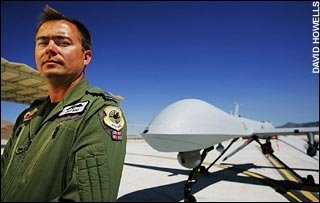
    Preening with the Predator - the Telegraph 'take'We have remarked on several occasions on the "Boys Own" tendency in the media, in the way they treat defence issues. A better example of this could hardly be found than in a gushing two-page spread in the news section of the Telegraph today, chronicling the deployment of Predator UACVs by the RAF in Iraq.

    Apart from the fact that this is hardly news – the MoD has been leasing Predators from the US for the best part of two years, to my recollection – such is the superficial nature of the story that it lacks any of the analytical bite that might be expected of a serious newspaper. It might, for instance, have questioned why it is that the UK finds it necessary to hire UAVs, in which event it might have stumbled on the much more interesting story of the abysmal failure of Britain's own programme.

    This is the story of the Phoenix, a drone with such embarrassingly poor hot weather performance that it failed entirely to deliver. Yet, oddly enough, this was reported by the Telegraph in November 2002, which told us that an upgrade to allow high temperature operations had been cut "to save money", something that the paper then branded "ill-considered".

    The flight of the Phoenix - notIt is due that that "ill-considered" economy that we had to go cap-in-hand to the Americans to lease Predators, until the Phoenix replacement comes into service – the Watchkeeper - not expected until 2010 at the earliest, at a cost unspecified yet likely to be substantial.

    And only hinted at in the Telegraph story is the problem that the Predators are regarded as "theatre assets" so that, while we are paying for the leases, and making our own personnel available to operate them, they are tasked according to coalition priorities, which means they are often unavailable for British use.

    Such is the juvenile approach of this once serious newspaper to such issues that it is hardly surprising that our population is so ill-informed and the government gets away with so much.

    COMMENT THREAD