Saturday, 26 August 2006

The British are running

It was as recently as late June – two months ago – that we were writing on this blog that al Amarah in the southern, British sector of Iraq had become the "badlands".

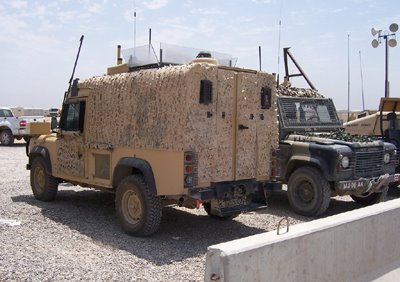
So far had the security situation deteriorated that routine patrols in the hopelessly inadequate "Snatch" Land Rovers had been abandoned and patrolling was limited to daily sallies in Challenger MBTs and Warriors. We recalled how, in order to carry out border patrols from their base in Al Amarah, the King's Royal Hussars were having to rely on their Land Rovers being airlifted by helicopters past the town, to avoid their being attacked en route.

Now, two month after our report, we are being told that the security situation has improved so radically that the British Army can afford to leave their base and hand over security to local Iraqi forces.

It is in that context that one must read the report in today’s Daily Telegraph which records that "jubilant Iraqi looters" stripped the military base after the British forces pulled out. Thousands of jubilant Iraqis, we are told, looted the base: everything from doors and window frames to corrugated roofing and metal pipes was pillaged.

No sooner had the British departed than a crowd gathered outside Camp Abu Naji. Three companies of Iraqi troops stationed in the base initially dispersed them with shots into the air but, the following morning, a mob of between 2,000 and 5,000 returned, hundreds of them armed with machineguns and rocket-propelled grenades. After sporadic fighting the Iraqi troops retreated to a corner of the camp as the base was stripped.

Hundreds gathered around the local offices of Moqtada al-Sadr, the radical Shia cleric whose followers had fired 281 mortar rounds and rockets at the camp, to offer their congratulations. A loudspeaker repeatedly broadcast the triumphant message: "This is the first Iraqi city that has kicked out the occupiers." By nightfall, said Lt Rifaat Taha Yaseen, of the Iraqi army's 10th Division, "everything" had been taken.

Says the Telegraph, "The capacity of Iraqi security forces to secure the country is the central plank of the British exit strategy. That they seem unable to secure even their own bases does not augur well."

In fact, the British strategy is a sham. It is plain as a pikestaff that the Iraqi forces are unable to maintain order – and neither can the British with their current force structure, equipment and numbers. But, rather than admit this and do the honourable thing, declaring that it is pulling out, our government is doing it on the sly. It is pretending things are under control and that it is achieving its objectives.

Once again, all we get is spin and lies, this time to dress up the fact that, when it comes to our policy in Iraq, we have made an ignominious retreat.

COMMENT THREAD

Sunday, 20 August 2006

The wrong kind of war

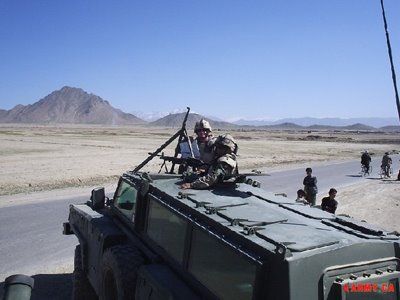
On the road to Al-Zubair - a Snatch convoy ambushedFamously, in the days when we had a nationalised railway network and the system was routinely brought to a grinding halt with the even moderate winter snows, a hapless executive was hauled before the cameras to explain why, on one particular occasion, a particularly light fall of snow had brought trains to a complete halt.

It was, he explained to the incredulous media, "the wrong kind of snow". This he later expanded upon, telling us that it has been a very fine snow which, while not heavy enough to block the lines, had invaded the engines, blocking filters and shorting out electrics. This was plausible enough but too late. Forever in the vocabulary now rests that sneering commentary on the inadequacies of nationalised industries, "…the wrong kind of snow".

Reviewing now the recent performance of the Israelis in the Lebanon campaign – something which I promised in a post a week ago, I suppose the best that can be said of it is that the IDF was fighting "the wrong kind of war".
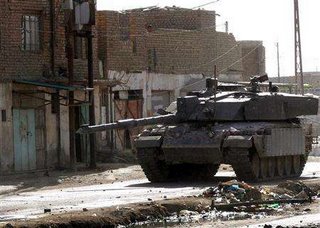
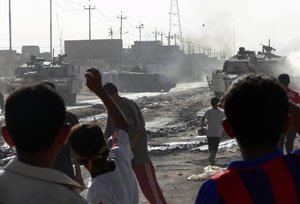
What brought this to mind was a photograph in today's edition of The Sunday Telegraph which we published on this blog nearly a month ago (so much for blogs being "derivative"), which illustrates a different facet of precisely the problem which the Israelis currently face (above left).

In the instance illustrated by the photograph and the accompanying story we have an issue rehearsed at length (and in depth) by this blog, where we argue that British troops attempting to police southern Iraq are dangerously ill-equipped.

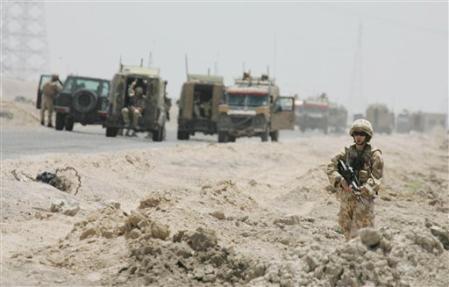
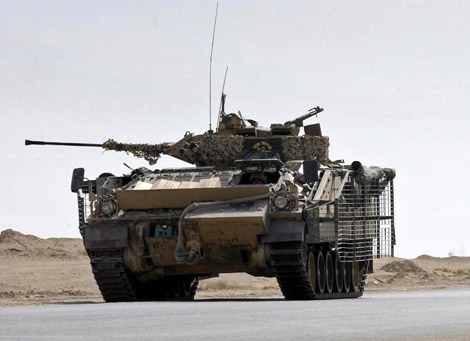
More specifically, we have an army in theatre relying on equipment such as the Challenger Main Battle Tank (MBT) (pictured above, on patrol in Al Amarah, southern Iraq) and the Warrior Mechanised Infantry Combat Vehicle (MICV) which were devised as the core weapons of armoured divisions intended to combat a massed Warsaw Pact armoured thrust in northern Europe. In short, they were never intended for counter-insurgency operations (especially in the high temperatures of the Iraqi theatre) and are wholly unsuited to it.
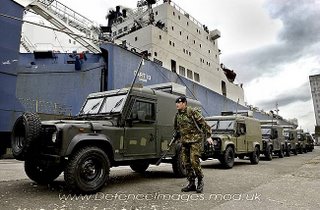
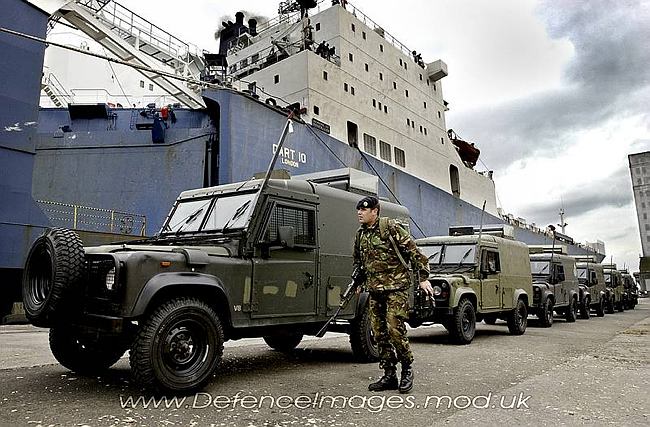
Snatch Land Rovers on the dock in BelfastPartly recognising this, in late 2003, the British Ministry of Defence drafted in a consignment of mothballed armoured Land Rovers (the nearest equivalent to the up-armoured Humvee), themselves designed for dealing with street violence in Belfast and other Northern Ireland locations, during the height of the "troubles".

Known universally as "Snatch" Land Rovers, these might have been adequate for dealing with the provisional IRA and general street violence but against an enemy which had access to any number of munitions and increasingly sophisticated roadside bombs – such as the explosively formed projectile (EFP) roadside mine – they proved easy prey. Thus it was that, by early this year, soldiers patrolling in "Snatch" Land Rovers had accounted for more than a quarter of our combat deaths in Iraq.

This was a problem which has also faced the US forces, which have suffered a higher proportion of casualties and larger absolute numbers from what are generically known as Improvised Explosive Devices or IEDs.
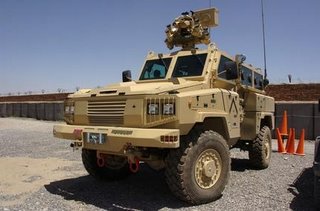
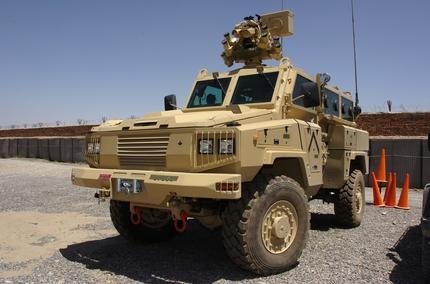
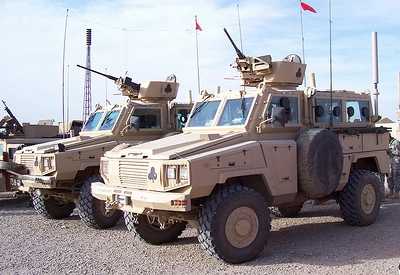
The RG-31, operated by Combat Engineers in the USMCIn response to that – after a series of false starts, which included a programme of adding armour to the standard utility vehicle, the Humvee – the US, led by the US Marine Corps, started a re-equipment programme using vehicles based on Rhodesian and South African experience, specifically designed to deal with the IED threat. These include the RG-31, the Cougar and the Buffalo.

Less obviously but just as significant, the US forces are undergoing a fundamental restructuring. In the war against the hit and run bomber, who will fight in civilian clothes and merge with the civilian population, there is no front line. Casualty rates amongst non-combatants (known from Vietnam days as REMFs) have matched those in combat units.
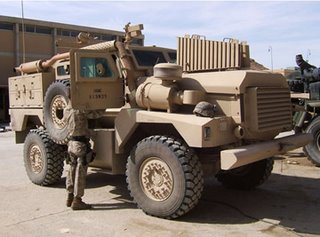
The USMC 'JERRV' Cougar vehicle used by ordnance disposal teamsThus, in this type of war, the spearhead troops are no longer the infantry and the tankers but the combat engineers. Numbers of these troops in the US order of battle have been increased substantially and, using their new RG-31s and other equipment, they have been active in hunting out IEDs. As a result, they are most often at the sharp end in the vicious fire-fights that develop when insurgents ambush the bomb hunters.

In Lebanon, the problem confronting the IDF was much the same – the hit-and-run fighter in civilian clothes – but the weapons employed by the enemy differed. In Iraqi desert conditions, where there is often little cover and most of the roads are metalled, the roadside bomb is the weapon of choice. In Afghanistan, where cover is also sparse in some areas, but many more of the roads are unmetalled, the mine is commonly used. But in south Lebanon, where the topography is in places more similar to the rolling, verdant hills of Gloucestershire and Somerset (not for nothing is the area known as "Little England"), the man-portable anti-tank weapon comes into its own.
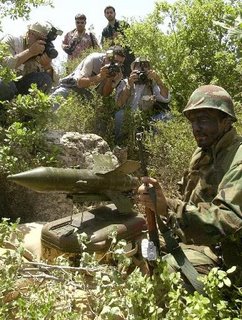
A Sagger missile - demonstrated by Hezbolla in yet another photo-opportunityWith thick cover, or the protection and disguise of civilian villages, small teams using RPG-7s, or the fearsome RPG-29, anti-tank teams can wreak havoc with armoured formations in what is nightmare country for tankers. Hezbolla have even been pressing into service Russian-made "Sagger" wire-guided missiles – which caused such great slaughter of Israeli tanks during the Yom Kippur war – and even captured (or purchased) US TOW missiles.

Combined with roadside bombs – some disguised as boulders, copying techniques pioneered by Iraqis, who have been known to cast their bombs into kerbstones) – these make a thing of the past, rapid armoured thrusts of the type that so thrilled us during the 1967 Six Day War, and the inspired counter-thrust over the Canal during Yom Kippur.

Instead, like the Americans have learnt to do, and the British are now following with a batch of Cougars on order, the Israelis have had to "up-armour" their engineers, on whom they rely for route clearing before what are now considered "conventional" armoured forces can be deployed. Thus did we see the widespread use of the Puma in the first, cautious phases of the ground campaign.
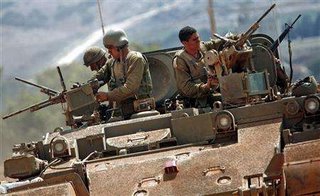
One of the most-photographed vehicle typesThese vehicles, deployed by combat engineers, are little more than turretless Centurion Main Battle Tanks, known as the Poretz Mokshim Handasati (minefield breakthrough vehicle). Although better than nothing, they are far from ideal, not least because they lack the essential attribute of an armoured personnel carrier – a rear exit door. Egressing troops are forced to clamber over the hull, exposing themselves to fire.
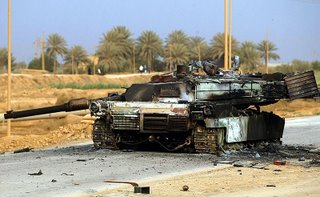
An Abrahms tank destroyed by an IEDFurthermore, as US forces have found – and as will the British – up-armouring invites a version of the arms race, where the terrorists use heavier and more sophisticated weapons, to the extent that not even the US 65-ton Abrams Main Battle Tank is immune from attack. As well as passive armour, therefore, a way of bringing the battle to the enemy must be found.

It was here, as we observed on this blog, that the Americans found a way, in the battle of Falluja which, when they comes to be drafted – will re-write the tactical manuals.

Contrary to perceived wisdom which has declared that tanks in urban warfare are death traps, the US used their Abrams as "point" to flush out the otherwise invisible enemies by presenting them with a highly attractive target. Dangerous it might have been for the tank crews but, generally, even if an Abrams is disabled, the crews tend to survive an RPG attack.
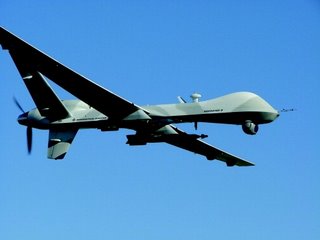
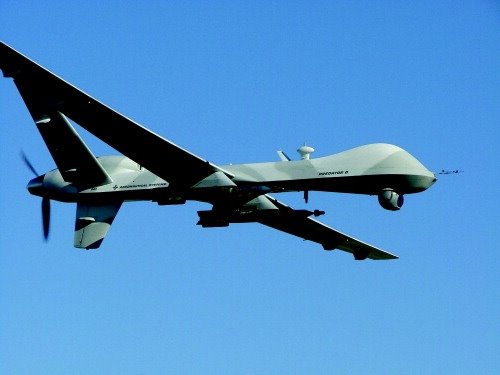
The US Predator UCAVOne the attackers had revealed themselves, above them were circling reconnaissance drones (Unmanned Aerial Vehicles, or UAVs) which would relay their co-ordinates to the artillery. Borrowing from a technique pioneered in Viet Nam, these were located in fire-bases away from the action and, within minutes, could bring down highly accurate, targeted fire on the insurgents, bringing instant death.

Additional assets, which could perform the same function as the artillery, were armed UAVs (known as UCAVs) or fighter-bombers stacked in the sky awaiting targets.

This, in the early stages, is what I though the IDF was doing, but it does not seem as if they had got the phasing and the tactics right. Casualties in tanks and crews, therefore, seem to have been relatively high, without corresponding gains in terrorists killed.

And, if this is the ground battle, there is the other element – the Katyusha strikes. In Iraq, the US forces are also prone to such attacks but their greater danger is the "White Van" mortar team. Merging with civilian traffic, these vans can park momentarily and discharge a mortar team to lob a few bombs, which then re-mount and drive off into the traffic, indistinguishable from the hundreds of other vans on the streets.

To counter this, the US has used counter-artillery radars which can locate the firing points of mortars within seconds and, with orbiting UCAVs, fighter bombers or even helicopter patrols, they can return accurate but lethal fire within minutes – or, if preferred, guide ground forces to intercept. Such would have been the expected response from the Israelis so, far from being impressed by their videos showing Katyusha launches, followed by IAF strikes a day or so later, this demonstrated that the capability was lacking.

The propaganda war

Alongside the shooting war, however, there has also been the propaganda war and it is here that the Israelis have proved dismally flat-footed. They are fighting an enemy which, as we have seen with the Qana incident – and many more – is willing to parade the bodies of its dead and, while hiding behind civilians (and even keeping them in harms way) exploits a sympathetic media and an "international community" which is locked into the paradigm that war is the greatest of all evils and any other solution is preferable.
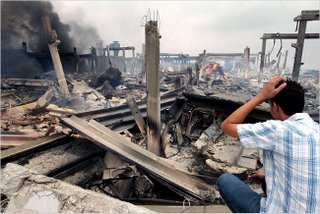
Hezbolla in particular are aided by the notoriously poor local building standards and their fragile, reinforced concrete-framed buildings which give rise to such spectacular pictures of collapsed buildings after relatively modest impacts. But, in using ordnance such as 500-1000lb bombs, with every attack, the Israelis have been creating propaganda opportunities for their enemies and detractors rather than achieving tactical battlefield gains.

And, while propaganda in war has always been important, it is more so in current campaigns. In the past, when Israel could conduct "lightning wars", by the time the international community had mobilised to enforce a cease-fire, the IDF had usually achieved its tactical and strategic goals.

But the nature of war has changed. No longer is territorial gain the objective and neither are the opposing armies conveniently lined up in uniform, fighting an open war. The objectives in this new type of war are to bring the enemy to battle and to kill people, to disrupt the hierarchy, the command and communication systems and to destroy materiel.

That process, against the weapons the enemy is prepared to deploy and tactics it uses, takes time. But, even at the glacial speed at which the international community operates, no sooner have the opening phases of combat been rolled out and the pressure is on to bring overt hostilities to a halt. To enable the battlefield objectives to be achieved, therefore, the armed forces also have to win the propaganda war, to give them enough time to complete their tasks.

Collateral damage

In this war, the currency is collateral damage – dead babies and destroyed buildings, images of which have had more effect on the battle than the tanks and guns deployed by the IDF (for a more detailed discussion, see here).

Therein, like the British Army in Iraq, the IDF is using the wrong weapons and tactics. For it too, it is the "wrong kind of war".

Much has been said and written as a result about the limits of military power – much of it nonsense. Of course, final solutions require diplomatic initiatives and societal changes but, when you have any enemy with weapons who is attempting to kill you, there is only one response – to kill them. That means military action and, therefore, war – by whatever name you call it.
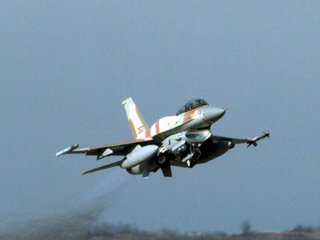
An IAF F-16But it is how that war is conducted that makes the difference, and the difference is a matter of technology. The IDF currently is equipped for its previous wars, with superb armoured formations and a fleet of high performance fighter bombers that are capable of executing great slaughter of conventional forces. But they are the wrong weapons for this type of war.

On the one hand, in the style of the Fallujah-type operation, they need heavy but highly mobile armour to protect their troops as they provide targets for the enemy, in order to flush them out. And, coming into service is a new generation of artillery with rates of fire that are simply stunning. Capable of firing 40 or more shells a minute, these guns can also lay up to seven shells on a target to arrive simultaneously. Combined with unprecedented accuracy from GPS guidance built into the shells, these can intervene immediately with deadly but highly localised force on any terrorist foolhardy enough to attack.

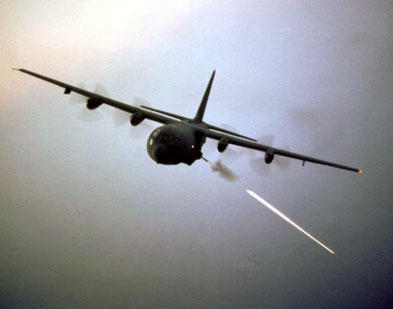
For the Katyusha problem, what is needed is not fast jets with limited endurance and, therefore, loiter capability, dropping big bombs. The weapons needed are long-endurance UCAVs and platforms like the AC130 Spectre, with high-precision, small-warhead weapons. One such, in the process of development, is the Viper Strike which, with a 7lb warhead, can kill the occupants of a car without scratching the paintwork of the next car in line, or take out the occupants of a room in a building, without disturbing the neighbours.
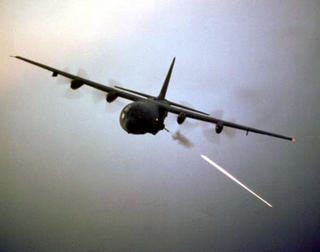
Suitable platforms, guided by sensor arrays in satellites, UAVs and electronic warfare aircraft, can loiter the battlefield and, when a fleeting target appears, can launch instant but again highly localised death, making terrorist attacks near certain suicide.

Will we learn?

Since Israel is fighting for its very survival, the odds are that it will learn its lessons from the Lebanon campaign, and apply them. There is some confidence that the US forces will do likewise – they, after all, are developing the technology.

One casualty will almost certainly be the multi-billion dollar project called the Future Combat System (FCS). The plan here is to equip forces not with heavier armour, but lightweight, air-portable vehicles, relying for their protection on sophisticated sensors, the rapid exchange of intelligence and stand-off weapons to take out the enemy before he is within range and can do damage. But, when faced with an enemy that has the capability to deliver lethal blows and reveals himself only in the act of firing his weapon (or not at all in the case of an IED or mine), this system is fatally flawed.

Many knowledgeable commentators believe the US will scrap this system but, as a letter in the Sunday Telegraph reminds us, the British Army is still committed to a similar system, a £14 billion fantasy known as the Future Rapid Effects System (FRES), all geared to providing the European Rapid Reaction Force with its "teeth".

Should this go ahead, we will find that not only are the British forces currently equipped for the wrong kind of war, they will perpetuate the error, at enormous cost in money and – eventually – lives. For once, we should look further afield and watch very closely what the Israelis do.

COMMENT THREAD
Thursday, 27 July 2006

Rethinking our role

A Type 23 frigateMulling over the implications of the Israeli situation, our activities in Iraq, Afghanistan and elsewhere, and following on from my post about the need for new thinking, my deliberations were given a new focus by an e-mail from a reader.

He had been to a presentation on UK Maritime Trade Operations in the Gulf/Middle East and offered a "few interesting facts".

In the Red Sea, Arabian Gulf/Indian Ocean and Persian Gulf area, he was told, there are generally about fifty coalition naval vessels (mostly frigates and destroyers) dedicated to security and anti terrorist operations.

To put this into context, this is twice the number of frigates/destroyers left after the Hoon cuts and more than twice the number sent to the Falklands in 1982. They are supported by submarines, maritime patrol aircraft (including RAF Nimrods) and various shore based facilities, as well as tankers and other support vessels.

Twenty of these vessels are kept in the Persian Gulf itself, with four on station at any time of the Iraqi coast. Furthermore, there are similar operations performed by NATO warships in the Mediterranean, while vessels carrying equipment, ammunition and other stores for UK forces have to be escorted by the Royal Navy. This includes ships carrying materiel stuff to Pakistan for use by UK forces in Afghanistan.

The increased operation tempo, combined with the cuts of the last few years, means that it is not just the Army (and elements of the RAF) which are suffering from overstretch. The Navy is also suffering badly as well, particularly since the UK has other commitments. As a result, nine-month deployments are becoming common, with an adverse effect on morale.

This is not helped by the uncertainty over the future carriers and the seventh and eighth Type 45 Destroyers but, more to the point – like the Army and Royal Air Force, they are largely equipped to fight a different sort of war from that which it is present undertaking.

It is all very well having the hugely sophisticated and expensive Type 45s, geared to knocking advanced fighters and bombers out of the sky, or massively costly aircraft carriers to support the European Rapid Reaction Force, but much of the Navy's work is in low intensity tasks such MIOPS (maritime interdiction operations – i.e., challenge, board and search potential smugglers) or deterring piracy and other forms of maritime crime.

For this, we are told, there is an urgent need for a number of fast, armed patrol vessels. Such vessels need a flight deck and hangar for an embarked helicopter, plus accommodation for a number of Marines/Special Forces - perhaps an upgraded River Class offshore patrol vessel, or even this little Italian number (below).

An Italian Commandante patrol vesselIn the longer term, this might be cheaper than keeping high-tech, multi-role frigates on station, such as HMS Kent (type pictured, top left) which was recently the lead RN ship in the northern Gulf. On the other hand, additional, dedicated patrol vessels might allow the UK to take a more active role in stopping the oil smuggling which is undermining the Iraqi economy.

What all this again points to is the need to re-orientate our thinking, and address the actual tasks confronting our armed forces, rather than fantasy tasks, perhaps in pursuit of EU foreign policy objectives, some time in the unforeseeable future.

This, to some extent, was what Liam Fox was getting at when he delivered his speech on defence in June, but the real debate has yet to start. Unfortunately, it seems, the Boy King is tiptoeing away from any such thought. As always, the debate will have to start without him.

COMMENT THREAD

Wednesday, 26 July 2006

Mystery solved

The 6x6 Cougar destined for the Army in IraqIt is a reflection of how deeply ingrained is my distrust for government that the last place I would think of looking for information on the armed forces is the MoD website – especially since it was "improved", whence most of the archives have rather conveniently gone missing.

Anyhow, one of our readers pointed me in that direction and, lo and behold, we have a picture of the new armoured vehicle which the MoD is purchasing for our troops in Iraq. The photograph, supplied by Force Protection Inc, is of a 6x6 Cougar variant and, from the colour scheme, it is definitely one of the batch originally destined for the Iraqi Army, known as the Iraqi Light Armoured Vehicle (ILAV).

The Snatch Land Rover - essential for its 'size and mobility' - now supplemented by the 6x6 CougarThere is an extremely good article on this here (which links to some essential reading here) and the indispensable Defense Industry Daily gives a good narrative of the MoD contract here.

Just what the Iraqi Army feels about the MoD jumping the queue has not been recorded but it is more than a little rum that, at a time when the Iraqis are being asked to assume greater responsibility for internal security, the British step in and swipe their vehicles from them, leaving the people who are most at risk to ride around in unprotected or lightly armoured vehicles.

If there is a comedic aspect to this, it is Lord Drayson, the defence procurement minister, who having told us of the RG-31, as recently as 29 June, that "we judged the size and mobility of the vehicle not to be appropriate to the needs of our Armed Forces today", is now buying something a foot wider and higher, and nearly four feet longer. Incredibly, it is nearly ten feet longer than the Snatch Land Rover and three feet wider and taller.

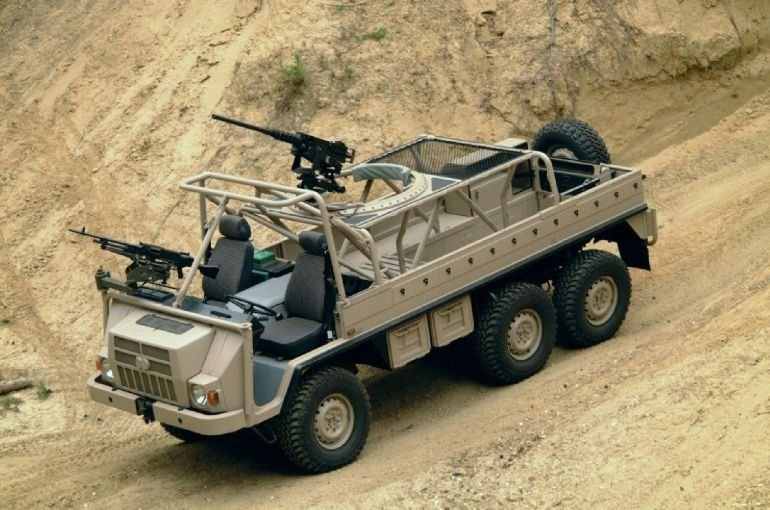
The Pinzgauer 'coffin on wheels' - destined for mine-infested AfghanistanBut there is nothing at all comic about the choice of the Pinzgauer Vector, a picture of which is also up on the MoD website. Bought primarily for its cross-country performance – which is superb – the MoD is calling this a "Protected Patrol Vehicle". With its slab sides and lack of window in the troop compartment, it is hard to believe the MoD is serious about this being used for patrols. The soldiers inside will be sightless passengers, guarded only by an unfortunate soldier (or two) with his head stuck out the roof as "top cover", terrified that the vehicle will overturn (as top-heavy, cross-country vehicles are prone to), crushing him to death.
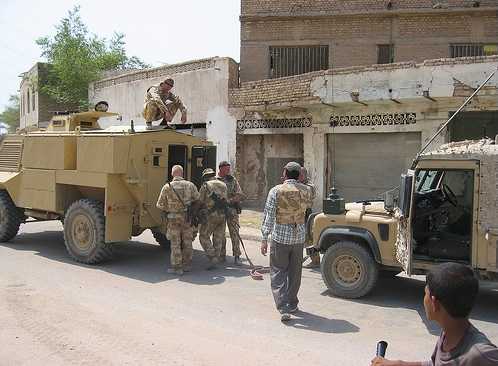
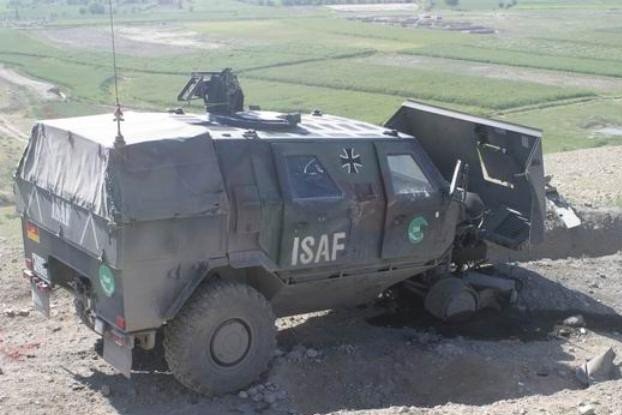
The German mine-protected Dingo, after a mine strike in Afghanistan - the crew were uninjuredAs for "protected", that it ain't, except against the lightest of threats. The vehicle, as we have observed before (here and here) offers no protection against anti-tank mines, which are available in abundance in Afghanistan – a fact to which the Germans and the Canadians will attest. The latter, having recently lost four men travelling in a lightly armoured G-Wagon (the Mercedes equivalent to the Land Rover) are now counting their good fortune that the next mine strike hit troops driving in an RG-31.

While there is some considerable debate about the benefits of mine protected vehicles in dealing with IEDs – which plague the coalition forces in Iraq - the situation in Afghanistan is different. In Iraq, most of the roads have metalled surfaces – which is why the insurgents resort to roadside bombs - but, in Afghanistan, huge areas are accessible only by unmade roads, which favour the use of mines.

Perhaps millions of mines are left over from the Soviet era and the accounts of the Red Army experience during their occupation show that most of their casualties came from mine strikes. In putting these Pinzgauers into Afghanistan, the MoD are out of their tiny minds… they are criminally insane.

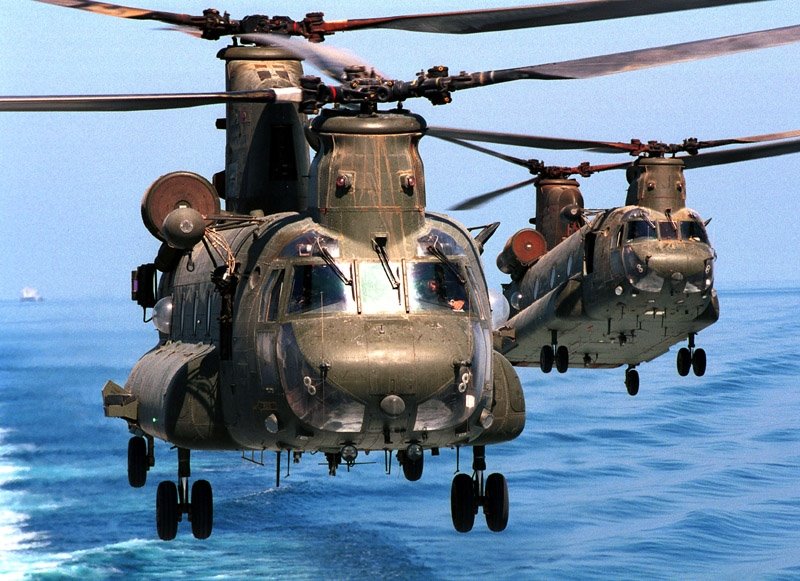
Chinooks - the optimal As opposed to mine protected vehicles, however, often the most appropriate way of protecting troops is to use helicopters. There, of course, we bump up against reality – the cupboard is bare.

Here though, is an interesting reflection for a site named "EU Referendum". Something that has haunted me from my days in the European Union Parliament is the cohorts of preening MEPs, each of whom cost the British taxpayer £1.2 million a year. Many would tell me how vital their roles were, in increasing British influence in the EU.

When it comes down to real influence, however, in the real world this turns out to have more to do with how many helicopters the British can field. With 78 British MEPs at present, costing us over £90 million a year, that is the price of five Chinook helicopters a year with change left over. Somehow, I suspect – given a choice – most people would opt for the Chinooks.

Similarly, for the £11 billion a year we pay in "contributions" to the EU each year – nearly twice our annual defence procurement budget – I suspect we could buy a great deal more influence if we spent it on "toys" – provided, of course, we did not fritter it away on the European Rapid Reaction Force, and spent it on kit that was actually fit for purpose.

COMMENT THREAD

Monday, 24 July 2006

Corporate manslaughter


The secretary of state for defence today confirmed the MoD's intention to supply troops in Afghanistan with Pizgauer Vector armoured vehicles, which we have already dubbed "coffins on wheels".

It says something for this issue that the only previous media coverage was an uncritical piece in the Sunday Telegraph which neglected to point out that this vehicle offers virtually no protection to mines – in what is one of the most heavily mined countries in the world.

The unarmoured PinzgauerIn our view, it is criminal negligence to purchase a vehicle, the design of which puts the driver over the front wheel, where he is most exposed to the effects of blast, and in which position it is almost impossible to devise adequate protection. And, while the danger is not immediately obvious from the pictures of the armoured vehicle, a view of the unarmoured vehicle, kitted out as a gun truck, demonstrates the point with clarity.

Cone of destruction from a mine blastShould the vehicle run over a mine, the driver is positioned right in the centre of what is called the "cone of destruction", an illustration of which we have taken from a technical manual on mine protection. A photograph of the type of damage caused shows quite how vulnerable drivers are. Furthermore, what applies to mines also applies to a greater or lesser extent to IEDs.

What is utterly amazing is that, while the MoD have conceded the point in Iraq, with its decision to buy Cougars, it is still pursuing the Pinzgauer option for Afghanistan. Yet, while the Cougars cost £258,000 each, the Pinzgauers cost £437,000. They are not only coffins, but very expensive coffins.

Interestingly, last Friday, the Telegraph ran a piece on the government's intention to enable the prosecution of companies for manslaughter if they are suspected of causing a death through management failings. A new offence would apply to corporations, including public bodies, and introduce unlimited fines.

In our view, if or, as is more likely, when troops die in a Pinzgauer as a result of a mine explosion, "corporate manslaughter" provisions should be applied to MoD for procuring such a dangerous vehicle. But second in line should be the media who have the power to raise such issues but who seem to prefer expending their energies prattling about bagpipes.

COMMENT THREAD

Wednesday, 19 July 2006

Taxi! £250 a mile, guv!

For an update on this post, see here.

A Warrior MICV in IraqThe defence questions we have been putting into the system are beginning to trickle through, dreadfully slowly, the answers, as we pointed out yesterday, largely incomplete.

One more which has come through is another question by Owen Paterson asking for the cost per track mile excluding crew costs of operating the Warrior MICV (often dubbed a "battlefield taxi") and an RG-31M in Iraqi conditions.

Adam Ingram again was the nominal respondee and again the answer is incomplete. The full capitation cost for the Warrior, he writes, is calculated for financial year 2006-07 as £154.04 per kilometre. That is equivalent to £250 a mile – no wonder the MoD prefers to quote in kilometers.

However, the figure quoted is "based on peacetime usage" and Ingram tells us that "specific operational track mile data is not held centrally" and could be provided "only at disproportionate cost". This does the MoD evade telling us what the Iraqi figures actually are. One has to be a little alarmed if the MoD does not have these figures to hand, as any efficient fleet manager will always be fully aware of his operating costs.

But that is not the name of the game. The MoD is seeking to conceal information and this is the classic get-out. And it is not surprising that it is trying to conceal the figures, as we are privately informed that the Warriors in Iraq are taking a serious hammering. Their operating costs could easily be double or more the "peacetime usage" figure – which is high enough as it stands.

RG-31s - cheaper and better?As to the RG-31 figures, Ingram gets away from answering the question by declaring that the Ministry of Defence "does not own any RG-31M vehicles". However, that is an irrelevance. In 2001, the MoD ran a competition for the Future Command and Liaison Vehicle.

Three companies were shortlisted, including (then) Vickers Defence Systems which fielded the RG-31M and RG-32M. Then, in June 2001, the company was awarded a fixed-price contract for "the risk reduction studies and trials phase" allowing the army to carry out extensive tests of the competing vehicles, including the RG-31, at the Armoured Trials and Development Unit.

This was announced by the MoD on 15 June 2001 where each company was paid about £500,000 each to take part in the trials.

The US Stryker - wheels is cheaperGiven that the current vogue in defence procurement is the assessment of "whole-life costs", it is inconceivable that the MoD did not acquire considerable data on the operating costs of the RG-31. This would include a fairly accurate figure for costs per mile. Yet, as we see, the MoD is not in the business of giving MPs information – who do they think they are?

Nevertheless, in view of the huge operating costs of Warriors, I am warming to the thesis that there may be an economic case for running RG-31s. This was certainly a factor in the US choice of the Stryker wheeled APCs, which proved considerably cheaper to run than the Bradley MICV, the American equivalent of the Warrior.

Nor, of course, it this an academic issue. When defence must compete with all other areas of public expenditure – from schools to hospitals and more police on the beat – our ability to project force largely boils down to pounds and pence. To be effective, therefore, we must also be cost-effective. And in this case, it looks like better could be cheaper.

COMMENT THREAD

Sunday, 16 July 2006

"Limousines" but no armoured cars

Italian-built 'battlefield limousines' for the British fantasy armyBooker, in his Sunday Telegraph column today picks up on the continuing scandal of the lack of armoured protection for our troops in Iraq and Afghanistan. He writes:

When US, Canadian, French, German, Australian, Austrian or Danish soldiers go patrolling in Iraq and Afghanistan they travel in "mine-protected" vehicles, such as the RG-31, specially designed to defend them against the explosive devices favoured by the insurgents. Only British troops have to rely on unarmoured Snatch Land Rovers, which has led to the deaths of more than a quarter of those who have been killed in action.

This scandal was half-acknowledged last week by our Secretary of State for Defence, Des Browne, when he admitted to the Commons Defence Committee that there was a "capability gap" in the way our troops are equipped. He also acknowledged, as the Tory defence spokesman, Gerald Howarth, was quick to point out, that none of the billions of pounds that the Ministry of Defence (MoD) is spending on military vehicles will provide our soldiers with those needed to fight counter-insurgency campaigns such as those in Iraq and Afghanistan.

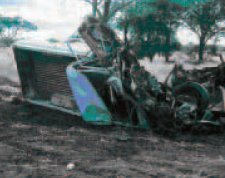
A burnt-out 'Snatch' Land RoverIn the name of equipping a fantasy army of the future to play its part in the European Rapid Reaction Force, the MoD has been happy to commit £14 billion to vehicles for its Future Rapid Effects System. It has already contracted to spend £413,000 each, twice the price of a Rolls Royce, on 401 Italian-made Panthers, "battlefield limousines" to ferry officers around behind the lines. But when it comes to equipping our troops to fight the very nasty wars in which they are already engaged, Gordon Brown has said there is no money left over. It is time this horrifying story was recognised for the major political scandal it has become.
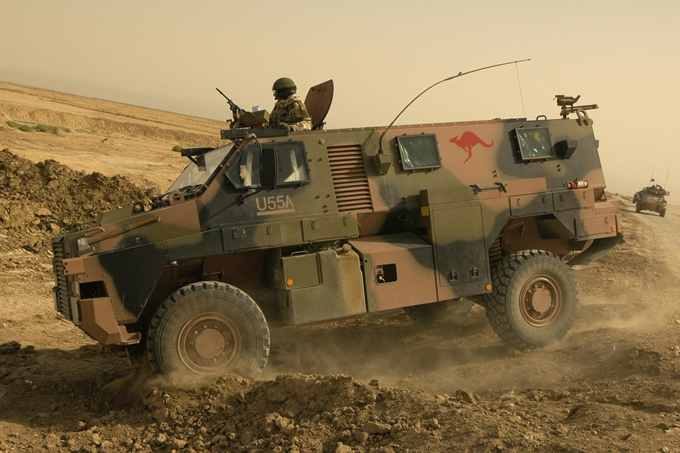
An Australian 'Bushmaster' Infantry Mobility VehicleThe picture we've shown on the left is the Australian Bushmaster Infantry Mobility Vehicle, currently in use in Iraq. It is an Australian designed and built vehicle, mine protected along the same lines as the RG-31.

It really has come to a pretty pass that we seem no longer able either to design or build our own armoured vehicles so that, while the MoD fritters away our money on Italian-built "battlefield limousines", our troops are still riding around in "Snatch" Land Rovers.

COMMENT THREAD

Wednesday, 12 July 2006

Nothing in the middle

Gerald Howarth - shadow procurement ministerOn the back of oral evidence given yesterday by secretary of state for defence, Des Browne, to the House of Commons defence committee, the Conservative Party has waded into the battle of the Land Rovers, calling for improved armour for British troops.

This is in the form of a press release issued by the shadow minister for procurement, Gerald Howarth, on the back of the evidence given by Browne. The secretary of state has at last admitted that our Armed Forces need a level of armour between the heavily armoured Warrior and the lightly armoured Land Rover. Gerald Howarth says:

Des Browne's admission that there is a capability gap in the armour available to our troops on deployment in Iraq and Afghanistan raises serious questions about the Government's commitment to ensuring Britain's Forces have the best equipment. They have failed to provide the Armed Forces with a medium capability between the heavily armoured Warriors and the lightly armoured, but more agile, Land Rovers to allow them to carry out the full range of tasks in Iraq and Afghanistan.
But Howarth's release also offers interesting insight into the total disarray into which land forces procurement has descended. He reminds us that it was always the MoD's intention to have a medium, wheeled armoured vehicle to fill the gap between the Land Rover and the Warrior which, originally, rested on another of those ill-fated European co-operative projects.

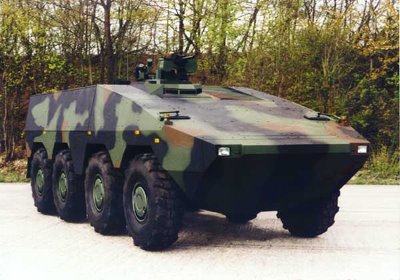
The tri-nation Boxer MRAVThis was the Boxer Multi-role Armoured Vehicle (MRAV), originally an Anglo-German project signed in 1999 and joined by the Netherlands in 2001. But, in July 2003, Britain pulled out after it was realised that the new vehicle, at 31 tons, was too heavy to be transported by the RAF's fleet of C-130 transport aircraft.

Not only did we lose £48 million in the process (a conservative estimate) – this also set back the re-equipment plans, which became subsumed into the Future Rapid Effects System Programme. However, the need for a medium vehicle remained, which was why FRES was originally given an early in-service date of 2009. This was later pushed back to 2010 and, yesterday, David Gould, chief executive of the Defence Procurement Agency, confirmed to the defence committee that the main procurement for FRES had not begun and that there was no in-service date.

With nothing on the immediate horizon, therefore, the Conservatives are demanding that that the government looks to "interim measures which will give commanders in the field a greater range of options, better protected than the Land Rover but more manoeuvrable than the Warrior". Howarth adds:

While we all accept that there needs to be a range of options available to our commanders on the ground, ranging from air transport to foot patrols, it is now clear that there is a shortfall in the range of armour available. It is imperative that the Government re-examine all the options to ensure that our Armed Forces have the best possible equipment to carry out the difficult job which we ask of them.
A Canadian RG-31 on patrol in AfghanistanThe problem for the MoD and defence planners is none of the platforms being considered for FRES are really suitable for counter-insurgency operations and, while the RG-31 is undoubtedly an improvement on existing vehicles, it is optimised for mine protection and itself can only be regarded as an interim solution. Anything produced will be, as Howarth readily concedes, a compromise but, so far, the MoD is showing no signs of addressing the issue.

This, therefore, has much greater resonance than just defence policy. It is yet another example of the dismal incompetence of the Labour government, the defects of which only now, after nine years in power, are becoming all too apparent.

Incidentally, confirming assertions made on this blog, Des Browne stated in his evidence that the Pinzgauer Vector which enters service in 2007 does not provide much greater protection than the Snatch Land Rover currently in use and also stated that the Panther vehicle, which also enters service in 2007 will not meet the armoured patrol vehicle role required.

COMMENT THREAD

Tuesday, 11 July 2006

Let's see now

A Dingo armoured vehicle after being nit by a mineAccording to DefenseNews, the German Parliament last week approved the procurement of an additional 149 Dingo 2 mine protected vehicles. This is after German forces were attacked three times last week in northern Afghanistan, including a suicide attack that failed to inflict harm on the crew of a Dingo vehicle, but killed and injured several Afghan civilians.

The decision was immediately criticised by Die Welt which complained the additional vehicles were not enough for the prospect of Germany committing itself to more out of area operations. This was echoed by Johannes Kahrs, a Social Democrat and defence rapporteur in the parliament’s budget committee. He believes that 149 vehicles is "too few and, more importantly, too late".

Let's see now. The German Army already has the Dingo in Afghanistan, where it is saving lives and is buying more – only to have the parliament complain that not enough are being bought. The US has purchased RG-31s, Cougars and Buffaloes. The Canadians have bought RG-31s as their patrol vehicle in Afghanistan. And the French have embarked on a crash programme of up-armouring their VBL armoured cars to increase protection against IEDs.

Five countries, therefore, are buying specialist, mine protected vehicles or adapting existing vehicles, to enhance troop protection in hotspots like Afghanistan and Iraq. And the British MoD? Ah… Lord Drayson thinks that "the Snatch Land Rover provides us with the mobility and level of protection that we need."

COMMENT THREAD

Is there a journalist in the house?

An all-too familiar picture, we are told - a broken-down 'Snatch' Land Rover out on patrol in Iraq, about to be towed back to baseIf there were any halfway decent journalists out there, with editors that would give them the space, they could have a field day with the lead story in DefenseNews this week.

Headed, "BAE Chief: UK Procurement in 'Semi-Paralysis'", it reports how Mike Turner, CEO of BAE Systems, is complaining that Britain’s procurement budget has fallen into a state of semi-paralysis, and only essential programmes are receiving money and approval.

Within the defence industry, adds DefenseNews, shortfalls in the Ministry of Defence (MoD) equipment budget have been an open secret. But now Turner has spilt the beans.

"I believe the MoD is trying to preserve the defence budget for certain priority programmes, and decisions are not being taken which the UK industry believes need to be taken for the benefit of the UK armed forces and the defence industrial base," Turner says. "We have a state of almost semi-paralysis for getting on with programmes unless they are absolutely essential."

As you would expect, Turner's main complaint is about the programmes his own company is running, such as the Astute nuclear submarine and Type 45 destroyer. The Nimrod MRA4 surveillance aircraft also is in limbo, although a contract for 12 aircraft could be announced at the Farnborough air show.

He adds that, "our armed forces cannot continue to be a force for good in the world, as the MoD says they are, without the right level of funding to go with it."

Turner is supported by "a leading industry figure" who says "the problem of underfunding is worse than ever" but, tantalisingly, neither of them say what the "priority programmes" are. However, in the absence of any MoD press release announcing the cancellation of the £14 billion Future Rapid Effects System, it is a pretty safe bet that this is one of them. That alone demonstrates that, above all else, the government is still committed to funding Britain’s contribution to the European Rapid Reaction Force.

This has been our continued complaint on this blog – that the government is pouring money into the European fantasy army and neglecting the here and now – the current needs of our armed forces. Turner's comments seem to confirm this.

Small wonder, therefore, that when BAE systems is finding money tight for projects which are already on the stocks, the Army is not getting any money to replace its dangerously vulnerable (and unreliable) "Snatch" Land Rovers, to say nothing of the rest of the kit it needs to fight an effective counter-insurgency campaign.

With troops actually engaged in combat and at risk, this is becoming a major scandal and one which surely cannot remain out the public view for much longer.

Now, what was that I was saying about journalists?

COMMENT THREAD

Saturday, 8 July 2006

The conspiracy continues

Des Browne - secretary of state for defenceAnd so to that defence debate held in the Commons last Thursday.

While we have been "banging on" about this on this blog, what perceptive readers will find is that the most significant issue to emerge from this debate is that the process itself transcends the subject matter. The way the subject material was handled actually provides a graphic illustration of how the conspiracy of silence in our Parliament over European Union issues continues.

To develop this theme, we need to look at specific aspects of the opening speech from the secretary of state for defence, Des Browne, a man new to his post and without any background military experience. He was, therefore, wholly reliant on his brief from his civil servants and was thus parroting what he has been told.

The Warrior - track wear and maintenance becomes a major issue with extended useThe touchstone issue, of course – for this blog – is the "Snatch" Land Rover. This subject is first introduced into the debate by way of an "intervention" by Mark Pritchard, the newly elected Conservative MP for the Wrekin. He asks the secretary of state, in respect of the promised review of armoured vehicles in Iraq and in Afghanistan, "whether Warrior armoured vehicles be supplied to the front line, where there is a demand for them, thereby reducing casualties resulting from Snatch Land Rover use?"

Before getting on to our Des Browne, Pritchard's intervention has to be marked down as utterly fatuous and unhelpful. It is a line that has also been pursued by the egregious Sean Rayment in the Sunday Telegraph and needs a little exploration.

The Warrior Mechanised Infantry Combat Vehicles (MICV) are tracked armoured vehicles designed specifically to carry sections of infantry into battle alongside main battle tanks, providing the infantry support without which tanks cannot operate. Moreover, they were designed specifically for the European theatre for action against Warsaw Pact forces.

As such, these are not patrol vehicles – they are troop carriers. Visibility for the troops carried is poor and they are not able to participate in the action until dismounted. Further, as tracked vehicles, they are noisy and uncomfortable – important factors when troops are carried for long periods – and, being built for the European theatre, they lack air conditioning. Being tracked, they are relatively slow and, crucially, require a high level of maintenance, as the tracks wear out very quickly in adverse conditions.

Very recently, we have seen a report from Canadian forces operating in Afghanistan, recounting the enormous toll that operations are exacting on equipment; we have first-hand accounts from British troops in Iraq about how the increased use of Warriors in that theatre is imposing acute maintenance burdens which will shortly reach a crisis point; and there are many public domain narratives which convey the concern of US over the extraordinary toll routine operations in Iraq are taking of mechanical equipment.

A long distance patrol in Afghanistan - hard on wheeled vehicles but harder on tracksWhatever the need for improved armour in both Iraq and Afghanistan, therefore, Warriors are not the answer. We are using them simply because we have them – and nothing else – but, given the huge distances they would have to travel in Afghanistan, they would be a liability. Pritchard, had he taken the time and effort to research the issue, would have known this. But, instead, we get a cheap little intervention that actually misses the point completely – that we do not have a suitable armoured vehicle in either Iraq or Afghanistan for use in counter-insurgency operations.

Turning now to Des Browne, the man responded by agreeing that "we identified a deficiency in capability as regards Snatch Land Rovers and the fully armoured vehicles and thought that it needed to be addressed", reminding Pritchard of the ongoing review. He then went into a long spiel about the IED threat and the use of armoured vehicles.

Improved armour, he said, is part of the solution and claimed that "additional armoured options" will become available to commanders over the next year. This included the "new patrol vehicle", the Vector (the infamous armoured Pinzgauer), which will enter service in Afghanistan in 2007. In addition, said Browne. "we have already upgraded the protection on Warrior, Saxon and the CVR(T), and we are currently upgrading it on the FV430 vehicle." There, the secretary of state seems to be unaware of his own department's decision to withdraw the Saxon completely. Heedless of this, he then continued:

However, Snatch Land Rovers will continue to be an important option. The Army's approach to its role in Iraq and broadly in Afghanistan - although not on certain tasks - requires a low profile and a highly mobile patrol vehicle that allows troops to engage with local people. As people will have seen from their television screens, paratroopers in Afghanistan prefer to walk the streets of towns there with soft hats on. That is not our decision, but a decision made by their commanders in the light of what they are trying to do. It is clear from the pictures relayed back in recent days that that engagement works in a substantial part of the area for which they have taken responsibility. Larger and significantly heavier vehicles, such as Warrior, might be better armoured, but they are not always suitable for the lower profile and less intimidating manner in which the Army often prefers to operate. That, in turn, feeds into the security of our forces, because their relationship with the people with whom they work is an important component of security.

We must remember, however, that equipment - armour and other counter measures - is only one element of protection. According to the experts who have advised me continuously over past weeks, it is only about a third of the story. The rest is down to intelligence gathering, surveillance and proactive operations to disrupt and capture insurgents, and to the tactics that our troops adopt to minimise the risks of successful attack. I am told by experienced commanders that they sometimes choose not to be in a vehicle at all but to walk the streets, which is much safer than being cooped up in a vehicle and provides a degree of flexibility.
What we have to remember, though, is that, of the four major armies in the two theatres, the Americans, the Canadians, the French and the British, the first three have decided to provide entirely new armoured equipment or upgrade existing equipment. Therefore, what we are seeing is Browne telling us that, beyond unspecified "additional armoured options" and the new and dangerous Pinzgauer – which is a troop transport rather than a patrol vehicle – the MoD, uniquely, does not see the need for re-equipment. The fact is that the MoD has been caught short, committing troops to two highly dangerous theatres without suitable armoured vehicles.

Now, you would have thought that an opposition, desperate to score "brownie points", and with a reputation to build and an election to win – whenever it happens – would have made capital out of this. Browne had just presented them with an open goal.

This was left primarily to Liam Fox, who was is next on his feet as shadow secretary of state for defence. But the open goal was ignored. He talked about defence spending, recruitment and retention, the territorial army and the reserves, overstretch and its effect on morale, family accommodation, shortages in the medical services, combat stress, the working condition of troops and the general situation in Afghanistan. But not once in his speech is there any mention of armoured vehicles – not even a passing reference to their deficiencies.

Then, throughout the main part of the debate, this became the dog that did not bark. We were treated to a huge range of issues – even one Labour MP bemoaning the injustices done to the Bevin Boys – the conscripted coal miners during that Second World War – but nothing more on equipment, until it cames to Conservative back-bencher, Ann Winterton. But she went further. She that asked members to cast their minds back to December 1998 during the negotiations on the St. Malo agreement. It was at that time, she said, that the Prime Minister decided that the UK would not join the euro. "In all matters relating to the European Union, there can never be a straight decision. There is always a trade off—that is, a price to be paid. In this instance, the UK conceded and agreed that our forces would be integrated into a European Union defence force".

She continued:

From that time onwards, the Ministry of Defence did not quite know in what direction it would have to commit our armed forces in the future. Would the first priority be to serve the interests of the UK, or to co-operate with the European Union or with the United States of America, or a combination of all three? If the MOD did not know in which direction it was meant to be going, how could members of the armed services second-guess the future? Subsequently, the problems have been exacerbated because the UK is engaged in conflicts in which our troops are committed in Iraq and Afghanistan.

It has been well understood that, moving on from the former cold war scenario, changes would have to be introduced and the concept of the future Army structure came to light with its objective of strengthening the medium sector. It is crystal clear that we are without a whole category of vehicles suitable for insurgency work, and this lack has been shown in both Iraq and Afghanistan. The focus and direction of policy has been to prioritise the future rapid effect system, which is an integral part of the European Union rapid reaction force, but which realistically will not be in operation until possibly as late as 2020. Moreover, the whole project falls into a world of fantasy in which the total package requires airlift, electronics, future technology and state of the art communication at a projected overall cost of £6 billion initially, which ballooned almost overnight to £14 billion.

Those sum are all beyond our financial means and are almost just a wish list, but these plans have resulted in us taking our eye off the ball. Rather than concentrating on what is needed now and for the immediate future to enable our armed forces to meet the challenges of fighting insurgents in Iraq or Afghanistan—insurgents who are highly mobile and armed with cheap but deadly weaponry—we are left in a virtual vacuum. We are expecting our forces to operate Snatch 1 armoured Land Rovers from Northern Ireland, which are clapped out and always overheating and breaking down. The No. 2s are just about acceptable, with a little life left in them yet, while the No. 3s are very few on the ground.

The problem is that we are forced to use these old vehicles because there is no alternative, and because of ongoing long- term commitments the MOD is now virtually broke.


While our armed forces are placing their lives on the line each and every day on behalf of us all, which they are now doing in Afghanistan as well as in Iraq, it is essential that the Government, through the MOD and Parliament, concentrate on providing what is necessary for the present and for the immediate future. The Prime Minister has spent too much time placing European Union integrationist policy first, rather than ensuring that present day servicemen and women have appropriate and adequate resources and equipment.

If we do not provide our forces with the best that money can buy, rather than some of the present outdated equipment, which is hardly fit for purpose, will it be any surprise if we cannot recruit or retain sufficient high calibre personnel? By spending too much time and energy on the future creation of forces which will eventually be totally integrated within the European Union rapid defence force, the Prime Minister and his Chancellor have sold the pass and limited the choices for the future.

Many commentators believe that the Army of today is being starved of resources in order to feed a fantasy army of the future. I hope that they will be proved wrong, and I trust that the MoD will provide the appropriate equipment for our armed services to allow them to perform their valuable and vital duties.
Looked at dispassionately, this was an extraordinary speech. Despite her measured tones, Winterton was effectively accusing the government is so obsessed with European integration that it was neglecting the combat army and sending troops to their deaths for want of the right equipment.

In the remainder of the debate, one more back-bencher, Tobias Ellwood, the Conservative member for Bournemouth East, did mention equipment but when it came to the summing up, there was not a mention of the European issue. Mark Harper, for the Conservatives, noted that Anne Winterton had "raised the issue of equipment" while Adam Ingram, the minister of state for defence, speaking for the government, simply ignored Winterton's speech. As to Europe, he ignored that as well, although he did take the time out to commend all the speakers, saying: "We have not been in party-political point-scoring mode today".

Thus it is that the conspiracy of silence continues. This is the new conservatism of "Dave", where the Conservative party doesn't "do" Europe any more, while the government blithely ignores any references made by errant back-benchers. And so the chaps all patted themselves on their respective backs, congratulating themselves on what a jolly good debate it had been and went off to the bars, or their offices, or toddled off home – or whatever.

The media, in turn, also ignored the debate and the elephant slumbered on quietly in the corner of the room.

COMMENT THREAD

Friday, 7 July 2006

What are we paying this man for?

The Panther 'battlefield limousine'Yesterday, there was yet another defence debate in the Commons, unreported by the MSM, as most of them are.

There were several references to the "Snatch" Land Rover and I will publish a compilation of these over the weekend. But one interesting exchange caught my eye, between Conservative MP for Salisbury, Robert Key, and his fellow Conservative (for Congleton), Ann Winterton.

In his speech, Key – perfectly properly – applauds the work of the Royal Military Police, pointing out that they do a difficult and dangerous job. He goes on:

The strange thing is that, in battle, the RMP are always right out there at the front. They are in front of the armour and the artillery, staking out the forward route in their Land Rovers and so on. They are very lightly armoured, if at all, and they have no protection from mines, small arms or artillery. I know that that is being addressed. I have raised the matter before with the Minister of State. We know that there is a new stream of Panther vehicles coming to the Army later. However, what bothers me is that, in a parliamentary question, I asked who was going to get those vehicles first, and the answer was the training regiments. That is fine, but no mention was made of the RMP. I thought that we were talking about what was meant to be a front-line reconnaissance vehicle.
Ann Winterton responds to the mention of the Panthers, asking, "is my hon. Friend aware that the theatres and situations in which they can be used are limited? They were preferred to the RG-31s, which are much more flexible, have performed extremely well in Iraq and are used by the Canadians in Kandahar province."

Robert Key, in turn, tells Winterton that he is "well aware of both that and my hon. Friend's advocacy of the RG-31s," whence Winterton replies that, "They are cheaper and better." That provokes Key into retorting, "Well, fine, someone must have evaluated them along the line. In any event, those out in the front of the Royal Military Police should have these vehicles, or some equivalent."

Out of interest, I checked up on the number of articles I has posted which referred to the Panther Command and Liaison Vehicle. There have been eighteen, and I have posted the links below, in date order:

17 December 2004
29 June 2005
3 July 2005
10 July 2005
15 July 2005
16 July 2005
17 July 2005
26 July 2005
12 August 2005
21 August 2005
30 August 2005
3 September 2005
4 September 2005
25 November 2005
23 February 2006
20 June 2006
22 June 2006
4 July 2006

Anyone reading these cannot but come to the conclusion that there is something highly suspect about the way these "battlefield limousines", at £413,000 each, were procured. Yet Robert Key, described by some as a "cut-down version of Nick Soames" seems quite happy that "someone" did the evaluation, without seemingly worrying at all whether they got it right.

If that is the best our hon. Friend can manage, one seriously wonders what he is being paid for.

COMMENT THREAD

Thursday, 6 July 2006

Through "toys" to the truth

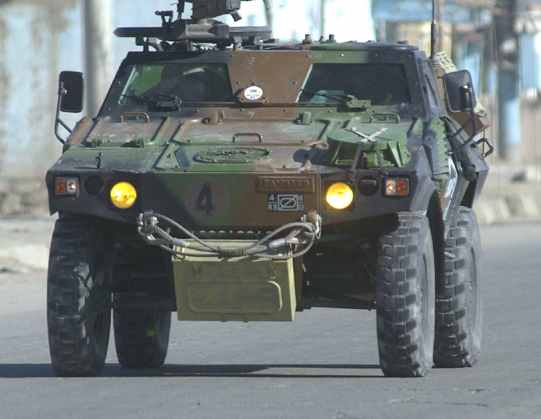
A French VBL armoured patrol vehicle in AfghanistanAlthough my otherwise staunchly supportive co-editor has little love for military "toys", even she recognises that study of the design, provision, and deployment of these highly functional machines gives an unparalleled insight into the military mind (such that it is) and the underlying political and strategic drivers.

In this context, a short press release from an obscure (to British audiences) French armoured vehicle manufacturer, assumes an enormous importance when fitted with the many other jigsaw pieces which we are trying to assemble to make a coherent picture.

The press release in question recounts how, on 19 October 2005, a French VBL armoured car patrolling the environs of Kabul was seriously damaged by an IED explosion. For the Americans in Baghdad and elsewhere, this is a common enough experience, and also to the British is southern Iraq.

But what is instructive is the French response. They immediately put their military research institute (la Section Technique de l’Armée de Terre) onto the problem and, within six months, a contract was given to the vehicle manufacturers, Panhard, to produce fifty armour kits to give lateral protection against IEDs. These are to be fitted in a crash programme to French VBLs in Afghanistan, from July through to December.

The RG-31... 'too big', 'wrong profile' and 'maintenance problems'Compare and contrast this with the British response to the "Snatch" Land Rover controversy. Rather than an immediate technical response of the like we see from the French, we see, in effect, a two-pronged campaign to oppose calls for better equipment.

On the political front, we get the likes of Lord Drayson down-playing the merits of alternatives, like the RG-31 – arguing that they are "too big", they have the "wrong profile" and that they had "maintenance problems". On the other hand, we see a sustained media campaign – which spills over into the carefully regulated unofficial Army forum – to make out that the particular threat to British troops is of such a nature that improved equipment would not counter it.

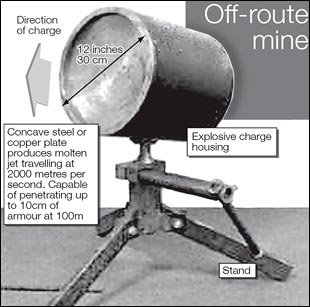
The 'off-route' mine graphic supplied to the Sunday TelegraphThis is both clever and subtle. The "threat" – for which the Sunday Telegraph's Sean Rayment, carefully "fed" by the MoD, has fallen, hook line and sinker – is that the "real" problem is not inadequate Land Rovers but the so called "off-route" mine, crafted by those wicked Iranians. The suggestion is that these are such powerful weapons that no amount of additional protection would suffice and, therefore, we must rely on training and tactics. Rather conveniently, this strategy costs the Treasury little if anything by way of extra funds.

Taken at face value, this is plausible enough for some of the more gullible hacks to believe and, if the troops are not entirely happy about being forced to ride around in sub-standard kit, at least it is sufficient to convince them that the problem has been considered.

The 'Snatch' patrol vehicle - now it has to be escorted in high risk areasBut the response – and previous events – do invite an alternative construction. In considering this, it is perhaps significant that, while we got a spate of bombings in May and June, there have been no recently reported casualties from Basra. To an extent, this is undoubtedly the result of a change in British tactics – Land Rovers patrols are now escorted front and rear by Warrior MICVs, and patrolling has been curtailed – but there is also a darker explanation.

Basically, the bombings of May-June could be construed as a warning, telling the Army – or the British government - to keep its nose out of affairs that were none of its business. So, as long as the Army does not interfere, it will be left alone and does not, therefore, need better equipment.

Strong support for this thesis comes not from the British press – which is hardly reporting on the affairs in southern Iraq – but from syndicated reports in the US media.

One such – picked up from Myrtle Beach online but carried in dozens if not hundreds of US newspapers – reports on how Iraqi Prime Minister Nouri al-Maliki's first major security initiative, a 30-day state of emergency intended to restore peace to Basra appears to have failed.

What is especially interesting is that the newspaper reports that "travel to Basra is difficult for Western reporters", so the newspaper group has "maintained daily contact with Basra residents, police officers and leaders throughout the month-long state of emergency to track its progress".

The reports thus come from residents, who say little has changed: Shiite militias and tribes still control the city's streets, political factions still fight for control of the city, and Shiite Muslim militias still threaten Sunni Muslims with death. Morgue officials report that the number of people killed in sectarian violence remains unchanged. Militias are still moving freely in the city and residents have given a steady chronicle of continued violence.

Oil tankers impounded by the British authorites in Basra after involvement in smuggling - but this is only the tip of the icebergFrom a report in the Seattle Times, syndicated from the Los Angeles Times, we get another report that says of Basra, "This once-placid port city is looking a lot like the mob-ruled Chicago of the 1920s, an arena for settling scores between rival gangs, many with ties to the highest echelons of local and national political power."

We are told that, according to residents and officials, Basra's sudden political troubles and violence are rooted in a bloody competition for control of millions of dollars in smuggled oil. The report continues:

On the Shatt al Arab waterway and off the coast of the Persian Gulf, boats wait to receive Iraq's smuggled oil, the most visible sign of what many suspect are vast multinational criminal gangs selling subsidized and stolen petroleum products for a premium in Iran, Kuwait and the United Arab Emirates.

"Oil smuggling is one of the biggest issues in Basra," said Furat Shara, the local leader of the Supreme Council for Islamic Revolution in Iraq, a Shiite political party. "It is over the smuggling of oil that there is a conflict among the political parties."

One local official estimated the value of the smuggling trade at $4 billion a year, or about 10 percent of the country's gross domestic product.

Basra is almost free of the guerrilla warfare, car bombings and suicide bombings that characterize daily life in Baghdad, Baqoubah and cities in the Sunni Arab stretches of the country. But this Shiite-dominated southern city and its suburbs have descended into chaos and violence that threaten to unravel the region's modest progress.

"The amount of actual terrorism in Basra is very limited," Iraqi Defense Minister Gen. Abdul-Qader Mohammed Jassim Mifarji told reporters. "The dominating struggle is between armed gangs and political groups."
According to local sources in Basra, smugglers have set up eight makeshift terminals along the coast to store the oil before smuggling it out of the country, a practice employed by Saddam Hussein during the 1990s to circumvent United Nations sanctions. Unemployed fishermen, struggling to make a living as their traditional livelihoods are destroyed by pollution and overfishing, run boats across the Persian Gulf, often to Iran or the United Arab Emirates.

A local schoolmaster, Mahmoud Salman Saadi, says, "Each political party is busy smuggling oil while we are busy looking for a quantity of gasoline to operate our small generators or cars."

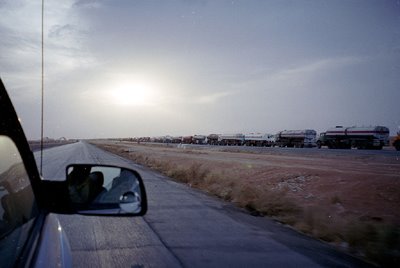
Oil tankers on the Jordanian border - officials say that smuggling is 'brazen'Thus, political leaders are more interested in retaining control of the oil-rich port city than in protecting it from militia and tribal violence. Residents complained about the Basra plan almost from its inception. The "state of emergency” seems to consist of nothing more than a few checkpoints, and the occasional high-speed, largely token British Army patrol. This leaves the report concludes, "not only is Basra falling apart, but the means to reverse the trend are disappearing. As conditions deteriorate, the educated middle classes — the people who know how to run the city — are leaving in droves."

Although nothing of this seems to be making its way into the British press – not least because the Army is tightly controlling media access to the city – it cannot be the case that the Army and the British government does not know what is going on. That it is not prepared to intervene speaks volumes of the attitude to the "occupation". We are just going through the motions, waiting for an opportunity to get out without losing too much "face", leaving the Iraqis to the rule of the gangster and the mob. But, as long as the government can continue muzzling an indifferent and largely ignorant British media, it can count on no one knowing until its is too late.

Meanwhile, our troops will continue to ride around in "Snatch" Land Rovers and the propaganda game will continue. And, as long as they do, we will know that the British government has no real intention of living up to its responsibilities in southern Iraq. Thus do we see that, through the study of "toys", we get to the truth.

COMMENT THREAD

Tuesday, 4 July 2006

Feeding the European fantasy

A Saxon APC - a top-heavy liability that has to goToday, we read in The Daily Telegraph that the Conservatives are concerned that our forces in Afghanistan are under-equipped for their mission.

In a separate piece, we also read that the Army is scrapping 500 Saxon armoured personnel carriers that are unfit for use in Iraq or Afghanistan, but is so short of money that it is planning to replace them with vehicles that are almost 40 years old.

If ever there was a time for saying, "I told you so", it is this. It was two years ago, almost to the day, that I first wrote a piece on this blog about defence equipment plans, noting that the government was planning to spend (then) £6 billion – since increased to £14 billion - on re-equipping the Army with the Future Rapid Effects System.

Presciently, I headed my piece "Another blunder of Eurofighter proportions", introducing a thesis since amplified that the government was preparing to spend huge amounts of money on an untried force structure, all to meet Tony Blair's commitment to providing formations for the European Rapid Reaction Force.

From a limited defence budget, therefore, we were devoting huge sums to feeding a fantasy army while starving our real army, increasingly committed to actual combat, of the equipment and men it needs.

A Panther FCLV - a battlefield limousine for RupertsOne of the first pieces of equipment actually to roll off the production lines for this new, fantasy army is the Panther Command Liaison Vehicle, about which we have written at length.

But what is particularly relevant at this juncture – when the Army is desperately short of a protected patrol vehicle - is that the Panther, at £413,000 each, was purchased against a specification so narrowly drawn that it is useable only for its designated functions. Yet, it was chosen in preference to the RG-31. This was not only £150,000 cheaper but is also a multi-purpose vehicle which could easily have accommodated the Command/Liaison role as well as providing an ideal, protected patrol vehicle.

Currently, the Italian-built Panthers are being finished off by BAE Systems, with the additional of a machine gun, radios and other accessories, when they will be delivered to the Army, effectively providing "battlefield limousines" for Ruperts – as officers are dismissively called – while troops are forced to patrol in dangerously vulnerable "Snatch" Land Rovers.

A Canadian RG-31 in AfghanistanHad the decision to buy Panthers, announced in November 2003, been different, we would have had RG-31s rolling off the production lines in British Army colours which, with minor modifications, could be re-fitted as patrol vehicles and shipped out to Iraq and Afghanistan. In the latter theatre, they would be joining the RG-31s operated by the Canadian Army which is so pleased with the vehicles that it has just ordered another 25.

Hindsight, you might say, is easy, but for the fact that the Panther decision always looked suspect and, in the context of a limited budget and an uncertain future, it makes sense to buy a multi-role vehicle, even if it is not absolutely ideal for all of the different tasks for which it might be called upon to perform – more so if, like the RG-31, it is significantly cheaper.

What has happened, though, is that the MoD – under successive governments – has taken its eye of the ball. Obsessed with the idea of constructing a mean, lean, high-tech army, with shiny new toys to impress the European "colleagues", it has neglected the here and now, and the immediate needs of our present-day armed forces, engaged in the messy, bloody counterinsurgency operations for which it is singularly ill-equipped.

Storm Shadow - the million £ bombThis obsession with shiny (and expensive) high-tech toys – and the prestige they bring - is also another fatal weakness of the MoD, their defence industry pals and the warring tribes within the armed forces. This is behind the decision to buy 900 Storm Shadow air-launched cruise missiles at over £1,000,000 each, the introduction of which was brought forward so that the RAF could indulge in a dick-measuring contest with the Americans during Gulf War II, proving that it too had a stand-off munitions capability.

During that war, the RAF managed to launch 27 missiles at a cost of £29.43 million in weapons alone, compared with the 400 or so US Tomahawk cruise missiles, making no measurable contribution to the campaign and saddling us with a massive bill which we are still having to meet. Yet, in simple terms, the £1 billion for these missiles – the bulk of which are now sitting uselessly in RAF stores – could have bought 4,000 RG-31s. It is not difficult to work out which would be of more use in our current situation.

British Army Apaches - at £60 million eachSimilarly, although there is a massive shortage of tactical helicopters in both Iraq and Afghanistan, as we have recently reported, the government has announced its intention to procure 70 "Future-Lynx" helicopters for £1 billion, to come into service from 2014. Once again, we see this obsession with "high-tech" kit for the future, when the need is here and now.

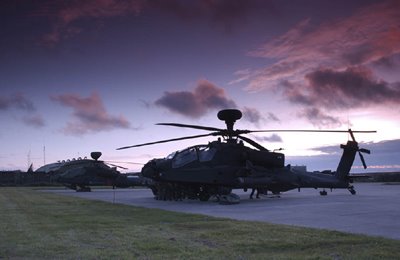
But even the £14.2 each to be expended on these aircraft pales into insignificance compared with the £60 million each paid for the Army’s 67 Apache attack helicopters, a squadron of which is currently deployed in Afghanistan. Undoubtedly, they have their value, as attested by a typically "Boy's Own" piece in the Telegraph recently. However, we saw in the Sunday Times, this weekend, a graphic account of a firefight between British troops and the Taliban.

The journalist, Christina Lamb, recounts that, at the height of the battle, the patrol leader, Major Blair, "was very angry indeed". "Where's the f****** air support?" the major was yelling on the radio to British headquarters at Camp Bastion, reading off a GPS position. Lamb continues with the narrative:

"Two A10s 10 minutes away can be with you for 20 minutes," came the reply. Nothing arrived. "We need air support. Where's the air support?" Major Blair radioed again after sliding on his back in another trench, pulled down by the weight of the kit on the mud. The message came back that the A10s had been called off to Sangin, a village to the north where two British special forces had been killed. No other planes were available because heavy fighting was still going on.
Now, let's do a little sum. An Apache costs £60,000,000. A Hughes 500 – a light, 4-seater commercial utility helicopter - costs £900,000. For each Apache, you could buy over 60 Hughes helicopters.

A Hughes 500 on convoy escort dutiesPurists will immediately say that there is no comparison between the two, and indeed there is not. However, in the hands of the private security company, Blackwater Security Consulting, off-the-shelf Hughes 500s, with two door gunners, are used to devastating effect as convoy escorts. Now ask which would have been more use to Major Blair – one Apache committed to a battle elsewhere, or a detachment of four Hughes 500s, on the spot, spitting out fire from eight machine guns?

And yes, I know you can buy such helicopters off the shelf, but it takes two years fully to train a combat helicopter pilot. But how many redundant or under-used helicopter pilots are there currently in the Armed Forces, and how many civilian pilots are there, who were military-trained? And how long would it take to train a pilot to handle a simple machine like a Hughes 500?

So much for the toys, but what about the political implications? These are graphically put by the Telegraph leader which cites Liam Fox, the shadow defence secretary, who told the Commons yesterday, the cost of succeeding could be very high, but the cost of failure would be intolerable. At stake, he says, is the future of both Afghanistan and Nato, under whose aegis the campaign is being waged.

This theme is amplified by Con Coughlin in an op-ed but, like so many, he misses the point. The Army itself, he writes, might be suffering severe overstretch through a combination of underfunding by Gordon Brown's Treasury and Tony Blair's messianic willingness to commit forces to resolve the world's ills…

Eurocorps - the Fantasy ArmyNo, Mr Coughlin, with the MoD committing £14 billion to FRES, having spent £166 million on its battlefield limousines for Ruperts, having spent £1 billion on Storm Shadow, and billions more on other grandiose European projects – not least committing £30 billion to the Eurofighter - you cannot say there is any underfunding. The real problem is that the Army is suffering from the cumulative effect of bad procurement decisions, which started under the Conservatives' watch but are currently being driven by the Blair government's obsession for European defence integration.

At the moment, it looks doubtful whether the small, under-equipped British force can prevail in a country four times the size of Wales and a border with Pakistan 1,500 miles long, but, as Liam Fox rightly remarked, the cost of failure would be intolerable. Equally, although attention has shifted from there to Afghanistan, the cost of failure in Iraq – where we also have a small, under-equipped force - would be intolerable. Yet, without more troops and more equipment – the right equipment – failure is a distinct possibility.

In fact, failure in either theatre would destroy what little credibility the UK has as a world power. Arguably, to slink out defeated, licking our wounds, would have a greater effect on our standing in the world community than our ignominious departure from Suez. That is what is at stake and the real reason why we are in such a parlous situation is that we have devoted far too much of our energy and wealth to feeding the European fantasy, while neglecting our current responsibilities.

COMMENT THREAD